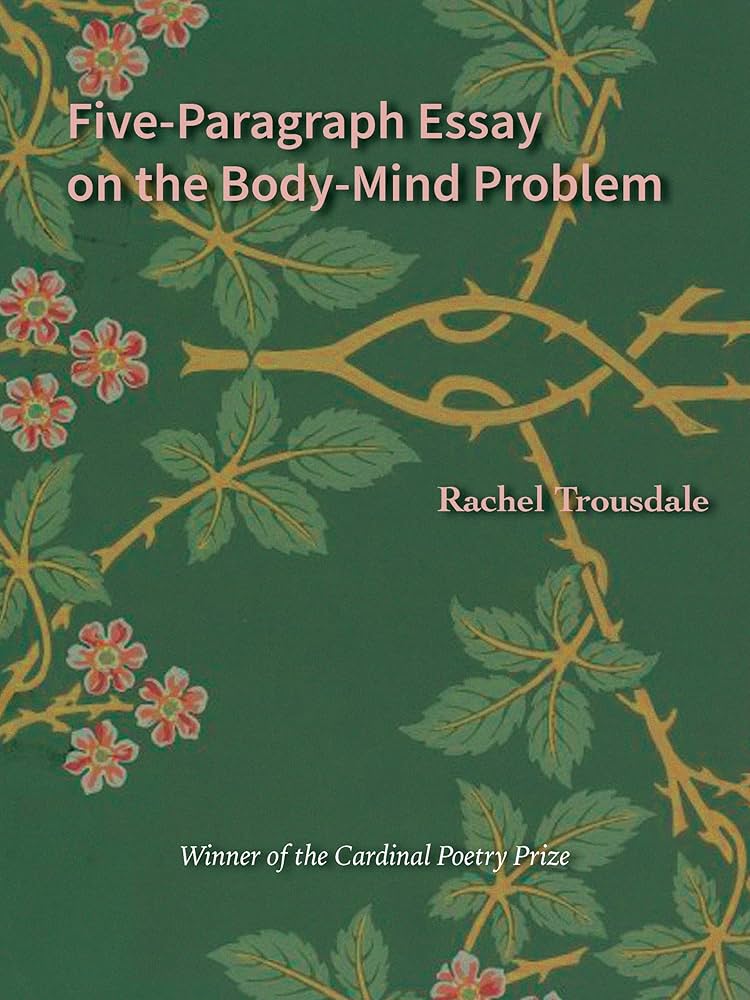
Five-Paragraph Essay on the Body-Mind Problem by Rachel Trousdale
Wesleyan University Press, 2025
Review by Sara Stoudt
::
The autumn backdrop for my writing of this review sets the right scene; with schools back in session, the season marks the return of the five-paragraph essay. Although the form can inspire dread in students and teachers alike, it has its uses (providing a template to put ideas on the page, helping to further organize those ideas into containers, and creating expectations for the reading experience), and reading and writing them can be educational. Rachel Trousdale sees the possibilities in this often-dry form, and stretches beyond it, subverting expectations in her collection, Five-Paragraph Essay on the Body-Mind Problem.
The collection is organized in five sections, each named after the part of the five-paragraph essay that they represent: Introduction, First Body Paragraph, Second Body Paragraph, Third Body Paragraph, and Conclusion. The opening poem, kicking off the Introduction section of the book, is the eponymous “Five-Paragraph Essay on the Body-Mind Problem,” and the opening line, “I love you because you are a unique snowflake”, is quite the thesis statement. The prose poem continues with a disorienting jumble of thoughts in its first “paragraph”: “The extent to which a snowflake can be unique is subject to debate. Humans share 25 percent of their DNA with bananas. Given two humans, fallen onto the coat sleeve of a Brobdingnag, would it be possible to tell us apart? To tell us from bananas? The yellow bananas found in American supermarkets are genetically interchangeable.”
Even though each line of this opening “Five-Paragraph Essay on the Body-Mind Problem” reads as part of a stream-of-consciousness brainstorming session, the introductory paragraph of this prose poem uses elements that are traditionally found in an essay’s opening paragraph: a thesis statement, an acknowledgement of a debate, a fact, a provocative question involving an allusion to another literary work, a double-down of the first question, and a complicating detail. This poem is our first introduction to the “structure with a twist” strategy that is used throughout the collection. It could feel like an essay draft before organization and revision, yet it hints at some of the major themes to come: romantic love, familial connection, and science as metaphor. The language is voicey, full of tongue-in-cheek declarations that are the opposite of sappy yet still leaving the reader knowing there is deep love present.
The “meat” of an essay traditionally comes in a trio, with each body paragraph supporting the initial thesis. In this collection, the three body paragraph sections of the book respond to the opening “I love you because you are a unique snowflake” line by introducing us to the recipients of that love. The first body paragraph has a common theme of courtship and early love with one body in particular, the speaker’s love interest. We see how their relationship got started in the section’s opening poem “Love Poem with Dereliction of Duty”:
when I said, let’s take a walk
and you said sure and we circled
the New Haven Green saying
who the hell knows what
because if we had seen
all this falling in love stuff coming, we
would have paid more attention…
The Second Body Paragraph section focuses on two newer bodies, the speaker’s two children. In “Avalanche Conditions,” Trousdale connects piling-on aspects of motherhood to the tipping point of an avalanche:
The everlasting universe of things
flows through the mind: pairing the tiny socks;
packed lunch, except on Tuesdays; show and tell;
and dishes. Snow by snow
The mountain seems to grow…
The poem continues to pile on, increasing the sense of heaviness through literal weighty phrases like “five hundred thousand tons” and “implacable dense mass”. The contrast of the impending break and those initial tiny socks makes the reader feel the precarity.
The Third Body Paragraph section then breaks free from the original organizing form of the collection to continually play with form itself. This break does not come as a complete surprise though, as there are early hints that Trousdale will not be limited by the title form. As early as the Introduction section, as she draws from her father’s scientific work on lasers in “Optics Lab” (first published in Psaltery & Lyre), Trousdale breaks the rules of established forms: “This is not a sestina, it’s a hologram.”
And in fact,”Optics Lab” isn’t a sestina, not quite. In each stanza after the first, at least one ending word deviates from the required pattern. However, the word that replaces what is expected is not completely random. Sometimes, they are related words (“dot” is replaced with “object”, “laser” with “radiation”, “father” with “himself”); sometimes the juxtaposition adds meaning (“lab” is replaced with “world”, “me” with “time”).
But the plot thickens. As I looked around for some more information on holograms, I learned that as part of one approach to laser holograms, a laser is split in two: an object beam and a reference beam. What is the first sestina disrupting word swap? “Object” replaces “dot.” This is not a break for a break’s sake, but rather the disrupted sestina form adds content for those willing to dig in and do their own research. The last sentence further spells out what this “not a sestina” is doing, breaking away from the closing tercet form of the sestina completely: “He is a hologram, an image, an incomplete experiment, a pattern that can almost write the whole.” Both this poem, at the micro level, and the book, at the macro level, can be seen as potentially incomplete experiments, with the sestina pattern and the five-paragraph essay almost “writing the whole” but always leaving room for further experimentation.
“A Long List of Small Mercies” twists a traditional list poem into a nested list, adding another level of organization, a more hierarchical container for how the speaker spent time with their son out of school.
II. Instead he has, A.) learned 1) to make a) rice
b) pie crust
c) lego catapults
d) pop-up dinosaurs
e) a stuffed sloth with embroidered eyes
f) the best of things
The extra nesting forces the reader to slow down and think about the hierarchy. Trousdale’s twists in form also play with pacing and give structure to how the reader should read the words on the page. Another example of this subtle training of the reader’s eyes occurs in “Slope”, a contrapuntal poem that can be read, as is traditional, in two columns, tracking the before and after of the speaker’s father’s life one at a time. However, the lines in each column are staggered so that they can also be read side-to-side, but only as if you are zig-zagging down a slope on skis. This way of reading leads to a weaving of the two stories, memory and present, together, and has the effect of real-time flashbacks as if struggling to reconcile a current life with a past one. “Night Shift, Summer, 1994” also leans on a zig-zag pattern and is literally to be read in shifts. Moving left to right downward before restarting to the left again, level by level the reader sees how an evening unfolds for fast-food workers. This arrangement of the text slows the pace of reading, mimicking how time might tick more slowly during a long lull in service overnight.
Instead of playing with time, “The Pyramid” plays with space. Two of the seven subsections provide literal maps of the bunker being built. The third subsection starts:
The neighbors are
unworried. Once reassured
no guns are in the slowly rising bunker,
they end the conversation.…
The second subsection looks like a pyramid, with the lines growing in length and then declining in length.
The pyramid
grows slowly.
First the sketches,
then the trucked in
bricks, then reclaimed
paving stones, then sacks
of cement, requiring shelter.…
The second-to-last subsection of this piece uses white space in the middle of the text to create architectural columns, or walls, separating rooms in the bunker. The effect of the many subsections and the variation in form as each one is unveiled gives the feel of building, and each component contains a snippet that hints at eternity or, when bunker turns tomb, a plan for the afterlife.
As much as I am drawn to the new forms in the Third Body Paragraph section of the book, Trousdale also shows that she doesn’t need to lean on novel forms to stand out. For example, the two line poem “Collection” in the Second Body Paragraph section has just as much impact: “A few stones at a time / my son brings home the mountain.”
Even the quieter poems mix the local with a bigger picture, as seen earlier in “A Long List of Small Mercies” and “Avalanche Conditions”. In “The Reef,” Trousdale compares a coral reef to a relationship, implying the naturalness of love.
but perhaps, in a limited way, a marriage is
like it – something that began with a few small motions
and has turned, by the grace of time, into – not an edifice –
a beautiful sprawl, a forest, a live extent.…
To close the collection, Trousdale brings us back towards the traditional form of a five-paragraph essay. The Conclusion section of this book ends with suggestions for future work, or literal take-aways, in the form of a poem called “Packing List.” Many of the listed items echo scenarios that have been recounted earlier in the book. Each line recounts a memory to hold onto, from a twenty-first birthday to a birth, accompanied by the frigid conditions in the background from an “aching-cold brilliant January” to “three-foot drifts of record-breaking snow.”
A well-informed essay sends a reader down reference rabbit holes, sparking interest into a topic or a particular source; a compelling essay encourages the reader to keep reading, to keep thinking, beyond the paragraphs themselves. This book does the same. I found myself Googling “hologram,” “body-mind problem,” and many of the references cited in the end notes. Through this search I learned that Trousdale elevates the body by flipping the traditionally named “mind-body problem.” Given the intentionality of all the other twists throughout this collection, I don’t think it was an accident. A discussion of that choice alone could lead to its own five-paragraph essay.
::
Rachel Trousdale is a professor of English at Framingham State University. Her poems have appeared in The Nation, The Yale Review, Diagram, and other journals, as well as a chapbook, Antiphonal Fugue for Marx Brothers, Elephaphant, and Slide Trombone (2015). Her scholarly work includes Humor, Empathy, and Community in Twentieth-Century American Poetry (2021) and Nabokov, Rushdie, and the Transnational Imagination (2010).
Sara Stoudt is a statistician, teacher, and writer from Pennsylvania. She is the co-author of Communicating with Data: The Art of Writing for Data Science and a member of the editorial team for the Future of Data Science and Our Environment creative data anthologies. Her other non-academic writing can be found in The Pudding and on the Cover Me blog among others.
 Psaltery & Lyre