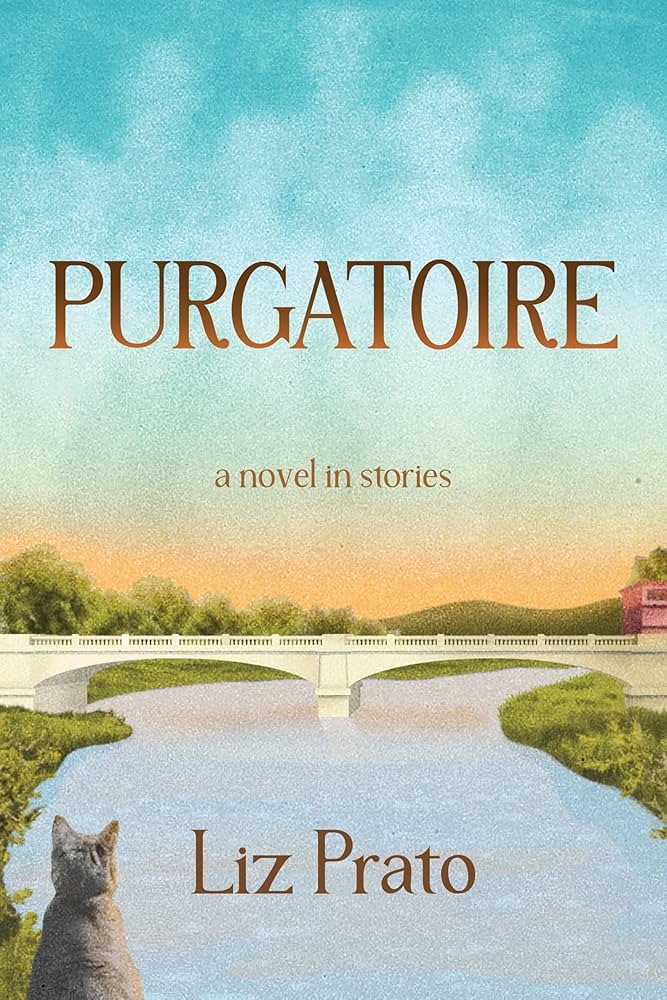
Purgatoire by Liz Prato
Forest Avenue Press
Review by Rebecca Beardsall
::
I came to Liz Prato’s fiction through her nonfiction — Kids in America: A Gen X Reckoning and Volcanoes, Palm Trees, and Privilege: Essays on Hawai’i. I’ve enjoyed and appreciated her work, so when Forest Avenue Press reached out to see if I’d take an advance reader copy of Purgatoire, I jumped at the chance. I expected Prato would bring that same precision and authentic voice to her fiction, but what I didn’t expect was how deeply her novel-in-stories would resonate with my own obsessions about lineage, memory, and the spiral of time.
Reading Purgatoire felt like being at a family reunion, listening as relatives share their stories where you only get bits and pieces, and you’re sitting there trying to figure out how everything connects. In this novel, you’re viewing a family through their stories, and Prato brings the reader into that space with such care.
Prato’s novel weaves through time with remarkable fluidity. The stories span generations, each one revealing another facet of connection. She moves the reader to look through the pages at how the choices of ancestors reverberate through descendants, how land holds memory, how we’re all tangled in webs we can’t always see. The novel in stories starts with Jan Parella in 1975 trying to explain to her kids that their dad is going into the psychiatric hospital without giving them all the details, which they will learn years later: “It would be another fifteen years until she asked me about it, after she’d graduated from college… We’d be sitting at the kitchen table chatting over iced tea, and she’d ask, ‘Wait, was Dad in a mental hospital that time when I was little?’” The novel highlights how childhood understanding gives way to adult comprehension — how we piece together the full story only with time.
Then the reader zooms backward sixty-five years to 1910 Italy, where Elisabetta (Sabé) Parella receives a letter that will change her life. Her husband, Tobia, asks her to leave her sons behind and join him in America. These two pivotal moments, separated by generations, frame the entire narrative and launch us into this family’s sprawling history. From the first pages, Prato makes clear that this family’s story will be one of fracture and consequence, of decisions that echo across decades.
What makes Purgatoire particularly compelling is how Prato explores the way secrets hum continually around a family — the unknown but known. The whispers that sit in the room with us, shaping us even when we can’t name them.When Elisabetta (Sabé) finally arrives at the train station in Trinidad Tobia is not there waiting to greet her, after walking into town herself she is eventually informed that Tobia left and isn’t coming back. She knows why, but as the reader we are left to wait for it to unfold, mirroring the way the whispers and answers eventually reveal themselves in families. The quieter hauntings that exist in every family like the things everyone only half-knows and the gaps that pulse with meaning.
Prato’s historical anchoring throughout the book is stellar and on point to keep the reader grounded in time. She goes beyond the typical markers (the World Wars, the Depression) to root us in time through moments like Joe Montana playing for Notre Dame, the Lindbergh baby, the shifting of borders and boundaries. At one point in the novel, Norma says: “It’s crazy how stuff shifts around over there… Opa Angelo was from this little town called Sfruz, which was in Austria when he was born, but after the First World War it became part of Italy. He grew up speaking Italian, but a lot of his recipes were Austrian. So what does that make me?” The borders we trace on maps now didn’t exist before. Identity isn’t fixed; it shifts.
What I really appreciated was Prato’s supernatural touch by including the fantasmi (ghosts) that bind the family stories together, lingering in places and linking themselves to people. We have ghosts throughout, people with connections to the supernatural who are hearing from the other side. The ghosts become the artery running beneath everything. The connection to others beyond our space and time becomes infrastructure, the thing that lets Prato show us what we already know but can’t always articulate. It showcases that time isn’t what we think it is, that our lives are connected in ways that defy linear logic, that the past is never really past. The supernatural becomes the vehicle for truth.
At the heart of this book are the ghosts, whispers, and their connected secrets. The hidden things that connect families but often aren’t talked about. They’re not talked about because either it was taboo at the time, or people were pushed aside because they weren’t understood or they weren’t allowed to be who they were. This thread of things (sexuality, nationality, gender, etc.) that families stop talking about but are really connectors. Really, it’s this opening up of the secrets, opening up of spaces for individuals to be who they were, who they are; therefore, allowing them to be no longer lost in the shadows or the whispers. The novel highlights how time changes the ways we view things and how that can bring healing.
Purgatoire is a gorgeous novel of connection, bringing to life how we’re tethered across generations, through blood and soil and the stories we carry. Prato moves fluidly between traditional narrative, letters, interview fragments, and ghost stories. Each form reveals new facets of these characters and their tangled roots. While this was fiction, it helped me connect to my own story and family. This is the kind of book that shows you what’s possible when you trust the shape your story wants to take.
::
Rebecca Beardsall (MA, Lehigh University; MFA, Western Washington University) is the author of My Place in the Spiral and The Unfurling Frond. Find her at: rebeccabeardsall.com
Liz Prato’s previous books include Kids in America: A Gen X Reckoning, Volcanoes, Palm Trees, and Privilege: Essays on Hawai’i, a New York Times Top Summer Read and a finalist for the Oregon Book Award, and Baby’s on Fire: Stories. She is a freelance developmental editor and teacher in Portland, Oregon. Liz lives for independent bookstores, literary community, and palm trees. www.lizprato.com
ID: Cover of Purgatoire by Liz Prato.
 Psaltery & Lyre