by Brandi Handley
When Vivian invited me along to see the stained-glass windows she’d created for a nearby Catholic parish, what came to mind were the windows of my grandparents’ church, which were tall and slim and made up of small rectangles of deep red, blue, and gold. The simple shapes and primary colors resembled building blocks in a preschool. The design was modest, but, as a kid, I was dazzled by the colorful beams of light they created. The windows at the church I’d attended weekly with my parents were plain and always covered by white blinds and surrounded by a vast expanse of empty, cantaloupe-colored walls.
::
The parish was much bigger and newer than I’d expected for being in a small town in Kansas. It was a compound made up of several large brick buildings with metal roofs that reflected the sun. The buildings surrounded a courtyard with a path through a rose garden that had mostly wilted and turned brittle in the cooler November air.
Members of the parish filed past us toward the parking lot at the end of the early service dressed up in floral skirts and dresses, shirts and ties, the occasional full suit. The familiarity of church clothes was offset by the fact that I wasn’t there to worship or collect a blessing or confess my sins. I felt warm and underdressed in my jeans and oversized sweater. It had been at least a decade since I’d been in a church building on a Sunday morning.
::
The church building I grew up in was always cold, especially in the summer. Because of the high ceilings, the air conditioner had to keep up a steady stream of cold air. The blank walls and covered windows gave the sense that even a glimpse of the outside world would distract or dirty my mind. Worldly was a negative word, a way to describe sinners and sinful activities like dancing. It was likely my curiosity about the world that created the first seed of doubt and eventually resulted in my leaving.
These days, the closest I get to religion is when I feel connected to the earth—plucking weeds from under the cone flowers and cat mint, thrusting my hands into a mound of warm cotton burr compost, watching the crown of the maple tree across the street delicately lift in a breeze.
::
I had only known Vivian for six months. She was a friend of a friend, and I had gotten to know her through weekly get-togethers at our mutual friend’s house. I knew she was an artist but had never seen her work until we made the trip to the parish. Once I saw the stained-glass windows she’d created, I realized how ignorant I’d been, how ridiculous the comparison to the windows in my grandparents’ church.
I later learned that Vivian had been a stained-glass artist for forty years. Before getting the commission from the parish, she had spent much of her career restoring historical windows and recreating historical looks in museums and residential neighborhoods in her home state of New York. One such project was in the South Street Seaport Museum where the main attraction was the Peking, a historic ship from 1911. Vivian recreated the etched glass of the skylight that was in the captain’s private quarters beneath the main deck. The skylight was meant to allow sunlight into the space without people being able to see in. This kind of practical use of stained-glass art was one thing Vivian liked about the form. She said, “Taking on commissions there’s always a purpose for it. And that appeals to me to have a purpose.”
::
Looking back, mine was a religion of the abstract. I was to love God, a father figure that had no face. I was told God had a plan for me but not one I could see or understand. My purpose in life was to get to a place after death that couldn’t be imagined, a place described only as good and joyful. If I didn’t get to the good place, I would end up in an equally abstract but terrible place full of pain and suffering. On the blank walls large as movie screens, I imagined a place of fire and always landed in the lairs of Disney villains, which were never that scary after all.
::
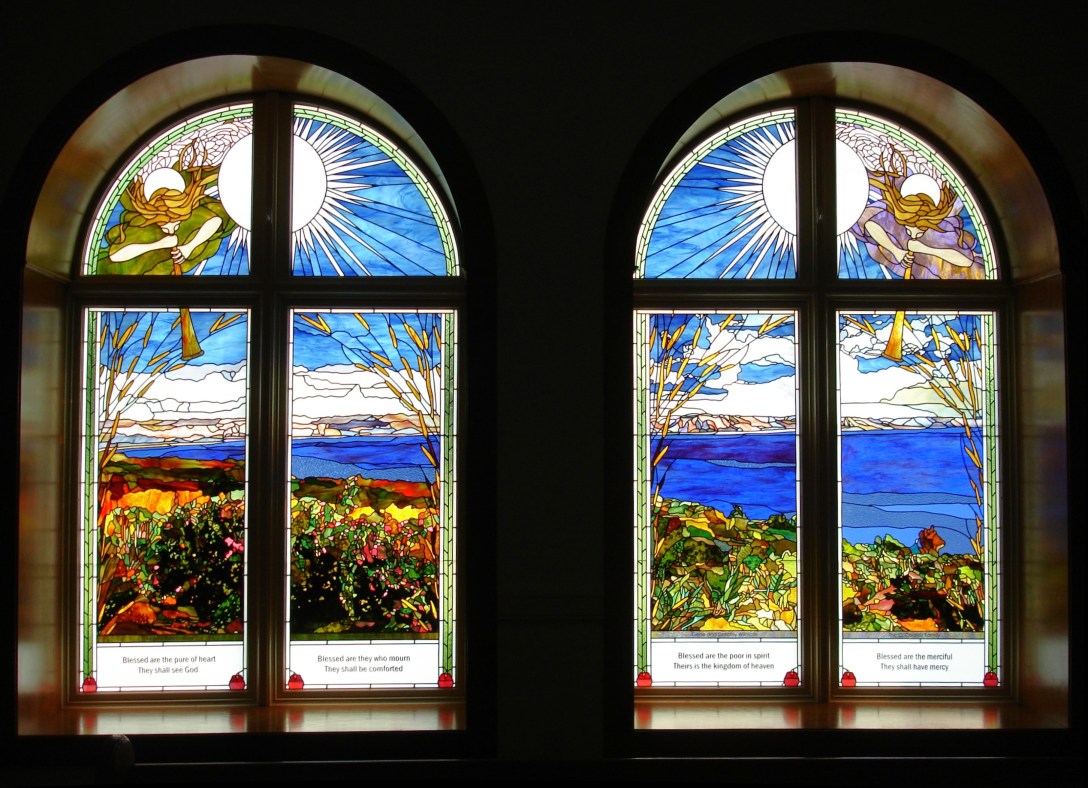
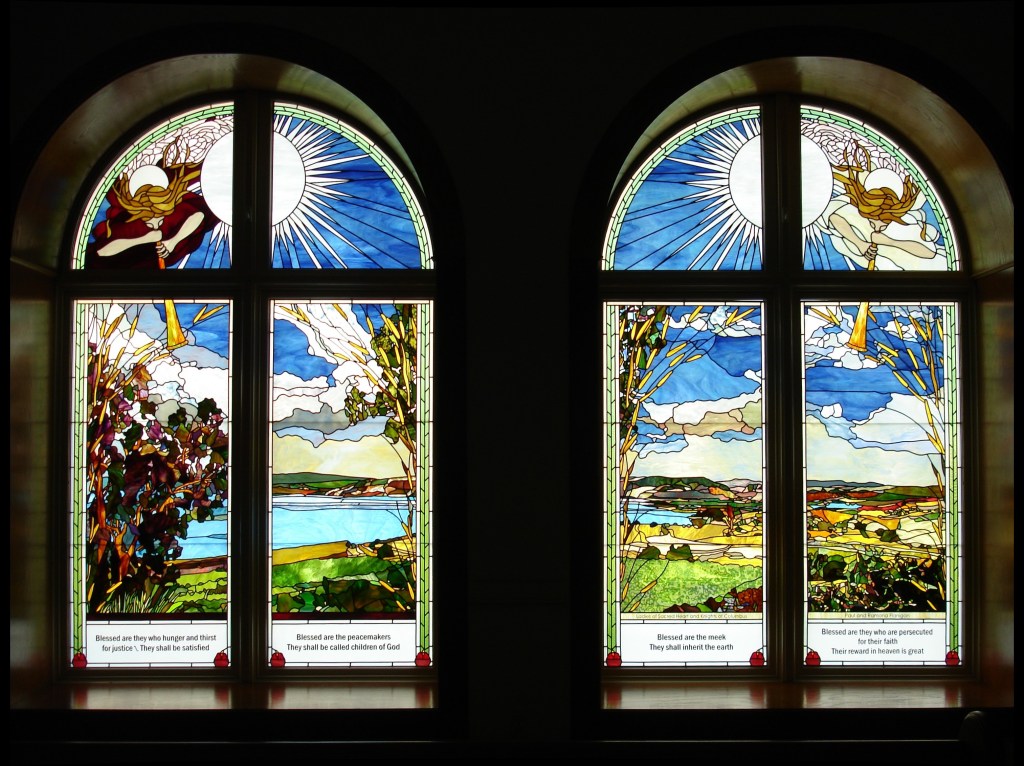
The parish leaders had wanted a depiction of the be-attitudes from the New Testament of the Bible for the sanctuary windows, but a representational style didn’t resonate with Vivian. “I wouldn’t know what that looked like,” she said. She wanted to evoke strong feeling and create a personal experience for each parishioner, so she turned to the tangible, to the place where the words of Jesus were spoken. She wanted anyone who stood inside the sanctuary to feel as if they were standing where Jesus stood during the Sermon on the Mount.
Vivian designed the windows based on photographs taken from the shores of the Sea of Galilee. Landscapes are unusual in stained glass. The art form lends itself better to renderings of objects and people. But as I stood among the pews in the middle of the sanctuary and looked from window to window, I was transported.
Each stained-glass window was a continuation of the others, all part of the same landscape. The eight panels that made up the windows on the east wall depicted a shore beneath a set of oblong clouds of white-blue stretching along the horizon. The horizon wasn’t just a line dividing the sky from the sea below. It was textured with lines that moved and color that revealed light and shadow. The sea rippled with the subtle changes in shades of blue. At the forefront was a tangle of foliage and flowers. Some of the leaves and petals were individual pieces of glass no bigger than the nail on my pinkie. Cattails were angled as though bending to a breeze, and light filtered through, making them dance.
The vantage point of the windows on the west side of the sanctuary was closer to sea level. The ground was covered in green grasses and clover fading to golden sand that led to a calm aquamarine body of water—the Sea of Galilee continued. The flowing foliage breathing over the grasses was a bouquet of dark plum, hunter green, chestnut, and gold. Behind these rich colors, glimpses of the bright blue sea flashed through the leaves and petals. A wall of bubbling white and gray clouds rolled in over the sea, the dark blue sky hovering just behind. A hint of farmland spread beyond the shore across the water. Footpaths and farmland were distinguishable from beach and pasture.
From the farthest hills along the horizon to the smallest leaf in the foreground, each piece of glass was an essential detail. Vivian didn’t want anyone to be bored. She explained, “I like every time the parishioners look at the windows they see something else, something new, and say, ‘Oh look at that. I didn’t see that before.’”
::
For months I puzzled over why Vivian’s windows struck me with such force. They were beautiful, yes. Extraordinary in their color and texture and design. But museums and churches are full of extraordinary art. The world is full of beauty.
I hadn’t come to worship, but the physicality of the landscape depicted in Vivian’s windows had served as a vessel lifting me up and outside of myself. I felt connected to a place and all its beings half a world away. The windows were alive and breathing and invited the world in rather than shutting it out.
Maybe that is what it means to be spiritual—to discover connection through the senses. I get on my knees every Sunday not to repent but to get close to other beings, to feel connected to them, knees and hands in the dirt, the world bending all around me.
Letting the world in creates moments of discovery and awe: The first green shoots of daffodil and hosta emerging from the hard ground of winter. The delicate yellow blooms unfolding from the stems of coreopsis that I thought were dead. The soft, supple leaves of Missouri dittany between my thumb and forefinger releasing the smell of mint and spice—the accompanying purple flowers breathtakingly tiny. A miracle, how small. This, a miracle I can believe in.
::
The parish sanctuary started to fill up for the second service. I took one final look at the glass landscape and glimpsed the cupped shape of a red poppy. “Look at that,” I said. “I didn’t see that before.”
::
Brandi Handley’s work has appeared in Post Road, The Laurel Review, Moon City Review, The Dodge, and elsewhere and has been nominated for the Pushcart Prize, The Best American Essays, and The Best American Nature Writing. She teaches English at Park University, a small liberal arts college in Parkville, Missouri.
More about Vivian Kallmann, the artist described in “Church Windows,” can be found at vkartwork.com. Vivian Kallmann’s commissioned artwork can be seen at The Hospital for Joint Diseases in NYC, The South Street Seaport Museum in NYC, The Bridgeport Public Library in Bridgeport, CT, The Barnum Museum in Bridgeport, CT, the Missouri Botanic Gardens in St. Louis, MO and Divine Mercy Parish in Gardner, KS. Private commissions can be found across the US and Canada. She has been a member in good standing of the Stained Glass Association of America (2013) and listed as a resource in the Old House Journal (1970’s) and Restoration Product News (1970’s) as an expert colorist and an expert designer of stained and etched glass for specific historical periods. She enjoys changing up materials including glass, watercolor, oils and mixed media as it offers a challenge and an opportunity to customize each piece.
Image: photos by Phil Putnam.
ID:
 Psaltery & Lyre