by Sophia Alapati
Nothing could have prepared Galilee for the amount of bones in this room.
This morning in the women’s shelter, she’d picked an item off her list and set out to learn. It had seemed like such a good idea at the time, and on the bus, and all the way up the wide marble stairs to the huge domed building.
Now that she stood in a reliquary of skeletons eyelessly judging her, she yearned for the easy understanding she was about to give up.
“We can do this,” she said under her breath, like she was praying. Like she was telling her younger sisters what to do. Galilee didn’t pray anymore and her sisters didn’t speak to her anymore, so she told herself what to do instead. “We’re going to look at the skeletons and read the little signs and we’re going to learn.”
She had always been good at learning. That was part of her problem.
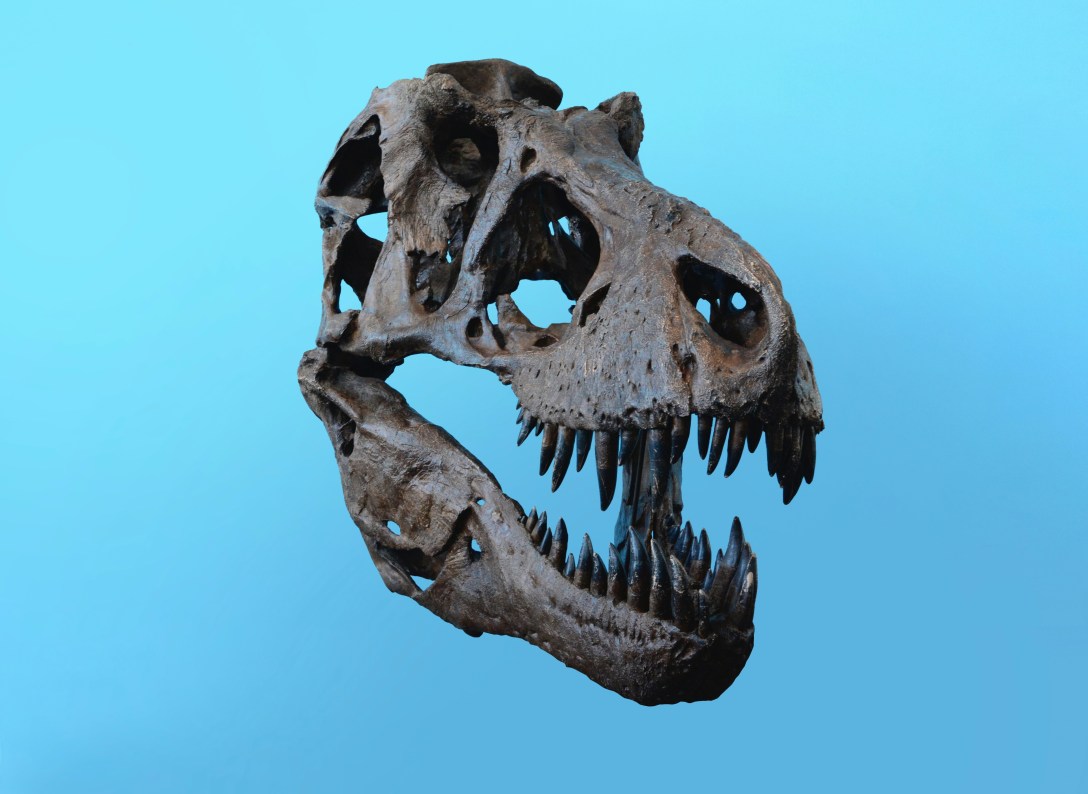
The biggest skeleton in the room had a long skull full of large holes and sharp teeth. Ribs like organ pipes hung from a knobby spine. Galilee imagined the tiny bones at the base of the tail would make the highest, sweetest notes, like when her sister Ardith sang the descant line on “Love Is Spoken Here.”
Galilee imagined the creature with pebbled skin and slitted eyes and a snarling mouth. The skeleton was terrible in the way that the great flood was terrible, the way the wilderness was terrible, the way the wrath of God was terrible. Looking upon it filled her with reverent fear.
Galilee read the sign at the monster’s feet.
Meet Barnum, our Tyrannosaurus rex! Barnum lived in Montana about 66 million years ago, during the Cretaceous Period. Based on paleontologists’ examination, Barnum died at the age of twenty-five years.
Galilee thought she knew all about dinosaur bones, how the Devil buried them in the ground to trick God’s people into doubting the glory of creation. She used to feel so smart, carrying that knowledge around town like a pearl: she understood a truth that all the world’s scientists with their fancy degrees and smug atheism did not. We were created. We are blessed. We are His.
Now, in this secular temple to natural history, her truth felt stripped bare, naked as the mounted skeletons. All that she’d been taught was some extinct thing left off the Ark, rotted to bones and wired in place.
Sixty-six million years. Not six thousand. Million. Million.
“Did you have any questions about ol’ Barnum here?”
Galilee’s heart hit her own organ-pipe ribs. The Hall of Fossils had been empty when she’d come in, but now there was a man in here with her, completely unsupervised. He was wearing a smile, and a nametag that said Rudy (he/him) – Museum Docent.
“Oh, um—”
She did have a question. She had too many. That had always been her problem: she asked questions at the wrong time, or to the wrong person. Questions a normal person wouldn’t ask. Questions that showed she didn’t have enough faith.
But in a museum, to a museum docent—surely that was the right time and the right person to ask. And Rudy didn’t look like he cared about faith. He had a gold hoop in the top part of his left ear, which Galilee tried not to stare at as she worked herself up to her question.
“How much is a million?”
She waited for Rudy to laugh at her, the way her roommate had laughed when she’d asked whether the grocery store would be open on Sunday, the way the shelter coordinator had laughed when she asked which of the job board listings women were allowed to do. People were always laughing at her like she was stupid for not knowing things, stupid for not knowing she’d been taught lies.
Rudy didn’t laugh. He drummed his fingers on his chin and said, “Do you know how much a thousand is?”
She nodded.
“Great. Well, a million is a thousand thousands. So if you think about it on a smaller scale of time, a thousand seconds is about seventeen minutes. A million seconds is about eleven and a half days.”
It was a long time. Sixty-six million. Sixty-six million years ago, Barnum had been the same age Galilee was now.
Asking another question felt like stealing something. But Rudy hadn’t laughed. Her question darted out like a hand in the marketplace, pocket to shelf to pocket, hopeful no one saw her. “How do you know they’re sixty-six million years old? Can you tell from the skeletons?”
“Good questions,” Rudy said.
Galilee hadn’t known there were good questions. There were You shouldn’t say those things questions, and It is not ours to question God’s plan questions, and I’ll ask Brother Jacobs to talk to you questions.
“It works a little differently than that,” Rudy continued. “So, to start with, we don’t actually have dinosaur skeletons, just fossils. When Barnum died, he was buried in sediment, probably ash. Over time, soft parts like his skin and muscles rotted away, and only hard parts like his bones were left. Eventually, minerals from the sediment seeped into his bones and replaced them, giving us a copy made of stone. We can tell how old they are from—”
When Galilee left, her father said she was dead to them. That was a lie. When a person died, everyone talked about how wonderful they were, how sweet, how dutiful, how much they’d be missed. When a person left, everyone talked about how selfish they were, how shameful, how corrupted, how terribly they’d betrayed the church and God.
Now that she was gone, the truth about why she left would be buried in ash. The gossip and the sermons would seep in, replacing every part until they had made something new in the shape of her, something that was never alive. Everything real replaced by a false copy. Galilee was a fossil now too, strung up for Ardith and the others to gawk at and say, How terrible!
If only she could have left a little sign to explain. Meet Galilee! She was not a problem. Despite what Brother Jacobs and the church said, she realized her church and her faith were hurting her. She saved herself at the age of twenty-five years.
Rudy kept explaining how they dated the fossils. Galilee tried to follow along, but she had a new question. Could she interrupt? She’d been told never to interrupt when a man was speaking, but Rudy was the kind of person who said she had good questions. He might not mind.
“What happened to Barnum?” Galilee blurted out, when he was trying to tell her about radioactivity. “Why did he die?”
She braced herself for the rebuke.
“Ah, the big question,” Rudy said approvingly, and then he told her about the meteor. The impact that vaporized rocks, that turned rain to acid, that plunged the world into darkness with the ash that covered Barnum.
This was the forbidden knowledge her church denied. It sounded just like scripture—fire, destruction, death. And yet they’d kept it from people because it contradicted the Bible, and if the church let one contradiction stand, they let other questions in. Their lies would wither on the vine as people stole more and more truth for themselves.
“Any other questions I can help you with?” Rudy asked, and he sounded like he meant it.
Galilee looked at Barnum again. Which was worse? To see the garden burn down around you? Or to be cast from it, knowing the garden was still there and you were forever unwelcome? Galilee had been told there was only barren wilderness beyond the walls, but she had found an orchard of knowledge.
“Yes,” she said firmly. “I have a lot of questions.”
::
Sophia Alapati (she/her) grew up in a public library and has been hooked on books since her first storytime. She is a therapist specializing in body-focused repetitive behaviors, anxiety, and OCD-related disorders. Her previous work appears in The Razor, Voyage YA by Uncharted, and Electric Spec literary journals. Sophia lives in Baltimore with a cat who doesn’t like her and a queerplatonic partner who does. She can be found online at www.sophiaalapati.com.
Image: Brett Meliti
ID: Dinosaur skull on a blue background.
 Psaltery & Lyre