by Abigail Myers
Four days after the election, I take a yellow basket into the thicket of Cordwood Landing. The baskets are placed in parks around here to encourage folks to clean up the woods and beaches, and I take one because I need to do something—anything, really, anything other than nothing.
My daughter happily plows through a scavenger hunt I threw together before we left the house, and takes a break to make her way across a tree trunk felled over a shallow pit with the physical and moral support of her father. To her, this day is only one more in a long series of adventures: Corey Beach, where I first noticed the baskets; Patriots Preserve, the first place I actually picked one up and gathered trash into it; Wertheim National Wildlife Refuge, which, presumably because National Parks types tend to be scrupulous rule followers as well as lovers of the natural world, has no baskets or even trash cans due to its carry-in/carry-out policy. I stuffed my pockets with protein bar wrappers and banana peels that day, the latter since I haven’t been able to decide if composing non-native species on public lands is acceptable. Putting trash in the basket, though, that seems reasonable. I suppose I should have put “cracked styrofoam cup” or “shredded plastic bag” on my daughter’s scavenger hunt, too, because we find those, and her father encourages her to pick them up and put them in the basket.
As we make our way down the last stretch of the trail, sloping down towards the beach along a precipitous cliff, I find a black plastic motor oil jug, the label long since disintegrated. There’s no way to separate recycling at the park, and I don’t even know if a motor oil container is safe to recycle. Then there’s the matter of plastic itself, all the kinds that can and can’t be recycled, the ways in which one kind appears identical to another. I know if I put it in the trash, it will just go to the landfill, so am I really making any kind of difference—perhaps not one for the waste stream, but for the safety of shore creatures, or at the very least for beautification?
I ask myself all this and more as I move on to the beach, beside the bright, calm waters of the Sound. Maybe, paradoxically, this is why I give myself these little assignments, to take my anxiety about something, in this case the absolutely fucked waste stream, and, instead of merely worrying about separating my recycling, I force myself to make a choice under suboptimal and constrained circumstances, which circumstances usually are. I pick up the motor oil jug and toss it in the basket.
::
I learned about this forest and beach from the Long Island Sea Glass Facebook group, which is why I find it difficult to quit Facebook altogether, along with my antique bottle collectors group, my affirming and theologically progressive Rosary group, my regional mycology groups, my women’s trivia groups, my bougie kids’ brands resale groups. Where else could I recreate so much genuine community? True, people always figured it out before, and are still figuring it out now. But I only have so much bandwidth, and I need to reserve some for calling my Congressman once the local progressive parents’ group tells me what to call them about, for sending postcards to registered Democrats once the postcard group tells me they’re ready to start sending, and for getting away from everything once the Island hiking group shares their latest kid-friendly trail recommendations. I did quit Twitter, which I will never call X, but only once it was abundantly clear exactly how up that particular jig was, so I don’t think I get any credit for that one.
And I’m still trying to get credit, to be clear. I know, I know: recycling is putting a bandage on a gunshot wound; there is no ethical consumption under late-stage capitalism; voting is at best harm reduction (and maybe not even that at this point); and the hardest work is internal and largely invisible. Human nature, while imbued with the potential for greatness and goodness, inevitably falls short, and the gap between what we are and what we could be is universally covered with the grace of God through the person of Jesus. I think I believe all of these things to my core. But do I really, if I’m still trying to get credit—if I’m still picking up the yellow basket and clearing about twelve cubic inches of trash from an East Coast beach? There’s a great garbage pile the size of Texas in the Pacific; while I dutifully retrieve flotsam and jetsam from my particular seaside, does anyone, even God, notice—and if I were a decent person, would I care?
::
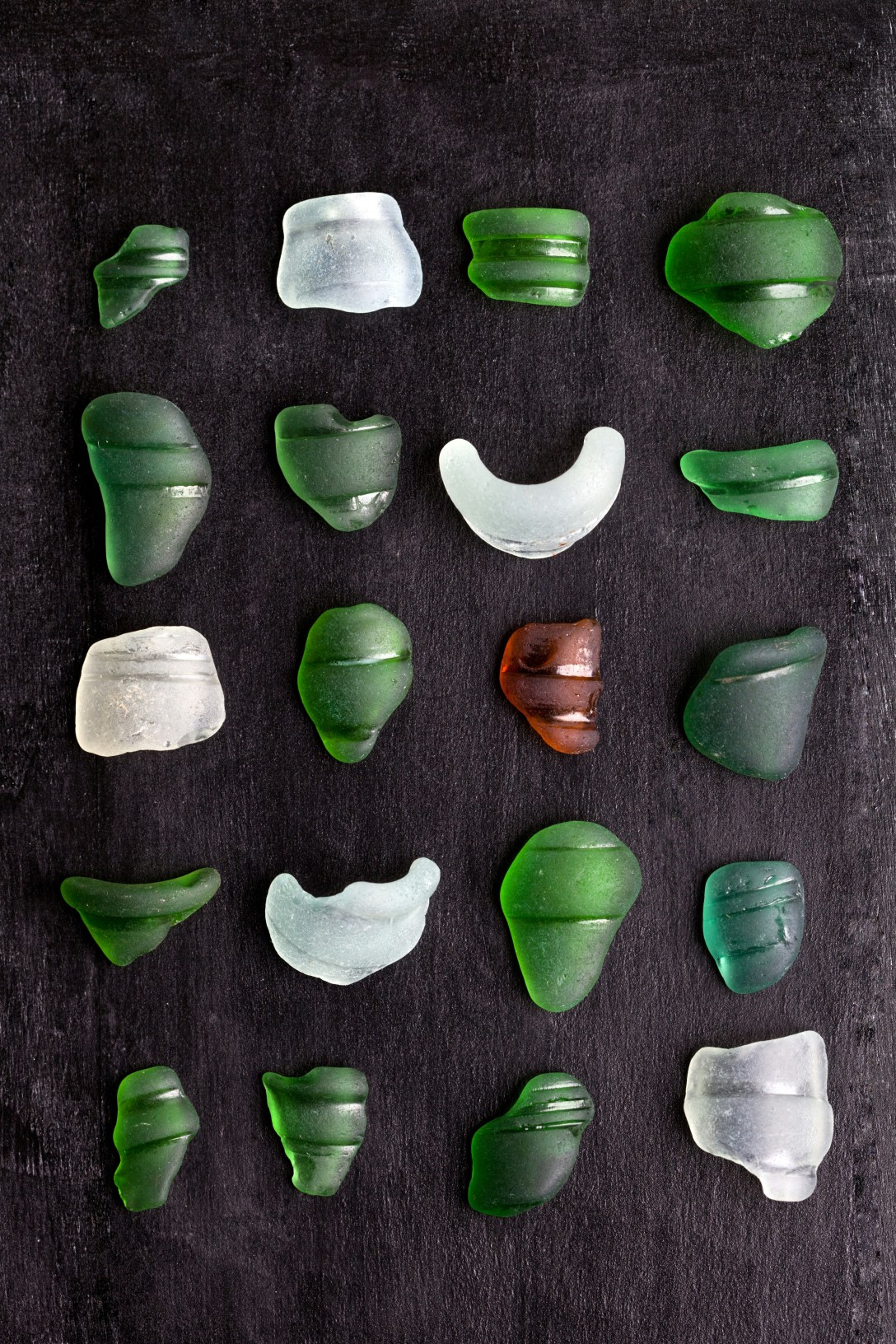
I carry my basket onto the beach, where my daughter literally frolics down the sand while I look for sea glass. I started collecting it only this year, while she was at swim lessons at our local swimming pool. The pool is situated beside a tiny but still pleasant stretch of sand and water, between the mainland and Fire Island, and I was truly hooked when I found a chunk of a bottle from a long-defunct Brooklyn brewery that was at least a hundred years old. Ever since, I’ve looked for frosty patches of green and blue among the sand and shells, collecting them in a glass vase in my kitchen.
What makes sea glass treasure, and the motor oil jug and cracked styrofoam cup and shredded plastic bag trash? Is it anything more than our attention—and, if not, what is our responsibility towards everything else under the trees and on the beach?
Four days after the election, I have more questions than answers. My daughter still doesn’t know who won. I don’t know what I’ll tell her when she asks—only the truth, I suppose, which is that he got more votes. She saw the signs on our lawn, and when she asked who Kamala Harris was, I showed her a picture of the first woman Vice President, a woman with a law degree and a Senate term and a pearl necklace and brown skin. When she asked why I didn’t want Harris’s opponent to win, I told her that the President-Elect was unkind and didn’t do a very good job the last time he was President. And when she asks why we have to pick up the trash on the beach, I’ll have to tell her that if we don’t, we don’t know who will.
::
In all of our futures are clusters of flotsam and nests of trash, and that’s if we’re lucky—if the mess we have to clean up as best we can before we leave our children with it is so tangible, so well-defined, so contained in yellow baskets; if we can also leave them broken glass with the sharp edges worn smooth and the bright surface sanded down.
With a palm full of glass and a bundle of garbage, I look to the sky. Clouds roll in and back out over the Sound. My daughter finds a fractured red Solo cup and half a soda bottle. The yellow basket is just about full. The trail off the beach and back through the woods isn’t as long as I think it is. We empty the basket into the can in the parking lot. “We helped clean up,” she says, brushing pieces of dead leaves out of her tutu.
“Yes,” I tell her, “we did,” because she deserves an answer, because she deserves the truth, because we filled up the basket.
::
Abigail Myers writes poetry, fiction, and creative nonfiction on Long Island, New York, and has earned nominations for the Pushcart Prize, Best Small Fictions, Best of the Net, and Best Spiritual Literature. Her debut short fiction collection, The Last Analog Teenagers, is available from Stanchion Books. Recent work appears with HAD, JAKE, JMWW, Stanchion, the engine(idling, Amethyst Review, and other fine publications. Keep up with her at abigailmyers.com and @abigailmyers.bsky.social
Image: Maria Kovalets
ID: small pieces of sea glass.
 Psaltery & Lyre