Jory Mickelson is an award-winning writer and educator living in Xwotʼqom / Whatcom / Bellingham on the homelands of the Lummi and Nooksack peoples. They are the author of three books of poetry: Picturing (2025, End of the Line Press), All This Divide (2024, Spuyten Duyvil Press), and Wilderness//Kingdom (2019, Floating Bridge Press) which won a 2020 High Plains Book Award. You can learn more about their work at www.jorymickelson.com
Stacy Boe Miller is a prose writer and a poet. Her work can be found in The Sun, Copper Nickel, Mid-American Review, Bellingham Review, Terrain.org, and other journals. Her book Ready to Answer With Hunger is forthcoming from C&R Books. More of her work, including information about the WorkWhile podcast can be found at www. stacyboemiller.com
::
Jory Mickelson: Stacy, it has been great to dive into the poems in your forthcoming book Ready to Answer With Hunger. There is such a delicious tension in many of these poems. In a recent conversation with a friend, we were discussing the author Jane Bowels and the multiple phobias she developed. It is an impressive list including: dogs, sharks, mountains, jungles, and elevators as well as fears of being burned alive. Not making light of mental health, I wondered what sort of fears or anxieties the speakers in your poems hold–because fear and daring seem to be the source of some of the tension I love so much in this collection.
Stacy Boe Miller: I love the way you phrase this list in such a positive light. I love collecting little found things–rocks, feathers, sometimes dead bugs or bird skulls. The idea of adding phobias to my collections makes me feel better about some of the things we humans collect that don’t feel so welcome–our fears for instance. The first poem in Ready to Answer With Hunger lays out a deep fear held by the speaker—being dirty. That fear of shame, of being left out of the holy, of being left behind after the rapture weaves its way in and out of these poems. It’s a kind of not being chosen, not living up to expectation or being enough. And while that shows up through the lens of religion, it also shows up in poems where I imagine the speaker is older and has let go of religion but still feels nervous or fearful about the kind of mother she is, whether her body holds up to societal standards, whether she can protect the people she loves and keep them safe from how harsh the world can be. I love seeing these poems through a new lens; I had never thought about all the anxieties my speakers are holding, but they are there, and they bring a tremendous amount of pressure with them. Early in the book, the poem “In the Tree Fort” the speaker hasn’t even learned all the terrible things she and her sister should be afraid of: punishment for love they might feel, miscarriages, abuse, physical pain. And daring shows up sometimes as the answer to those fears.
In these ways, the speakers in Ready to Answer With Hunger seem so different from the sure voices in the poems of Picturing. These speakers are boldly weaving their voices in and out of art and speaking even of the poem itself–literally calling attention to being in a poem! How bold! Where do these speakers find this boldness?
JM: Great question! I wish I knew, then I might be able to borrow some of it for myself. I think some of that boldness is bluster or bravado. The daring we see in the women posing in the photograph dressed as men in 1891 in the poem “Ladies” in an era when doing so was a crime. They dare, and at the same time the photo was kept in a private collection until recently.
The speakers in these poems are speaking in their own voices, maybe for the first time. Well, for the first time in my imagination at least. They are eager, hungry to tell their own stories–ones lost to history. The poems become vehicles for them to say what they must, sometimes even what they don’t want to, such as confessions of failure as in “The Illustrator, 1938, Domestic Images as Still-life.” The speaker admits to maybe just himself, that he was unable to love his partner well in their time together.
Perhaps some of the boldness is also a little narcissism. We as writers have to believe in our own writing–and if we are seeking publication–believe that other people will want to hear what we say. Visual art, dance, music, filmmaking, and sculpture are no different. I know I am guilty of this, but if we want to call it boldness, I am okay with that!
I love the way your collection both builds and breaks gender stereotypes. The women you create in these poems are capable of everything. I was especially struck by the poem, “Mother, Any Given Day.” Could you talk a bit about the fearsome and formidable women in these poems and maybe in your life?
SBM: This book is really shaped by my life, but I feel like I didn’t get to know these women in the way you are alluding to until I began to write them. Writing them, or versions of them–my mama, my sister, friends, and other women I was shaped by–I learned a lot about them.
We always saw my mother as so feminine and fragile, but when I write in a poem about her putting chains on tires in the bitter Wyoming winter and burning our garbage every day in metal trash cans–both things she regularly did–I see her in a whole new light. She was feminine, but she wasn’t fragile.
I was so shaped by the expectations of gender roles, but what I can see now about the lives of so many women (mine included) is that they/we were and are keeping the world running while pretending we aren’t– all while bleeding monthly, counseling children, birthing and losing babies, burning the garbage. The women I knew, in the church especially, were gaslighted into believing they needed men, but in writing these poems, and through years of experience, I find that’s not true. I think we all need community and each other in a million different ways that have nothing to do with gender.
In this collection, I SEE these women. I see them putting chains on tires, miscarrying into the toilet, brushing children’s hair, but I also see them hiding the birds that live inside.
The first poem in Picturing asks, “But how is this related / at all to art?” I love that question early on in this collection because it echoes throughout the whole book. All of these stories are woven in and out of film, art, paintings, and photos… It becomes a layered cake of meaning making. Why do these speakers want to know how “it” is related to art? What does it mean for us to look at our small lives in conversation with these artifacts that last so much longer than we do?
JM: That last so much longer than we do, exactly! One of the things I discovered in sifting through many artifacts of differing cultures and art movements is that humans remain essentially the same even as we are shaped by the cultures, societies, and religions that we are immersed in. Joy, love, grief, loss, illness, rage, the mystery of death; all of humankind has experienced and wrestled with these things since–well since whenever we began. In my poem, “In haraqa al-film” the reader gets a warp-speed tour of middle-eastern history from 5,000 years ago (Egypt) to the mid-20th century (a Lebanese photography studio). But the same dilemma remains for the speaker and for the reader too.
Our prayers, too, will go unseen
or be lost beyond our time, the gods forgotten,
and every couple a speculation.
Even we, with all of our science and technology, are subject to the span of a human life. Our lives and our cities remain just as susceptible to wildfire, famine, earthquakes, war, and every other sort of world-shaking event. To think we are immune, even as we watch catastrophic flooding in the South and whole neighborhoods in Los Angeles burn to the ground, is either denial or hubris.
So the artifacts of culture, the art and architecture, the things one generation preserves and is either passed on or discovered by future generations tell us about what we value or privilege in our contemporary lives, and maybe something about the lives of people in the past as well. So does an artist’s same-gender lover have anything to say about art? Yes and no.
Your book is bursting with the world from Buzz Aldrin to Instagram, from Yetis to small town swimming pools, from meadowlarks to god. In some ways, I see Ready to Answer With Hunger as a little ark, ferrying the world forward. What do you hope to leave the reader with at the end of your collection?
SBM: So simple, Jory, but I guess I just hope that even if the reader can’t name it, they might feel a connection with the world I’ve built, and even if our experiences weren’t exactly the same, the sentiments of being human are: shame, grief, power, fear, loss.
I have thought for so many years about Mark Doty writing in The Art of Description that when we artfully match language to experience, when we match the world to words, “some rift is healed, some rupture is momentarily salved.” I am comforted by poetry in this way. I hope I can give that to others.
Picturing gives us individual lives within the context of larger history, long-lasting art, war, film. Can you share something you took away from the experience of writing your book?
JM: In some ways, the writing Picturing showed me that we as humans have the same longings, fears, hopes, and at times overwhelming emotional states across time and space. In this collection, individual identities are important, but when the individuals give voice to their inner lives, well, it is our inner lives too–whether we can draw a stick figure or not.
Some poet, somewhere in my years of reading said that the more specific we get in our poems the more universal or relatable the poem becomes. I don’t know if that is always true, but it is a good maxim. This book affirmed for me that queer people want what everyone wants: safety, love, community, security, and a place to call home. At the same time, this book shows me again how easily those things can be taken away through legislation, the destruction of reputation, and by violence.
I didn’t know that when I began writing this book we would be entering a new period of regression and the daily erosion of rights for LGBTQIA+ people. Yet here we are in the United States. This book taught me about survival and hope, even in the darkest of times.
Thanks so much for our conversation. It has been a joy! Anything you would like to leave the readers with?
SBM: I think it was Richard Hugo in The Triggering Town who said that about the most specific being the most universal!
Thank you for talking, Jory. Thank you for writing a book that is specific and universal and so necessary right now. We need a map for survival and hope. I’m so glad poems can be a map for us. There’s nowhere I’d rather look for a way forward.
::
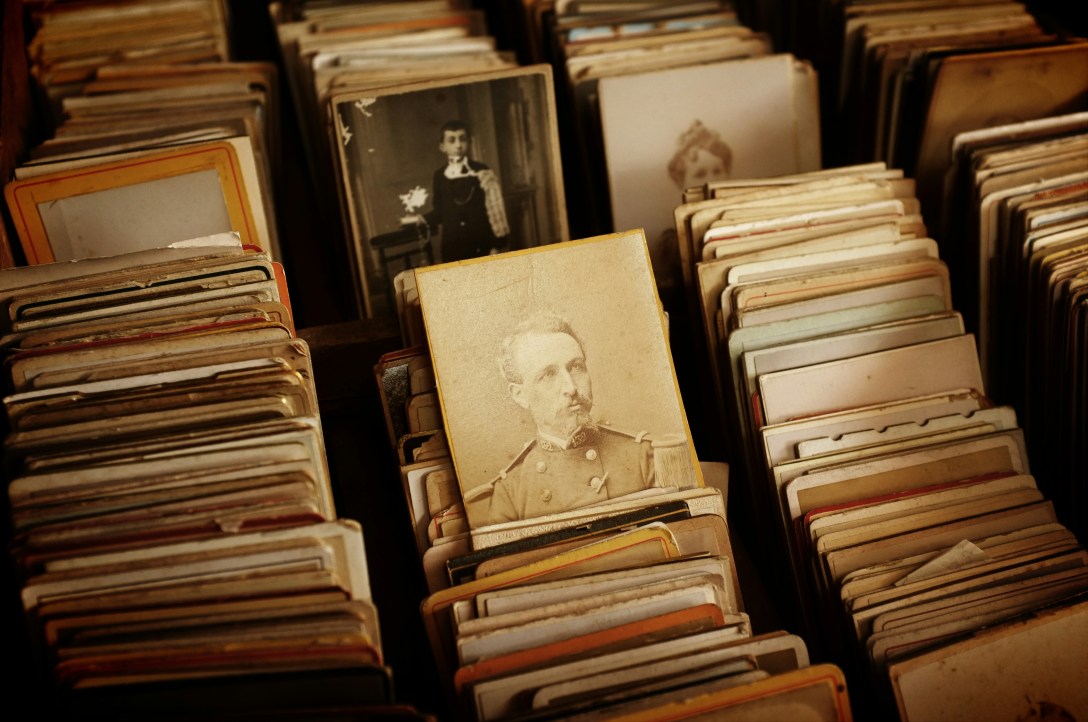
Image: Mr Cup/Fabien Barral
ID: a box of old portrait photographs.
 Psaltery & Lyre