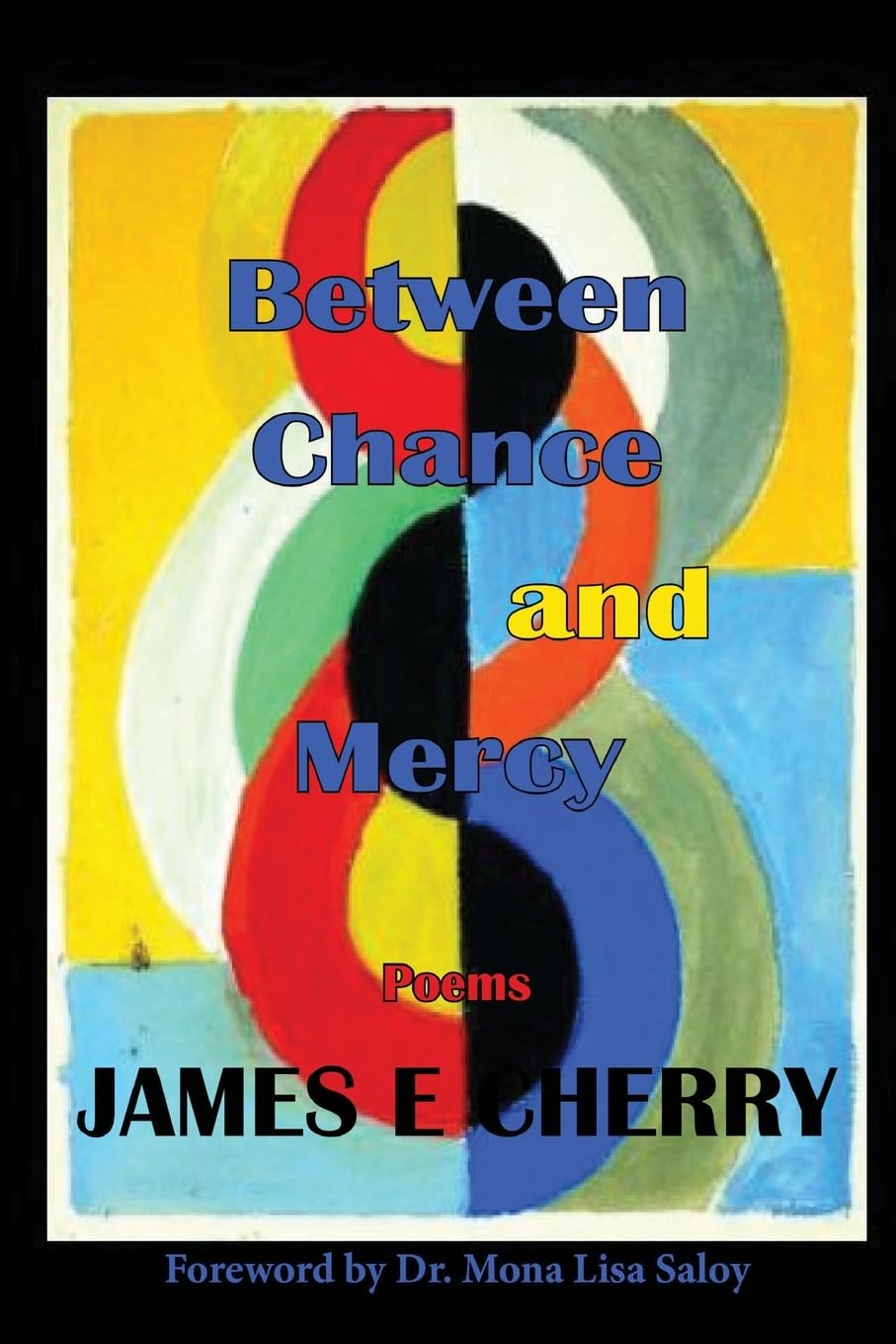
Between Chance and Mercy by James E. Cherry
Aquarius Press, 2024
Review by Whitney Rio-Ross
::
Our world needs good political poetry. I don’t limit that category to poetry about specific legislation or people in power. It includes poetry about systems of oppression and social issues. It’s the kind of poetry we might call “necessary” or “urgent” for our times. Many of my favorite poets–Tracy K. Smith, Carolyn Forché, Ilya Kaminsky, Audre Lorde–write this kind of poetry. Recently, though, I have grown wary of political poetry. It isn’t because of the poems’ topics, which are profoundly important, but because the poems often read as op-eds with line breaks. The argumentation is compelling, sometimes even emotionally affecting. But minutes after I’ve finished reading, the language and sound dissolve from my memory.
And so I have been asking myself what has felt like an impossible question: What makes some political poems last while others feel more like edifying sermons that I will soon forget? What makes Anna Akhmatova’s and Lucille Clifton’s decades old political poetry–so wildly different in style and circumstance–what I think of when considering the world’s current issues? This is where James Cherry’s Between Chance and Mercy came in to answer my question.
Between Chance and Mercy covers several topics, primarily mortality, writing, religion, and racism in America. Cherry, a Black man who has lived and written in Tennessee for several decades, has plenty of wisdom to offer on these fronts. Additionally, as a poet who has diligently honed his craft, he offers an arresting voice that in turn welcomes and demands the reader’s attention. His imagery is remarkably inventive: “(t)he sum parts of my days / are scattered in the margins of morning” (“60th”). Many are profound yet mysterious enough to warrant several rereads: “the distance between grace and mercy, / just wide enough to bring four walls down upon itself, / for buzzards to regurgitate the rubble” (“House of God”). Most impressively, his poems stick the landing with breathtaking consistency, whether they are images–“A dark hand rises, refuses / to surrender until history crumbles / into a lie or stone eyes give birth to tears” (“Higher Ground”)–or theological statements–”each dawn births sufficient grace / to walk through the world, just enough mercy / to return home at the end of the day” (“The House Across the Street”).
Throughout the book, Cherry guides the reader seamlessly from one topic to another. The book has no section breaks. As someone who thinks in outlines, I can’t imagine arranging a poetry book without clear sections. But this choice forces readers to experience the book in a specific way. The first third deals with universal topics such as aging, faith, mortality, and awe. Cherry doesn’t write in generalities but writes of his personal experiences. His persona sounds like a kindly neighbor, someone who wants to share stories and meditate on life’s mysteries with his readers. Then, as they lean in close, he grabs them by the collar and turns their heads to something much darker. It’s time to get political.
The following poems address police brutality against Black Americans and the history of slavery and racist violence. By weaving poems which reference names from recent headlines (Tyre Nichols, Michael Brown, Eric Gardner, Trayvon Martin, George Floyd, Therese Patricia Okomou) with poems describing other parts of Black history (slavery, a Black regiment in the Civil War, lynching, blues, Harlem writers), Cherry illustrates how contemporary discussions and art addressing Blackness cannot throw off the past. To illustrate this point, Cherry often conflates images of the past and present. In the poem “Pass,” he writes about sit-ins, enslaved people thinking of escape, and Trayvon Martin, concluding, “a hundred lashes / across your back feels no different than a single bullet / exploding inside your chest.” One poem for George Floyd conveys this vision in the title: “A Survey of American History in 7 Minutes & 46 Seconds.” The lines that continue to haunt me most are from “I Can’t Breathe”:
History is a forearm pressed against the throat,
a knee jammed to the back, a head mashed
into the sidewalk and I have learned
from its austere lessons that eternity exists
between inhaling and the act of letting go.
As those lines followed me for weeks after I first read them, I felt a strange familiarity. Where else had I seen eternity compressed into such devastating imagery, truth rendered as a revelation both clearly and mysteriously? Then the word came to me: prophecy. Though I do believe that sometimes the two overlap, there is a difference between preaching and prophecy. Most preaching concerns itself with understanding sacred texts, divinity, and how to lead a life according to the tenets of one’s faith. But prophecy is not as concerned with understanding; it is chiefly about proclaiming truth, and the truth it speaks rarely comes in the most “efficient” or simple statements. Biblical prophecy comes through poetry. It bears witness in sound and image. It does not simply explain to us what has been, is, or is to come; prophecy shows us these things all at once. Likewise, Cherry doesn’t simply retell a news story or tell us what he thinks or feels about life as a Black man in America. His language captures truth by engaging all our senses, and his natural music causes lines to linger. If I wanted to forget the uncomfortable truths many of these poems present, Cherry’s phrases—especially those closing lines—would haunt me. This is what great political poetry and prophecy do; they refuse to be unread. They force us to live with truth, our eyes burned clean.
Between Chance and Mercy also reveals another aspect of prophecy: relationship. The biblical prophets do not shout into the void but act as messengers to the world. Through prophets, God implores beloved and grievously flawed people to listen for the sake of their relationships with Godself and each other. Cherry’s poetry does the same, especially as the book’s final poems turn to the COVID-19 pandemic. The turn took me by surprise on my first reading, but I soon realized what a perfect ending it was for the book. These poems are also political; they illustrate a time when the world as a whole was reminded of the terrifying truth that something could wreck us by no fault of our own. Cherry locates the universality of that isolation in achingly familiar particulars—emails, takeout, silent walks, empty churches during Holy Week. These poems reach out a hand in solidarity. They say, “O my people, I know that you, whatever your race or sex or class, have lived in fear.” By drawing all readers together after poems of sharp grief and rage, Cherry reveals that love is at the heart of his poetry. Love requires that we all act as prophets, however we can, speaking honestly about our neighbors’ suffering rather than looking away from it. Calling out injustice is love. Forcing us to confront our own biases or complicity is love, tough as it may be. Perhaps Cherry explains himself best in “The News From Wuhan.” In the poem, Cherry and a man from China email each other at the beginning of the pandemic, powerless and increasingly isolated. After describing how the disease has ravaged his home, the man asks for a poem. Cherry obliges, knowing that in a time of shared suffering, “to trouble a few lines of verse / is another way of saying I love you.” And that, I now see, is what the best political poetry achieves–prophetic communion.
::
James E. Cherry is a poet, fiction writer, professor, literary activist, and impresario. He is the author of four books of poetry, two novels, and a collection of short fiction. His latest novel, Edge of the Wind, was re-issued in 2022 from Stephen F. Austin University Press. His latest collection of poetry, Between Chance and Mercy, was published by Willow Books in 2024. He has been nominated for an NAACP Image Award, a Lillian Smith Book Award and a Next Generation Indie Book Award. His writing has been published in journals and anthologies both in the U.S. and internationally. Cherry has an MFA in creative writing from the University of Texas at El Paso and resides in Tennessee with his wife, Tammy.
Whitney Rio-Ross is the author of the chapbook Birthmarks (Wipf & Stock) and poetry editor for Fare Forward. Her recent poetry has appeared or is forthcoming in Whale Road Review, Image, Stonecoast Review, Relief Journal, and elsewhere. Her debut collection, thunder makes us, is forthcoming from Belle Point Press in 2026. She lives with her family in Nashville, TN.
 Psaltery & Lyre
Excellent review for a WONDERFUL collection.