DEED by torrin a. greathouse
Wesleyan University Press, 2024
Nonbinary Bird of Paradise by Emilia Phillips
University of Akron Press, 2024
Review by Chiara Di Lello
::
In their 2024 collections Nonbinary Bird of Paradise and DEED, poets Emilia Phillips and torrin a. greathouse pursue the powerful work of marvelously trans/genderqueer self-making. The poems in DEED and Nonbinary Bird wrest power back from religious rituals, ancient texts, and the normative terminology of medicine and disability, remake mythological figures in the image(s) of queer bodies and sexualities, and mine etymology to expose its violence, absurdity, and beauty. In distinct but conversant ways, these collections showcase two poets skillfully crafting “crooked” lineages all their own.
The shared use of Greek mythology in both collections is easy to spot, but by no means a superficial connection thanks to the ways both poets select and morph their source material. From a pantheon already full of metamorphosis, Phillips and greathouse draw on creatures and deities to better represent trans and genderqueer bodies. In greathouse’s “Masturbating to Greek Myths,” the speaker “is searching for porn with bodies like mine, but / not made fetish,” and finds parallels in the whirlpool Charybdis and many-headed Hydra, because “they remind me of my chimera body.” This act of hybridizing and self-mythology is the opposite of settling or making-do–it is a portal, as evidenced by the poem’s dense imagery of “birth and drowning” and “breaking the surface.”
Phillips similarly transforms a Greek myth to their own ends. In “Artemis Wears a Strap-On,” the goddess of the hunt is both thundering and gentle: “Chariot, I am. And six / golden-antlered stags. Legs fuzzed above the knee… I’ll make your heart / beat like all four hooves / left the ground / returning, and kiss your ankles.” Having transformed themself, Artemis transfigures their lover, too: “What’s godlike in you / I’ll godden.” Those familiar with Phillip’s 2021 collection Embouchure may recall a poem in which the speaker wears a strap-on while washing dishes and folding laundry, “to get used to the heft and weight”–this poem feels like a triumphant sequel.
Not coincidentally, Artemis appears in DEED, too, in greathouse’s poem “Etymythology:”
The root of Artemis,
goddess of the hunt, is still unknown,
but likely comes from artamos–butcher.
Let’s call this a kind of etymythology,
post hoc history; let’s call Artemis
the root. For her wild heart. Her failed
femininity. Goddess of gender-fucked
girls.
greathouse wields this practice of etymythology throughout DEED, delving through layers of word histories and meanings to follow an idea like a thread through a labyrinth, or cut straight to the heart. “On Possession” is an adept example, as greathouse’s spacious lines meander across the page and through interwoven meanings of the title word – seizure, latch, ownership, theft, orgasm, bridle, bride – to craft a multifaceted poem about illness, desire, kink, and religion. As she arranges these overlapping semantic circles, light shines through in new versions of sacred patterns. These elisions are both subversive and beautiful: “They hold me through a seizure / or pin me to the bed, fingers / a bit inside my mouth. I am wed / to their hands.”
Nonbinary Bird, too, subverts patriarchal religion through “The Queerness of Eve,” a multi-part poem rewriting of the Book of Genesis. In this sequence the first woman (an observant, dry-humored Eve) makes herself a female lover in her own image:
she unfolded
herself from the blistering
noon light, split into three
dimensions by a prism
of want.
Shown from Eve’s perspective, paradise is far from perfect. As Eve reports, “My feet were calloused / there just the same / as the cast-out lands. / Thorns always pricked.” For his part, Adam comes across as ridiculous, rather than some heavenly ideal. He picks his teeth with a fishbone, tries to kiss Eve with a beard full of juice. Eve chafes from the start against the hierarchy in place, as well as the constraints of gender: “Eventually, my spine / was as straight / as the definition / narrow.” But when Eve’s lover moves from dream-presence to reality, the knowledge Eve discovers is not sin, but her own pleasure: “I burned yes like sage / on the tongue of flame / in my mouth.” In this retelling, it is male jealousy that leads Adam to eat the fruit, in order to separate Eve from her lover. Yet even after they are both cast out of Eden, Eve knows
no one
can exile
me from
desire, not
even
desire.
Desire is complicated, but greathouse and Phillips embrace its complexities. Just as their poems explore how gender and embodiment are made up of many facets, both poets also insist on this multiplicity when writing about desire. greathouse explores this at length in “I Want to Write an Honest Poem about Desire,” a section-length poem at the core (and perhaps the crux) of DEED. “I don’t know how to talk about lust // without also talking about violence,” says the speaker, as they begin to narrate their own history of sex work and survival. This poem is personal but also about “all my trans loves / & lovers” and the meaning of labor and desire in the first place: “Let’s say I did sell / my body to every John. So what? / I also sold it to every nine-to-five.” There are hard truths in this poem and throughout the collection about economic precarity, trans identity, and sexual violence committed in the context of sex work, but the speaker remains unapologetic: “I expect you are expecting / shame, I’m sorry to disappoint. // You won’t / find that here.” Other poems in DEED address additional common tropes, refuting the reader’s tacit expectations: for example that queer pleasure be punished with disease; that “immoral acts” must end in death. The tone throughout DEED alternates between forms of confrontation and visual lushness, and this deepens the poems’ impact.
For its part, Nonbinary Bird approaches the queering of gender through absurdity, in examples both negative and positive. “Gender Reveal” takes aim at the ridiculousness of a gender-normative practice, and creates a delightful poem as a result: “We’re having a scandal! / A child of Zeus!… A kiwi! A cantaloupe! / We’re having an argument!” In “Sir,” the speaker is misgendered when picking up a fast food order, but finds that “sir” and “ma’am” are
two sounds
at the same frequency–
so loud both and neither
can be heard.
Elsewhere in the book, gendered words are an absurd pleasure, as when the speaker turns all senses to the enjoyment of the phrase “lesbian elephants.” “I suck on it like a Werther’s / Original. I involve my vocal cords… I blow my coffee cool with it. I take it apart like clock // to see how it works.” We get to revel with them at the taste, texture, and sound of the words, which have as much physicality for them as other sensory experiences (poets can surely relate!).
At certain points, each of these poets has a righteous bone to pick with specific figures: for greathouse, it’s the TERF tendencies of Adrienne Rich, in a no-holds-barred poem that turns Rich’s own famous words back on her and takes to task a literary establishment that has refused to reckon with Rich’s anti-trans rhetoric.
Her words
were purposeful. The words are maps.
I won’t forget the damage that was done.
The meds denied, surgery withheld,
the girls who suffered…
& here I am–in the meaningless
wake of it–the thing she denied:
The girl & not the story of the girl
the thing herself & not the myth.
I regret to say this poem is how I myself started to learn this history. Phillips’ collection also includes poems that talk back to the casual violence of gender-policers (“I Told the Man Who Yelled ‘Don’t You Want to Look Like a Lady’ to Fuck Off,”) as well as the subtle violence of heteronormativity.
In “Anti-Domestic,” the speaker moves toward their queer desire while reflecting on their socialized relationship to housework, and realizing “The rest of my life / I have been unlearning.” One thing I appreciate about Phillips’ work in this vein is that sometimes the reckoning happens at a far remove from the experience–a gentle reminder that changing, becoming, fully claiming our narratives is longform work, and it takes time. And as greathouse shows in their collection, transformation is not a matter of neat endings, but embracing the layered and multivalent nature of our selves and our wants. DEED and Nonbinary Bird of Paradise do not shy away from the violence and long shadow of patriarchy and anti-transness, but they glimmer with the flourishing of complex, desiring, unapologetically queer life.
::
Emilia Phillips (they/them) is a poet, nonfiction writer, and book reviewer. They are the author of five poetry collections from the University of Akron Press, including Nonbinary Bird of Paradise (February 2024) and Embouchure (2021), and four chapbooks. Winner of a 2019 Pushcart Prize, 2015 StoryQuarterly Nonfiction Prize, and the 2012 The Journal Poetry Prize, Phillips’s poems, lyric essays, and book reviews appear widely in literary publications including The Adroit Journal, Agni, American Poetry Review, Gulf Coast, The Kenyon Review, New England Review, The New York Times, Ploughshares, The Southern Review, and elsewhere. They are an Associate Professor of Creative Writing in the Department of English; MFA in Writing Program; and the Women’s, Gender, and Sexuality Studies Program at UNC Greensboro, where they regularly teach MFA- and undergraduate-level poetry workshops, Queer Poetry & Poetics, and Women’s Health & Bodies.
torrin a. greathouse (she/they) is an award-winning transgender cripple-punk poet and essayist. She received her MFA in creative writing from the University of Minnesota. Their work has been featured in Poetry Magazine, The Rumpus, the New York Times Magazine, Copper Nickel, The Kenyon Review, and elsewhere. She has received fellowships from the National Endowment for the Arts, the Effing Foundation for Sex-Positivity, Zoeglossia, The Ragdale Foundation, and the University of Arizona Poetry Center. They are the author of DEED (Wesleyan University Press, 2024), winner of a 2025 Stonewall Book Awards Barbara Gittings Prize in Poetry, and Wound from the Mouth of a Wound (Milkweed Editions, 2020), a Minnesota Book Award and CLMP Firecracker Award finalist, and winner of the 2022 Kate Tufts Discovery Award. She teaches at the Rainier Writing Workshop, the low-residency MFA program at Pacific Lutheran University.
Chiara Di Lello is a queer writer and educator. She loves coffee, art, and bees, and unequivocally supports the movement for Palestinian liberation. Her chapbook, CHILDLESS MILLENNIAL, is forthcoming from Game Over Books in 2025. Her poems have appeared in Stonecoast Review, Ninth Letter, HAD, and elsewhere and have been nominated for the Pushcart Prize and Best of the Net. Born and raised in New York City, she now resides in the so-called Hudson Valley. necessarymess.wordpress.com
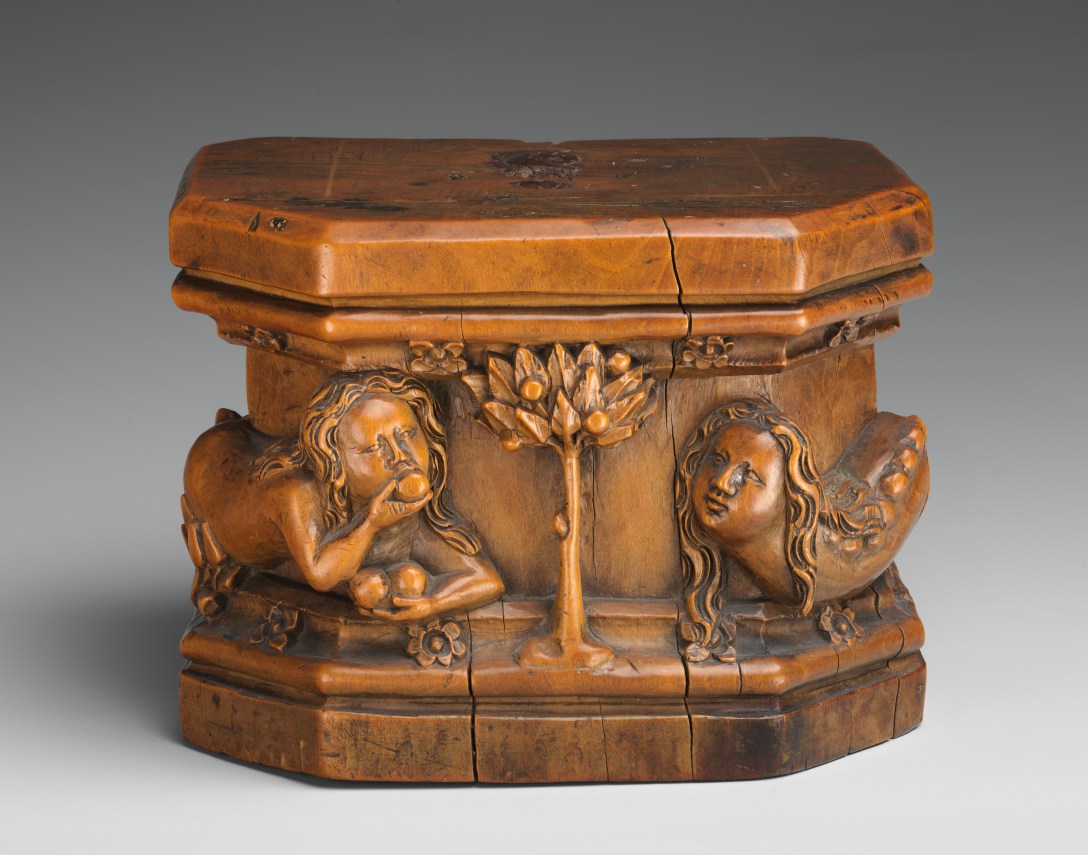
Image: “Base for a Statuette [The Garden of Eden].” South Netherlandish. 1470–80. In the Public Domain.
ID: Wooden carving of Eve and the serpent beside the Tree of Knowledge in the Garden of Eden. The serpent has long hair and a human face. The figure may represent Lilith.
 Psaltery & Lyre