Interviewed by Joanna Theiss
If the pleasure of a novel is in its world-building and the solid development of its characters, and the joy of flash is in the beauty of the prose and the novelty of how it tells a story, then the challenge of a novella-in-flash is to hold both the steady pleasure and the joyful sizzle at once.
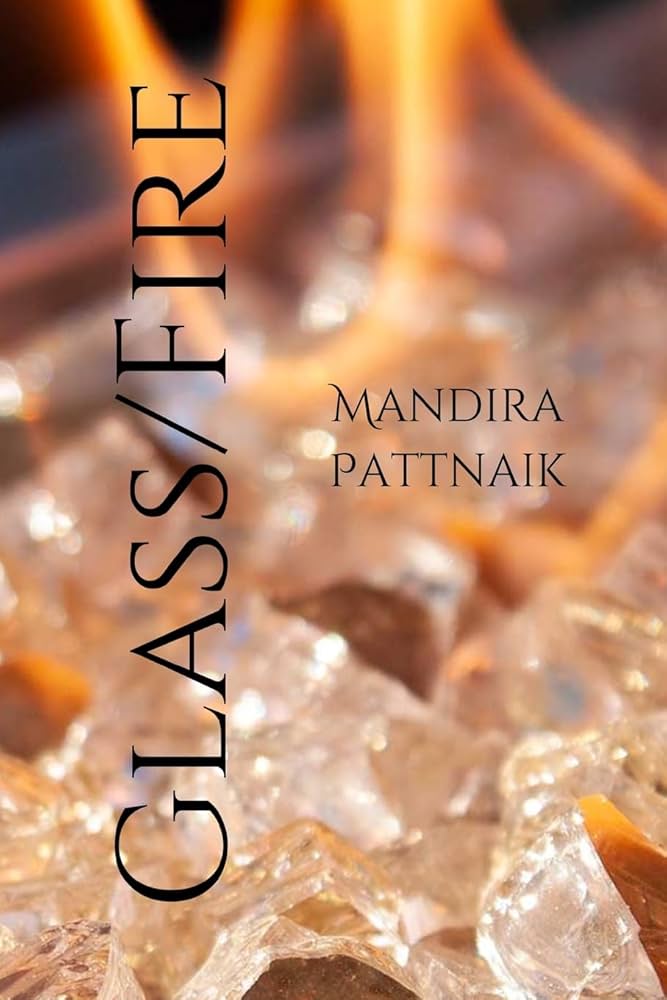
It’s a tall order, and one that Glass/Fire, Mandira Pattnaik’s second novella-in-flash, delivers. Glass/Fire follows Lily and Jo as they navigate adolescence, displacement, and love’s disappointments while growing into powerful women. Pattnaik has managed to create a complete world for the characters while staying true to the hallmarks of flash: unusual forms, unconventional storytelling, and prose that reads like poetry.
In a recent conversation over email, Pattnaik and I talked about her process for creating a novella through flash, how science and politics feed her creativity, and the inspiration she finds in describing the resilience of women and girls.
::
Joanna Theiss: The twenty-five pieces in the novella, ranging from several pages to a few paragraphs, seemed cohesive, each with a place in the larger narrative. I wonder if you could talk about your process for determining the length and style of the prose in Glass/Fire.
Mandira Pattnaik: Thank you for saying this! I wrote stories from the time I was a little girl, and it is wonderful how the story asks you what it wants to be. My natural writing style will assume the “shape of the vessel in which it is kept,” so to speak. I realize that the idea is only an impulse and the story becomes what it has to be. The world these characters inhabit needed to be fragmented, and their lives are unplanned, somewhat ruined, definitely fractured. I think the novella-in-flash form totally surrenders to this vision of brokenness. A few subplots made their way into the novella, and readers will perhaps notice a cadence of construction and deconstruction in how this novella is structured. I would love Glass/Fire to be read as this concise, miniature world that has everything that would describe a novel.
JT: Glass/Fire contains a lot of different story forms, such as stories told through lists, instructions, a breathless paragraph, and repetition, while others—I’m thinking of “Jamun,” which is a reflection on the narrator’s changing perspective on a jamun tree—read like a prose poem. Do you tend to choose the form first, and write the story within that form? Or vice versa?
MP: I believe narrative forms have an underappreciated accountability towards the premise. They necessarily direct a reader’s attention to something they should not miss. The same story would flow to the reader in an unintended manner, and end up conveying an entirely different emotion or message, should the writer misuse a borrowed structure. So yes, I do tend to choose the form when I know what story I need to tell. “Jamun,” as you rightly point out, is a pause in the vigorous pacing, intending to allow the reader the room to reflect and look back. I wanted to get dreamy and nostalgic and what better way than to run to poetry to bail me out—I ended up with a reflective voice in the shape of a prose poem.
JT: How important was it to you that readers could trace the story’s timeline and progression of the characters?
MP: I’m always interested in how much I’m narrativizing, logically and intrinsically, the gamut of changes a character goes through. I find it fascinating that not all can be predicted because some responses to the situation can be uncharacteristic and even morally or fundamentally wrong. But that is also, sort of, a limitation—to write within the scope of the character’s inner inhibitions and the society or culture they belong to. Therefore, to me it is very important that readers trace the storyline not just as a cumulative summation of the progression of the characters but also notice the irregularities and aberrations that are unexpected and strange to their natural responses. There’d be fountains and rivulets feeding the river, and also gorges and rapids—in a sense that the narrative continues to hold attention by offering contingency and improvisation.
For example, it might seem unlikely that the narrator’s sister, Lily, would do something like run away from home, and in this I was in a dilemma, like who are runaways? Can anyone say for sure this kid is going to run away from home one day? So, the character doesn’t fully show itself unless the situation prompts them to. I wanted to see if I could do something that disrupted that normal expected response from a character—and this was challenging to translate into “Rodent Behavior,” originally published in trampset. Interestingly, it opens through a reference to “standardized behavior” as in ants, bees and rodents, and kind of sets up the “non-standardized behavior” to be expected from this particular character. I felt that instead of showing the transformation by way of description, of introspection on the part of my characters, I tried to see if I could make a total breakdown of this person from how we’d been seeing her since the beginning. For me, this almost always makes a reader take notice. I’d rather avoid a smooth transition along the curvature if I know there’s a shortcut possible—I think that is more imitative of real life than otherwise.
JT: Which story did you write first?
MP: “Tide.” Now that I look back, it makes perfect sense. I had been to Sunderban’s Delta as a teenager. The width of the delta, the humongous mass of water at the confluence of several tributaries of the Hooghly River, the wildness, the lonely but bloodthirsty tigers, and the sunbathing crocodiles—all these literally creep up on the visitor there. You’ll see people living normal lives on the islands hemmed in by the mangroves. You’ll see mothers with babies looking at your tourist vessel while their mud house is being washed away bit by bit by the lashing water. You’ll see older women at the banks hunting crabs and men on country boats catching riverine fish. It’s that idea of “gnawing” or “encroaching,” something taking away from you bit by bit like slow torture, without you realizing its harm, or giving you a chance to guard against it. I thought it was a perfect place to put the three women together, in a home that is being nibbled away by the tide, and that made the tide a metaphor for losing something instinctual in a slow but persistent manner.
With “Tide,” a close partnership between the plot and unfavorable natural elements emerges. The unpredictability of nature is balanced with the gloom, and the finality that human lives have. I was fairly conscious of that aspect, generating the propulsion to drive the narrative forward and to act as a unifying thread between the stories.
JT: I noticed that many of the pieces have been published in literary journals, but one of my favorites, “Someone like Annabelle,” is new for the novella. Was this piece expressly written for Glass/Fire?
MP: I’m so glad “Someone like Annabelle” is a favorite of yours. I’d like to believe that this story, which appears close to the opening of the novella, serves as a deconstruction in the way it busts the perception that if you’re good and obedient enough as a woman, nothing bad will happen to you.
Annabelle is not really an active character in the novella, yet she is introduced in the title story. She is almost fire power personified. She has the feminine power and can dictate terms; she is the beauty people are scared of. We know in that first story that “someone like Annabelle” can be, unexpectedly and unfortunately, tricked into a marriage and be devastated, too. The narrator’s (and Lily’s) Mum cannot be “someone like Annabelle” because she simply isn’t wired to fight back. She’s used to quiet domesticity, subservience and unquestioned obedience. She can’t defend herself against her husband’s baseless accusations of unfaithfulness.
JT: Poor Mum! Her husband accuses her of infidelity, then “dishevels the laundry Mum had just been folding.” As a person who folds a lot of laundry, that hit me right in the gut. I’m so impressed by how you manage to capture that gut-punch in so few lines.
MP: To me that gut-punch must make you go back and start re-reading what nuances of the plot or character you may have missed. That’s how I envision the unsaid part of the plot, the intricacies so fine that only a discerning reader will sense them, and by which the narrative will demand attention the reader may have been hitherto unwilling to reward it with. But it might not always work and then that’ll be something that isn’t discoverable if simply left unsaid. I believe the unsayable is a masterful calculation and the minute one falters, the work appears incomplete, even juvenile.
JT: Science is featured throughout the novella. There’s the process of creating and destroying glass, along with components from the studies of geology, astronomy, and biology. Do you have a background in science? If so, do you find yourself naturally reaching for these metaphors?
MP: I do have a background in science. I love how science intersects and nourishes the arts. And it is not just science. I love how politics, history, and economics make their way into literature. I read widely and my choices are eclectic. I will read a piece in Business Standard with the same interest as a piece in Nature. I guess those elements percolate into my writing. The subjects and their academic details are not options I exercise while I write. Rather the issues make those choices for me, almost involuntarily. One thing which I consciously make a decision about is how my work can be relevant to the readership in contemporary times. I always endeavor to find ways to extend and assimilate personal narratives with global, universal realities. I think it is not optional to write social fiction. Writers have a responsibility.
JT: This Seamus Heaney quote comes to mind: “I can’t think of a case where poems changed the world, but what they do is they change people’s understanding of what’s going on in the world.” Writing may not be overtly social or political, but our writing about these issues might cause readers to think differently.
MP: Absolutely. I want to figure out, for myself and for others, how the issues affect us and how we are responding to them. I want to analyze what I observe in the world—in society, in economies and in politics, and offer a perspective, whether or not that perspective is something new or radical. I definitely want to make readers think.
JT: I enjoy reading your nonfiction essays, including your column at trampset. I wonder if you alternate between writing nonfiction and fiction, and if you prefer one genre over the other.
MP: Thank you. I do hope to extend that idea of bridging the personal and the global in my columns for trampset. Curious as it may sound, fiction and nonfiction are, in my opinion, very interestingly related. In an interview published in The Paris Review in 1981, Gabriel García Márquez said: “It always amuses me that the biggest praise for my work comes from the imagination, while the truth is that there’s not a single line in all my work that does not have a basis in reality. The problem is that Caribbean reality resembles the wildest imagination.” It makes sense given how our brains work—there’s always some seepage, and neither of the two is watertight. On the other hand, I am not someone who thinks authors model their novels on their lives. It’d be too heinous for the author and their family. So, let’s just say, fiction and nonfiction, I enjoy both—like salt and sugar. Both have their flavor and their uses.
JT: Can you talk about the publication journey for Glass/Fire? How did you come to work with Querencia Press?
MP: Glass/Fire is my second novella-in-flash. I had been working on it before I published Where We Set Our Easel (Stanchion Publishing, 2023). Where We Set Our Easel took a little over a month from start to finish to acceptance, but Glass/Fire took me two years. It is longer in length and far wider in scope. The novella was longlisted in the Bath Novella-in-Flash 2023 contest judged by John Brantingham on its first submission outing. I had it on submission with Querencia Press and a couple of others right after. In the meantime, it was shortlisted by Conium Press. Emily Perkovich, the Editor-in-Chief of Querencia, reached out to me soon after. I suppose it was destined to be published by Querencia Press, a publication that actively supports marginalized voices.
JT: I thought Glass/Fire’s dedication, “to all the girls of underprivileged background who must make the best of their circumstances in order to survive,” was very touching. Can you talk about why you chose this dedication, and why it is important to you?
MP: It was important to me to dedicate Glass/Fire to the strength of character among those who are nameless, living in regions untouched by common privileges—the back-of-beyond women who toil endlessly to achieve what they think is rightfully theirs.
JT: How would you describe your writing practice?
MP: Stories, I believe, might increase their reach and resonance if they can achieve a difficult but worthwhile equilibrium between the personal and the universal. I do not worry about the readership, which is expected to be global but (and that’s a reassuring but) they are increasingly well-informed about diverse cultures and multivariant ethnicities. So my writing practice is local authenticity modeled on universally identifiable realities. I enjoy the use of local languages, names of places, unfamiliar settings and unique cultural markers, and these heavily seep into my work, but I’ve done otherwise many times—like, a lot many of my stories are based in places I have never been and the protagonists are nothing I will ever be. It is great how Glass/Fire is a story of want, depravity, defiance and hope in the midst of odds. It is also a story about women and their struggles, confined within a territory that many might not be familiar with but whose emotional pull is highly relatable.
JT: What are you reading right now?
MP: Ah, that’s a question that I find hardest to respond to. I do not know how to stick to one book or one genre. I jump from one genre to another and only read a book at one go if it is that irresistible. I often read three to five books at the same time. At the moment, I’m gathering a list of books based on human psychology, and particularly, highly sensitive individuals. It seems like a very useful subject and I will settle down to read soon.
JT: When do you write?
MP: I write between whatever other jobs I may have. That’s the case for most of us, I guess. When I was working on my first novel’s draft, I used to wake up at pre-dawn for four months straight and work on it for three hours until breakfast time. I have lost that routine sadly, and I’m now back to being erratic.
JT: Where do you write?
MP: I tend to use all the spaces in the house. I know it sounds crazy but it’s like that. I’ll spend an hour on the sofa, an hour at my study table, which, thankfully, overlooks a beautiful patch of green and an enormous ancient tree looming over the window, and the next hour I’ll probably be typing away while lying on my belly in bed. So yes, I have some bad pains from my bad postures —neck and back pains—but I can’t imagine being at one place, sitting straight for hours doing the same thing unless I must write breathlessly in order to rescue a character in grave danger in the story.
JT: What are you working on now?
MP: I’m writing short stories but they are at my own pace. I hate the advice to write every day—it is just not possible. There are too many things to care about. I am a mother. My children won’t be this young forever, so I need to give them time and attention. I have a hybrid poetry and prose chapbook titled White Hot Moon forthcoming in 2025 via Red Bird Chapbooks. I also have a collection of short stories under submission that I am really hopeful about. My debut novel is also complete, but I’m hoping to reopen it for revisions in the coming year.
::
Joanna Theiss is a writer living in Washington, DC. Her short stories, interviews, and poetry have appeared in Chautauqua, Milk Candy Review, Peatsmoke, Best Microfiction, and elsewhere. She is an associate editor at Five South Lit. Previously, Joanna worked as a public defender, an international trade attorney, and a matchmaker, but not all at once. For more of her writing, please visit joannatheiss.com.
Mandira Pattnaik (mandirapattnaik.com) is an Indian writer, poet, editor and columnist published in The Rumpus, IHLR, Emerson Review, The McNeese Review, Penn Review, Quarterly West, Passages North, Timber Journal, Contrary, Watershed Review, Amsterdam Quarterly, Quarter After Eight and Best Small Fictions Anthology (2021 & 2024), among others. Her writing has secured multiple nominations, placings and listing in Wigleaf Top 50 (2023). Glass/Fire is her second novella-in-flash.
ID: Cover of Glass/Fire by Mandira Pattnaik.
 Psaltery & Lyre