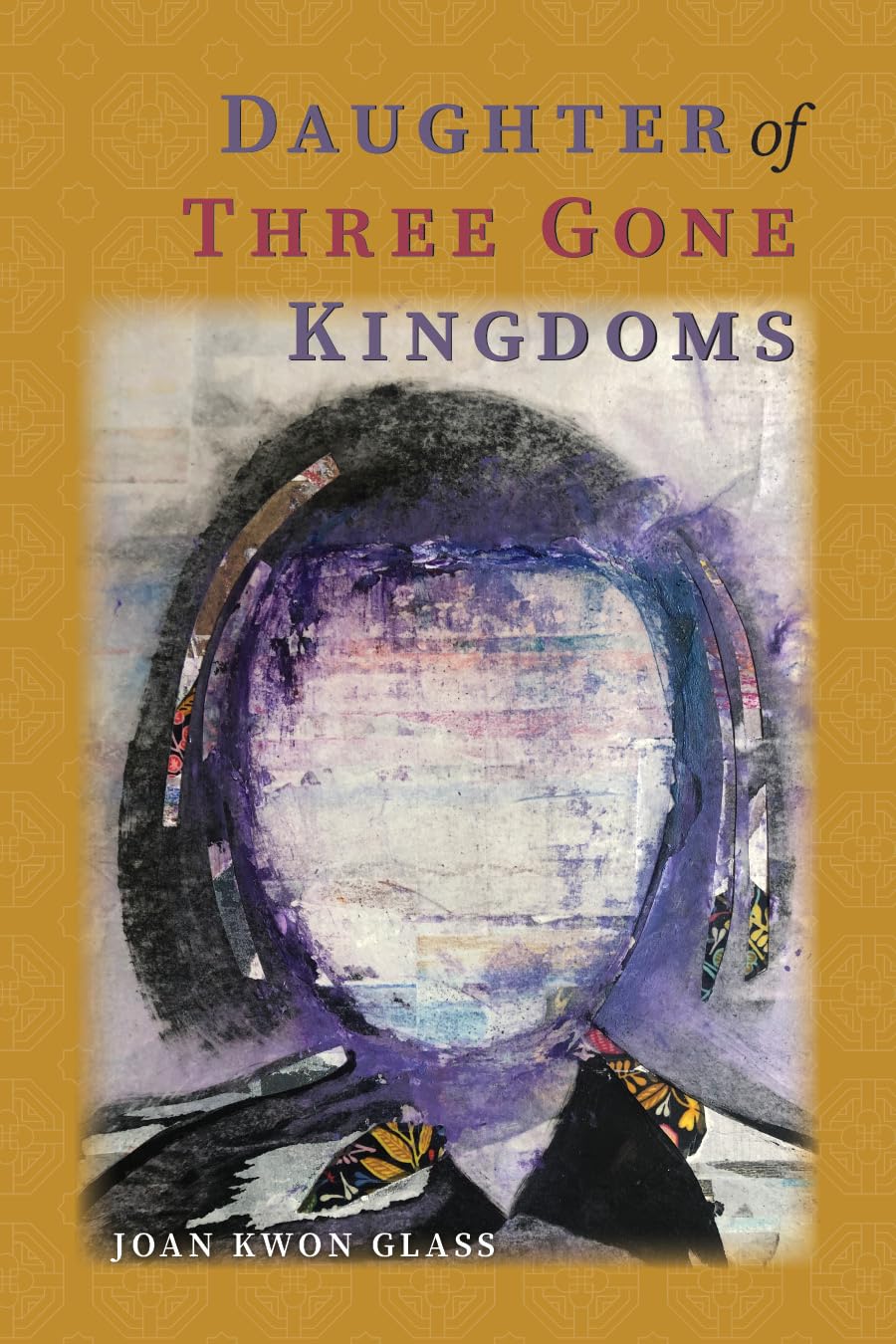
Daughter of Three Gone Kingdoms by Joan Kwon Glass
Perugia Press, 2024
Review by Lizzy Ke Polishan
::
“The first Koreans were part god, part beast. / Every morning I look in the mirror and ask: / Which will I be today?” asks “Bloodline,” the opening poem in Joan Kwon Glass’s Daughter of Three Gone Kingdoms, the winner of the 2024 Perugia Press Poetry Prize. This animal/divine dichotomy recurs thematically, like a lighthouse, guiding us through the collection. As these poems navigate the complexity of incarnation, they hold a space for us to be both. This collection fuses a macro view of contextual forces—historic, scientific, mythological—with Kwon Glass’s personal narrative, embodied and kaleidoscopic, pulsing as a heartbeat.
Like a masterful camera, the collection zooms in and out, sometimes plunging us into the reality of personal embodiment, sometimes pulling back with a wide-angle lens on the contextualizing forces of history, mythology, science. “Black Cows” spans 100 years and multiple continents, braiding the historical occupation of Korea by Japan together with the family history of Kwon Glass. “Mystery” interrogates origins, zooming hugely out onto the formation of galaxies before zooming tightly in on personal origin, ultimately holding space for uncertainty surrounding both. A series of “Hungry Ghost” poems punctuates the collection, fusing the mythology of Korean Buddhism’s thirty-six hungry ghosts with Kwon Glass’s complicated relationship to hunger and food. Throughout the collection, Kwon Glass keeps fluid the boundaries between the personal and the contextual. No single poem excises the personal in favor of a broader context or vice versa; they inform and shape each other, constantly both comprising and transcending one another. Each poem is simply fitted with a larger or smaller, and often dynamically shifting, lens.
Daughter of Three Gone Kingdoms presents a multidimensional version of identity, situating the “I” in a multiplicity of roles: we are sometimes animal, sometimes divine, sometimes observer, sometimes observed, sometimes body, sometimes ghost, sometimes grieving, sometimes light. In “Glass Menagerie,” Kwon Glass finds herself in the position of the “queen of glass menagerie,” a menagerie that the ninth-grade version of herself stole from the Hallmark store, one animal at a time, on her Saturday trips to Twelve Oaks. In “Parakeets,” she slides into the role of observer, watching the parakeets her paternal grandma kept in cages, noticing how “their attempts to fly / sound almost like song.” In a later poem, she seems to embody the form of a hummingbird: in “The Oriental and the Hummingbird at the Trailer Park,” her mother watches her while she retreats and “hum[s] my wings so fast / I can almost hide behind my own heartbeat.” Part of what makes this collection magical is this subtle shifting: the way the poems follow a singular “I” yet create a space for the singular to branch open into many different, sometimes opposite, roles.
As this collection explores embodiment, it explores hunger. Hunger recurs, drives. Hunger dwells in the body, emanates from the specificity of the incarnation. This world is a world where food is carefully regulated. Where at the Pizza Hut, for example, her mother would “fill a small plate / even though a large plate was the same price.” Time and time again, Kwon Glass faces the impossible task of trying to feel full and remain insubstantial. In second grade, during lunch time at school, she and a friend raided the teacher’s desk and stole “scratch ‘n’ sniff stickers” redolent of “chocolate cake, strawberry pie, / buttered popcorn.” This was the same age when she “stopped eating.” The scents of the stickers became “a paradise [she] might never see,” an unfulfilling substitute for what her body craved. Later, in therapy, prompted by a breeze through a window, she “imagine(s) what the wind tastes like, / whether anyone has ever tried / to swallow it whole.” In another moment, she tries to find another kind of fullness, in bed, “thinking maybe if I ate a prayer, / it would finally be enough.” The hunger lingers, remains, drives, no matter how many food stand-ins are consumed. No substitute is ever enough.
The collection juxtaposes these moments of urgent hunger with beautiful, though brief, moments of communion. These moments find Kwon Glass eating together with her daughter. “Ode to the Big Boy Hot Fudge Ice Cream Cake in Troy, Michigan” lingers on the huge sundaes she and her daughter each eat: “two squares of chocolate cake…double scoops of vanilla ice cream…a cascading tower cloud of whipped cream.” For one moment, “[i]n every bite, we had everything we wanted.” These sundae dates, fleetingly beautiful, recur until they don’t, when Kwon Glass’s sister passes, and grief makes it too difficult to return to Michigan. With visits no longer possible, these moments shift from recurring realities to photographs. Another moment of communion occurs in “Taking My Daughter Out for Smoothies.” On the smoothie runs with her daughter, Kwon Glass tries to extend the time they share, “hoping / for long lines, for traffic, for anything to keep you / close to me a little bit longer.” The poem, like Kwon Glass, remains aware of its subject’s temporality, its eventual disappearance, and clings to the present. In doing so, it transforms mundane nuances—everyday cages of traffic, of long lines—into something truly beautiful. An extension of the fleeting present. Of the simple shared moments. Where they are, finally, however fleetingly, full.
::
Joan Kwon Glass is the mixed-race, Korean diasporic author of DAUGHTER OF THREE GONE KINGDOMS (winner of the 2024 Perugia Press Poetry Prize) & NIGHT SWIM (winner of the 2022 Diode Editions Book Award), as well as the chapbooks HOW TO MAKE PANCAKES FOR A DEAD BOY (Harbor Editions, 2022) & IF RUST CAN GROW ON THE MOON (Milk & Cake Press, 2022). Her books & poems have been featured on Poetry Daily, The Slowdown & Rattlecast. Joan has been a finalist for the Poetry Northwest Possession Sound Series, the Tupelo Helena Whitehill Award, the University of Akron Poetry Prize & the Subnivean Award & her work has appeared or is forthcoming in POETRY, Poetry Northwest, Passages North, Terrain, Ninth Letter, Tahoma Literary Review, Prairie Schooner, Salamander, AAWW (The Margins), RHINO, Rattle & elsewhere.
Lizzy Ke Polishan’s poems have appeared in or are forthcoming from Gulf Coast, Passages North, Epoch, Tupelo Quarterly, Poet Lore, RHINO, and others. She is the author of A Little Book of Blooms (2020). Her work has received the Eleanor B. North Poetry Award and been nominated for Pushcart and Best of the Net. She is a reader at Psaltery & Lyre, a Guest Editor at Palette Poetry, and the Managing Editor of River & South Review. She lives in Pennsylvania with her husband. You can find more of her work at lizzykepolishan.com or on Instagram @dizzymiss.lizzy.
ID: Cover of Daughter of Three Gone Kingdoms by Joan Kwon Glass.
 Psaltery & Lyre