by Abi Newhouse
While I was out with friends one night, they led me into a hell-themed bar. It was lit a deep red, the stools around the counter were covered in spikes, and there were figures with horns graffitied behind the makeshift stage, where employees were setting up mics and amps for an upcoming performance. And maybe these details aren’t explicitly hell-themed, but I was a Mormon girl, and hell for us was a slippery concept. My friends ordered drinks, and everyone turned to me, knowing I’d say my usual line: “I’ll just have water tonight,” as if I didn’t have water every night, every time we got together. I started to dread going out with friends in my grad program near Washington, DC, because I knew they’d ask why I wasn’t drinking, and the reasons, even for me, were starting to feel disingenuous.
The Mormon church taught me that even one sip of alcohol would lead me to certain doom. I adhered to the Word of Wisdom, a health code that forbids us from drinking coffee, tea, and alcohol, among other health rules and guidelines. The Word of Wisdom promises members that if they follow the rules, they will “run and not be weary, walk and not faint.” Some members interpreted this to mean they would not be affected by major illnesses, while others recognized the benefits of simply avoiding the less fun aspects of the drinks—hangovers, jitters, a lack of control during blackouts, alcohol poisoning. In fact, the fun and beneficial aspects of alcohol, tea, and coffee were completely lost on me as a child and even as a young adult. Drinking alcohol, specifically, was all bad all the time.
One of my friends sipped her gin and tonic and offered to pay for my drink. When this happened, as it so often did, I would laugh and say no. And then, inevitably, the conversation would turn to why drinking wasn’t that great anyway and why my friends don’t actually drink as often as I might think.
“It’s literal poison,” my other friend said.
They tried to meet me on my sober level, and I tried to meet them on their tipsy levels. I knew that if I wasn’t present, their night would be totally different—less inhibited, less observed. I watched them from behind my water glass, asking them questions about drinking to prove I was interested in it at least intellectually. And I was interested—especially as I learned about different drink cultures and traditions that were previously unknown to me having grown up in the Mormon bubble of Utah. It felt counterintuitive to ignore this part of humanity—to pretend I was above it somehow—when even my own pioneer ancestors subsisted off beer while figuring out how to clean the water when they colonized Salt Lake City.
I withstood though, feeling proud and deflated all at once, and we walked to a karaoke bar where our other writer friends danced and sang under blue and green disco lights. My friends ordered pitchers of beer and margaritas, and I sipped a ginger ale, watching and waiting for my turn at the mic. My friend from the hell-themed bar started swaying and slurring, flushed and lovely in the darkness. I danced with her, and we laughed and then she pulled me close and said, “No shade, but I really wish you were drunk with me right now.”
::
I was raised believing that the founder of the Mormon church, Joseph Smith, received the Word of Wisdom as a revelation from God. At the time, it wasn’t considered a commandment, but rather, as the name suggests, “a word of wisdom” to Mormon members. In the early 1830s, Americans from all backgrounds and faiths debated the limits of alcohol, as at the time it was a ubiquitous addition to any meal of the day. But its negatives were easy to spot: temperance activists pointed out physical and mental health concerns and social impacts like poverty, crime, and family separation. The United States was beginning to address these societal ills with government-related temperance movements too, so Smith’s guidelines weren’t as revelatory as I was taught. They were just of the times.
In fact, it was Smith’s wife, Emma, who pointed out the lack of propriety in church meetings; men spit chewed tobacco over the floor, and she wondered whether that was Smith’s envisioned environment for what he called “the school of the prophets.” And so, he prayed, and the revelation appeared for Mormon members as a list of both hyper-specific and also vague dos and don’ts. For instance, wine was forbidden, except for in church meetings and only if it was made by the members themselves. Other strong drinks were “not for the belly, but for the washing of your bodies.” Tobacco was out, unless it was used to help heal sick cattle “with judgment and skill.” “Hot drinks” were out. Herbs and fruits were in, as long as they were used seasonally. Meat was to be used “sparingly” and “only in times of winter, or of cold, or famine.” Grains were cool, but in this specific order: “wheat for man, and corn for the ox, and oats for the horse, and rye for the fowls and for swine, and for all beasts of the field, and barley for all useful animals, and for mild drinks, as also other grain.”
Some members followed, some didn’t. It wasn’t until the Prohibition era that the church really buckled down on specifics. Before then, the pioneers carried alcohol with them on their journey from Illinois to Utah, and they began brewing almost as soon as they set up their home in the Salt Lake Valley. Brigham Young, the second prophet of the church, built breweries and wineries and distilleries around Salt Lake to sell and trade with people passing through, those he called “the gentiles.” At the communal department store ZCMI, they sold beer, wine, and other spirits to travelers—including most famously Mark Twain, who enjoyed a whiskey called Valley Tan. There was also the Dixie Wine Mission in Southern Utah, originally created to produce grapes for sacrament wine, but the wine was ultimately used for parties and weddings and other church functions, too. Besides alcohol, the men continued smoking tobacco and the women could not be torn from their tea.
The Word of Wisdom today is considered a commandment. After Prohibition, when the then-prophet Heber J. Grant cosigned national laws forbidding alcohol, interpretations of the Word of Wisdom were locked in. No alcohol, tea, or coffee. No drugs of any sort. The church-sanctioned distilleries and wineries shut down. Members are not allowed to enter the temple if they partake of anything listed as a don’t. This was the main message; the rest of the Word of Wisdom about meat and grains is largely ignored. Conversations about the Word of Wisdom end up focusing on the don’ts and are often reduced to members’ interpretations about why tea and coffee are included at all, since their downsides are more difficult to spot. Some decided it had to do with caffeine, and so many members swore off caffeine altogether, even forgoing chocolate in extreme cases. Whenever we went over the Word of Wisdom in church—a few times a year, usually, among other rotating lessons about repentance and Jesus Christ and faith—members debated the limits and benefits of such strict rules.
On my mission in Houston, Texas, I taught investigators—people who were in the process of learning about the church—that the Word of Wisdom’s main purpose was to help people rely on God instead of on substances. To me, that felt like the real answer to the Word of Wisdom’s existence and benefits. Go to church instead of numbing your mind with alcohol. Pray and ask God to help you wake up instead of drinking coffee. I didn’t like getting tied up in the debates of minutiae. Rely on God or don’t, I thought. That’s all it comes down to.
::
Within my Mormon community, I knew a few people who tried alcohol. My dad was a convert to the church, baptized when he was 20 years old. He grew up in Amargosa Valley, Nevada, in the deep desert near Area 51. In small-town Beatty, he tried beer, rode his bike to get home, fell off, and threw up near the road.
“Tastes like piss,” he told me.
Two of my mom’s four brothers, who grew up Mormon, drank alcohol at different points throughout their life. One ended up with a few DUIs and spent some time in jail. The other not only drank alcohol but also did all sorts of drugs, leaving his mind a confused and barren place. He hinged his jaw back and forth while talking to me, a tick I know now came from the drugs. He was paranoid and abusive, but he was praised for still going to church.
In all cases, their stories only confirmed what the church told me: that drinking alcohol and doing drugs will ruin you, hurt you—and even besides all that, the taste and effects are not even worth it. In college, I roomed with a few girls who didn’t grow up Mormon or who had left the church, and I watched as they lay in bed, hungover, or else I heard stories of them throwing up all night at different parties. I couldn’t understand the appeal. I had heard about the pleasant buzz after a couple drinks, but it seemed like the people around me were taking it much further, hurting themselves to ends I couldn’t comprehend.
I stayed with my Mormon friends for the most part, having ice cream sundae parties, or making waffles with buttermilk syrup late at night. We did freshman things like building barricades out of dorm furniture in common spaces, playing catch in the hallways, and dressing in kitschy pajama sets we’d bought at a small-town store to sing the Les Misérables soundtrack in a locked room, the lights shut off. We sound drunk in all these scenarios, but we were just trying to feel uninhibited in our own innocent ways. Our drunk friends would arrive home and look at us like we were aliens, and we’d look at them the same.
I was close with one roommate in particular who left the church while we were living together. I remember once she came home from a party where she’d tried alcohol for the first time, and her eyes were wild. She spoke two volumes too loud as she asked me about my night, interrupted me to laugh at sentences that were not meant to be funny, and stumbled before sitting in our living room chair. I wanted to tell her that I didn’t care if she drank at the party, but she was trying so hard to act like she didn’t, overcompensating in obvious ways, that I didn’t want her to know that I knew. And so, we carried on in our good-intentioned semi-fake conversation, and I wondered, without ever asking, if she would recommend her experience.
::
Utah’s alcohol laws are more restrictive than other states. Even though less than half of its residents claim the Mormon title, many government leaders are members of the church, and their interests tend to cross over. In grocery stores, you’ll find beers of up to only 3.2% alcohol content by weight (or 4% by volume). There are 45 liquor stores in Utah compared to 1,750 liquor stores in Washington, DC, where I live now, which has 79% less people than Utah (about 700,000 compared to 3.3 million). Restaurants and bars in Utah are basically prohibited from offering happy hours because these deals, according to Utah’s Bar License Handbook, “encourage overconsumption of alcohol.”
I considered overconsumption of alcohol equaling one drink. In grad school, a friend offered me a ride home after a night out and I deflected by saying I’d just call an Uber. She called me out immediately: “You think one beer makes me a danger on the road?” she asked. Truthfully, I had no idea.
Since I didn’t grow up around alcohol—a night out was cheeseburgers and root beer at Applebee’s with my family—I was shocked to see alcohol everywhere around me in DC. It seemed every event needed alcohol: there was wine at poetry readings, coolers of White Claws on river floats, seltzers at house parties. My friends’ apartments had shelves dedicated to whiskeys and gins and tequilas, frosty wines in the fridge. People invited me out for coffees or drinks, where previously I’d go out for breakfasts and dinners. I had to learn how to navigate these scenarios so I wouldn’t miss out on opportunities to make friends, to network, to connect in ways humans have for so long.
For a while, I ordered hot chocolates or water with baked goods. Occasionally I’d order an herbal tea, which was an inexplicable loophole in the Word of Wisdom. At night, I’d get mocktails or an appetizer. This is where I started saying, “I’ll just have water tonight.” Some people pushed me, some people didn’t—and I loved most the people who didn’t. Once a girl in my grad program grew so frustrated with my constant refusal that she surprised everyone in the room by saying, “Just drink it” louder than she meant to.
I thought I owed everyone my story, so I explained my conundrum with Mormonism over and over again to new people and probably to people who had heard it before. I was constantly apologizing for ruining the party, excusing my refusal to drink, and overexplaining how I wasn’t sure if I even believed in the church anymore. I became a spectacle; once I brought out the Mormon card, people asked me all the questions they’d ever had about Mormonism, and I answered like a dutiful circus performer. I waffled between justifying Mormonism and making fun of it.
But eventually, I stopped telling my story. I realized no one else in these group settings was asked to divulge such intimate and conflicting details of their inner turmoil. I certainly wasn’t asking people about their decisions to drink or not to drink, and I didn’t need to know their history with alcohol even though they were a spectacle to me, too. It seemed like people couldn’t wait to drink, and that they couldn’t fathom an event sans alcohol. I’d spent my entire life learning how to live with myself, how to feel comfortable in new situations, how to act socially without an inhibitor. I read essays where authors questioned their need for alcohol in social events and couldn’t relate at all.
Alcohol started to take on a different meaning to me. It wasn’t about the effect it gave, it wasn’t about the tradition, it wasn’t about the connection. Alcohol represented agency. I kept saying no to drinking because Mormonism threatened me with a dark life if I partook; I couldn’t go to the temple or take the sacrament in church, and I might lose out on living with my family in heaven for eternity. The church’s major tenets relied on agency, and yet if I were to choose wrong, I would not receive eternal blessings. Alcohol, to me, represented agency in that it represented a point of no return.
I watched as cocktail after cocktail appeared on tables with friends, with their pink bubbles, their egg-white froth, their aromatic basil, fruit, or smoky cinnamon toppings. Friends drank them without a second thought, no guilt, no fear. I wanted to take the drinks, down them one after the other, unabashed, to prove to these people—and to myself—that I decide.
::
In Mormonism, hell is actually pretty difficult to get to. Theology states there are three levels to heaven, and then a place called “outer darkness” reserved for those who had seen God or Jesus Christ and then denied their power, like Satan or Judas Iscariot. Some members interpreted this to mean anyone who had an undeniable experience with God or Jesus Christ, like a prayer that was answered so specifically, or when a literal miracle occurs. If those people denied the experience, they might also be sent to outer darkness.
But really, we rarely ruminated on outer darkness; hell was most likened to the two levels of heaven below the top tier. Eternal families exist only in the top tier of the celestial kingdom, a realm our mortal beings can’t even begin to imagine. A place so beautiful and peaceful, and in God’s presence, that only the most elite and faithful members can access it. The other two, the terrestrial and telestial kingdoms, were reserved for anyone lesser: at best, those who were honorable people but who were blinded by the evils of the world, and at worst, murderers, adulterers, and abusers. The telestial kingdom’s realm is modeled after earth in its current state—a beautiful place that’s still full of so much evil. The biggest distinction is that in these lower kingdoms, you cannot live with your family forever.
The church got one thing right: Hell was the level in-between. Hell was ignoring my deepest instincts to keep up appearances. Hell was listening to my mom cry when I told her that what would make me happy would also be the very same thing that would hurt her the most. Hell was living in the haze—an abstract life in some imagined heaven or an abstract result from partaking in something forbidden on earth. Hell was the middle ground, the fence, the glass on the table that’s about to tip.
::
I took my first sip of alcohol when I was 27, sitting on my friend’s balcony in DC. She had covered the small space with a blue tarp to protect us from impending rain, and my tall glass of sparkling white wine glowed a pale green in the filtered sunlight. I held the glass, turning it by the stem, considering each tiny bubble rising in the drink. I was determined to try it, but my Mormon alter ego was dusting herself off, ready to pick up the strings and puppeteer my life once more.
“Cheers,” my friend said, holding up her identical glass.
I had officially left Mormonism earlier that year—and by “officially” I mean that I woke up one morning and decided I was done. I knew Mormonism wasn’t true or real long before I actually left; I had spent the years prior determining whether disappointing my family was worth the peace I might feel on the other side. As I raised my glass of wine, I pictured them—my mom crying, my uncle’s jaw twitch, my dad throwing up in the desert. I used to think those who left Mormonism chose the easy way out, as if there is such a thing, as if any life-changing decision is ever easy for anyone.
My arm was a weightless thing I didn’t recognize. We tapped our glasses, and I took a sip, quick, so as not to think any more about how I’d fallen. I let the wine burn down my throat, all its bubbles and poison. I looked at my friend and laughed. She took a picture of me and sent it to our other grad school friends, captioned, “Look who’s joining the dark side.”
She sent me off with homemade scones later that night, and I sat in my car for a while before leaving, trying to decide if feeling absolutely nothing was a bad thing, or one of the best possible scenarios.
::
In DC, I got a job as a writer for a local magazine, where I would review plays and report on new community art spaces and evaluate new restaurants. Colleagues’ reviews of restaurants always included sections about the cocktail menus, involving words and language I’d never heard before. I’d come from a land of juice at parties (mixed with Sprite if we’re feeling wild), Martinelli’s cider for the holidays, an orange soda if I felt like splurging at restaurants. The only notes I caught in different drinks were sweet or bubbly.
The restaurant world was the crash course in alcohol I didn’t expect. At each new location, I tried new base alcohols, experimented with what flavors enhance them, and learned what foods they pair best with. It was all about flavor for me; the alcohol never really affected me in the ways I came to expect—and sometimes I wondered if I just didn’t let it affect me. I limited myself to one or two drinks and let my interviews with bar managers and chefs speak for the rest of the menu.
With friends, I went to breweries and wineries and cideries—even meaderies—all over the city, trying different pours. Many were surprised I preferred a darker lager, and many were unsurprised I preferred white wine over red. Mead fit my Mormon palate well: I love a sweet thing, and the honey base mixed with all sorts of fruits and spices and florals felt familiar in its stronger and more specific flavor. At Maryland’s Renaissance Festival, I drank bee stings and raspberry wine like it was juice at a childhood church party.
Still, I never really cared about the alcohol. I never drank enough to feel fully drunk—only tipsy every so often. The strongest I’d ever felt the effect was after downing a fireball shot with friends, and then swaying to the music of my friend’s choir concert. I was floating. I didn’t want to let go fully, and it turns out I started drinking at the right time: my friends in their thirties didn’t want to get drunk, either. They had already been through their party phases, and I caught up to them at a time when it seemed everyone was committed to Dry Januarys and drinking less in general.
At the magazine, I was assigned a few stories about the non-alcoholic and low-ABV movement in DC. We covered the Mindful Drinking Festival each year, where vendors from all over the DC area showcased bitters, zero-proof spirits, and non-alcoholic cocktail contests. I interviewed a drink consultant who had quit drinking almost a decade ago because the alcohol was weighing down his life. He kept telling me, “I just want drinking to be fun again.” He partnered with restaurants throughout DC to help curate and concoct non-alcoholic cocktails for their menus. Now, it’s commonplace to see an intentional, substantial non-alcoholic section on drink menus at many restaurants in DC.
There was a time when drinking still felt somewhat forbidden, and every new sip I took caused a slight moral panic deep inside of me, distracting enough that I had to ask friends to repeat themselves. Even drinking coffee and tea gave me pause. And then there was the other side of it: a friend from Utah moved to DC in the middle of her faith crisis, and so I witnessed the turmoil from the outside. She ended up leaving the church but still hasn’t tried alcohol—not that alcohol is such a symbol of freedom for everyone who leaves. For her, alcohol was a barrier in both worlds. Before leaving, not drinking helped her keep relationships. After leaving, and still not drinking, making friends has been more difficult. Potential friends often asked her what they could possibly do if not meet at a bar. She, like other post-Mormons works to rewire her brain: now that she can make decisions for herself, she wants to be intentional about them. Both ends of the spectrum of neuroses surrounding forbidden drinks for me are unhelpful—villainizing alcohol and glorifying it tend to put me in the same skeptical position. Alcohol has a hold over us Mormons and post-Mormons in such nebulous ways that sometimes I want to yell, like my old friend from grad school, “Just drink it” because I now know alcohol is such a small and insignificant part of my life. It has the power to harm if abused, but we have power over it, too. I want my friend to know that after my first sip of alcohol, I thought, “This is so dumb.” Most of the time, still, I say, “I’ll just have water tonight.” But now, the reasons for saying that are informed and authentic.
::
Once, in my undergrad, while I was questioning Mormonism but not out, I went to a literary reading with a few people from my program. My roommate who had left the church was there—we were roommates throughout college—and she was drinking red wine out of a clear plastic cup. We were on the top level of one of the only restaurants in Logan, Utah that served alcohol—it was this wooden meeting house, one that looked similar to the pictures of where Joseph Smith met for his “school of the prophets.”
I asked my roommate how she liked the wine, and she held it out to me and said, “Do you want to try it?”
Without thinking, I raised my arm to take the cup—it was so natural, so primal even, to take a communal offering.
I could feel my face flush, and I laughed and shook my head. She sipped the wine and walked away, and I stood staring at the slatted wood walls, wondering what was the worst that could happen. One sip and God would strike me down? Wonderful people who I respected but who didn’t go to church surrounded me at this reading, drinking and debating, imbibing and discussing. They were doing the wrong thing. And yet, I felt like the one who was punished.
Years later, I went to that old roommate’s wedding in Sun Valley, Idaho, where she married her partner with the sunrise as their backdrop. That night, we drank wine together and danced for hours, sharing an experience only so few in the post-Mormon community understand. People in the church consider alcohol an “earthly pleasure,” one that satisfies us now but ultimately damns us in the afterlife. They say just because I don’t believe in the church, that doesn’t mean it’s not true. And I present the inverse, about everything humans have created, from God to drinks: There is real freedom in understanding everything is made up, and therefore everything can be redeemed.
::
I met up with some friends from grad school in Utah once—a chance crossover from when I was visiting family, and they were there on a ski trip. We went to Red Rock Brewery and a restaurant called London Belle, named after Dora B. Topham or “Belle London,” Utah’s first madam of the early 1900s. I was in this part of Salt Lake I didn’t recognize; restaurants and breweries I had passed many times by car had been shielded by the Mormon bubble I used to carry with me. In high school, I would have looked past the pints of beer at a pizza restaurant, and I wouldn’t have known what a bottle of sake at a sushi restaurant even was. But that night out at Red Rock with my friends from DC, I picked a lager out of a list of other beers that I understood by type and ingredient.
“Cheers to you,” a friend said, lifting her beer so one eye was covered by foam. “Leaving a religion like Mormonism? That’s not fuckin’ easy.”
I clinked glasses with all my heathen friends and drank. I felt brave and I didn’t. Mormonism made me wonder about all decisions in my life—whether I was doing something because I wanted to, or because the church wanted me to. Now, on the outside, there was a third option: was I doing something because the church didn’t want me to?
At London Belle, I had a sour cocktail and talked about books in the dimly lit back room. The restaurant was constructed to feel like a speakeasy, a hiding spot for the rebels. My mother called hiding a “bad secret,” something you don’t want people to know. An addiction, a shameful action, something you stole. But there, hiding felt like camaraderie, as if I was a reincarnated human several times over—in the back of a pub in the dark ages. In a speakeasy during the 1920s. A Mormon pioneer in her small house sipping her forbidden tea.
We left as the sun was setting, the city lights gleaming against the mountain backdrop. Like Mormon’s version of Hell, Salt Lake City had become the in-between, a place so recognizable and so foreign all at once. Right and wrong, good and bad, dark and light co-existed, and I finally felt some semblance of peace. If balance was hell, if openness was hell, if nuance was hell, I suppose I’d have to accept that hell was home. My friend’s silhouettes danced across the street, and I watched them take one easy step at a time—as if it were just another night.
::
Abi Newhouse is a writer, editor, and podcast producer based in Washington, D.C. A graduate of George Mason University’s MFA program, she’s at work on a collection of essays about growing up Mormon in Utah. Some of her writing can be found in The Rumpus, The American Scholar, and Potomac Review. You can find more of her work at abinewhouse.com.
Image: Sérgio Alves Santos
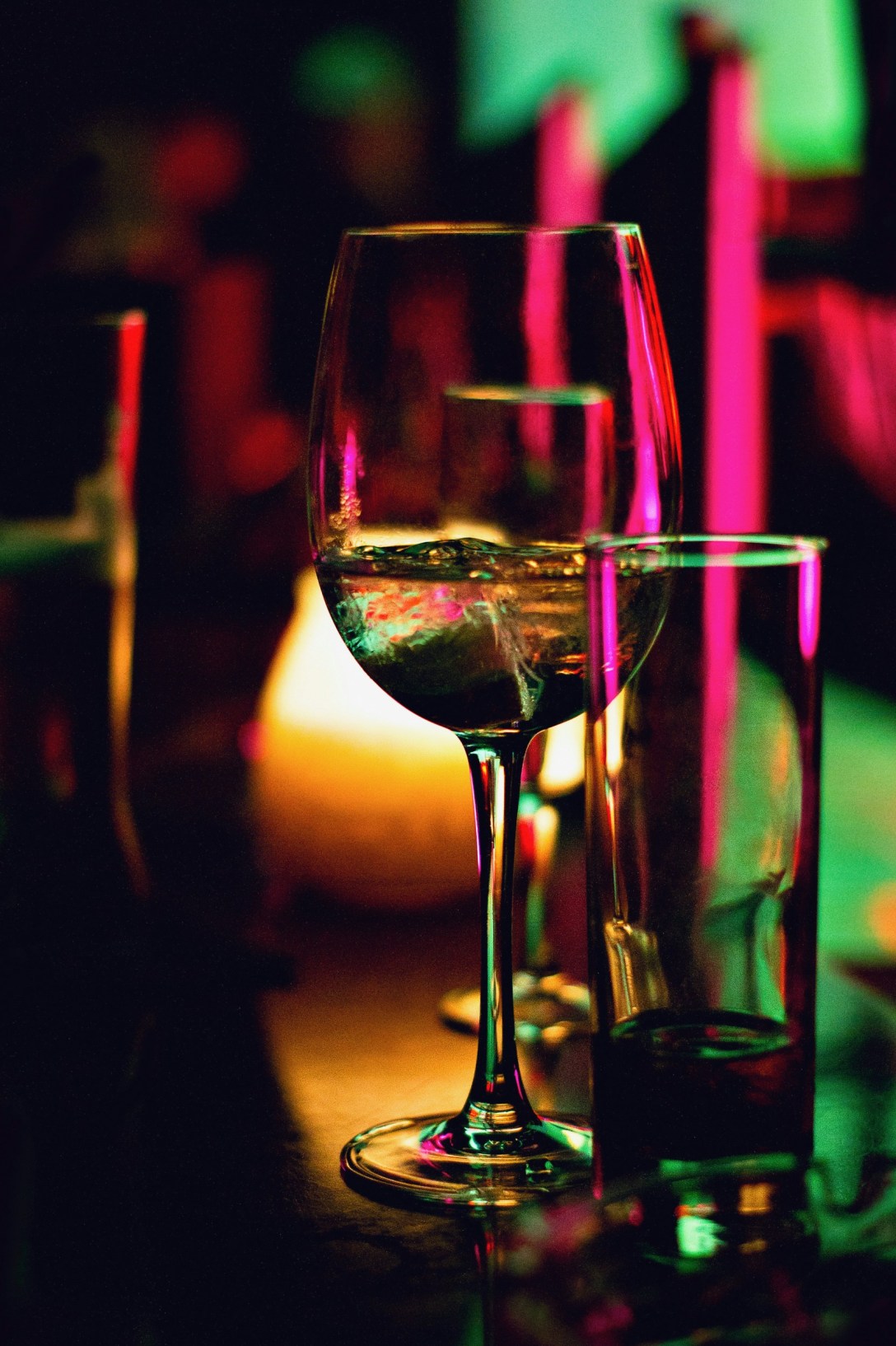
ID: wine glass in a colorful bar.
 Psaltery & Lyre