
Interviewed by Donna Spruijt-Metz
Dear readers—I would like to preface this interview with Philip Metres by thanking him for the incredible depth of engagement that he showed me in making this interview, which took us months. It was truly an honor to work with him. I want to say that here, thank him up front for his generosity and brilliance, because after his last answer, there needs to be silence. And so, we begin—
DSM: First, I want to congratulate you on Fugitive/Refuge (Copper Canyon Press, 2024), your labyrinthian new book, a book-length ode to your great grandfather, Iskandar. There are themes that return or are borrowed from other poets and themes that return from your larger body of work. For instance, the poem “At the Arab American Wedding” echoes back to “A Toast (for Nawal Nasrallah)” (from Sand Opera). A good portion of the first section of the book is given to the Arabic translation of “The Ballad of Iskandar” from To See the Earth, which I believe was your first full length book.
There are things hidden inside of things, as if boxes need to be unpacked, and then there is your (nearly demonic) use of footnotes and references to keep the reader unpacking and unpacking and going back and forth between various sources. Some poems are “Arabic simultaneities,” and are read right to left, or in both directions simultaneously.
The book is in Qasida form, a three-section form which you explained in an earlier interview in this way: “After considering the predicament of memory (‘Of Fate and Longing’) and loss (‘Of Exile’), the third section of the book concerns how we come home and wondering what we’re returning to.” And there are two Qasidas inside the Qasida! Given all these marvelous magic boxes, while the Qasida might suggest something circular or returning, I began to experience the book as more of a spiral—a book spiraling out. It reminded me of visual poetry, for instance some of Monica Ong’s work or Karen Hamner’s. I expected it to jump off the page, to become like a spider web—starting at the central point and expanding in all directions, or unfolding from the center, folding out in all directions.
If the page was not a physical constraint, could you imagine various forms this book might take and how that would change the reading of it?
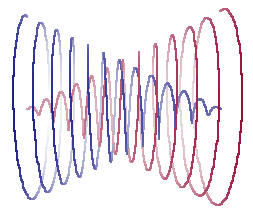
PM: What a wonderful question and reading of Fugitive/Refuge–as a spiral rather than a linear progression. Perhaps it’s both, as in Yeats’s notion of the gyre–that in every collapse is the beginning of something else. The book is architecturally modeled on two sources: the Arabic qasida and Dante’s Commedia. The qasida’s form is one of departure and return (a circle), and Dante’s tripartite journey–which is both a linear progression from hell to heaven and a kind of circle (he must have returned to tell us this vision). What is time, anyway? We experience it in both dimensions–both as a march toward death and as a seemingly-endless set of recursions (memory, the pasts) and projections (fantasy, the futures).
Every time I am in the final stages of completing a book, I find myself wanting to make the book its own singular poem, its wholeness greater than the parts. I want to be surprised by this unfolding new thing, and for me that happened when I broke apart and threaded through the book our family story of exile from Lebanon and Mexico. That’s when, suddenly, the braid of the book manifested both personal and global dimensions.
For my last book, Shrapnel Maps, I’ve been working on a theatrical adaptation that employs some of the poems as “songs” in a dramatic semi-autobiographical story that recounts being asked to speak at a rally for Palestinian rights. Staging it, bringing it into new dimensions of space and time, has been a way to continue the work. That piece, too, goes backward and forwards as I explore the past and the future. Who knows what will come of this book? Or of the next one? Our obsessions have a way of returning, of returning us to ourselves, to the self that is bigger than ourselves.
DSM: I would be quite interested in a stage production based on Shrapnel Maps, which allows you to leave the constraint of the page, go backwards and forwards in time at will–the freedom that a proscenium and the suspended disbelief of theater provides. Indeed, what is time, anyway? One of my teachers says: “Everything in the Torah is happening all at once.”
Thank you for introducing me to the gyre! It’s a wonderful concept! Graphic representations of Yeats’ gyres remind me of the models that we behavioral scientists are trying to build to describe the dynamic nature of human behavior, ever perturbed by time and nature and environment. In our models, time is indeed recursive and loopy.
I love that the thread of your family’s stories of exile and refuge was one of the last things to come into the book, how you “broke it open” with history and longing. As if things finally “fell into place”—and I have a question for you about “place.” Can you amplify on the process of realizing that your family story needed to be woven into the book—what prompted that, how did that feel? I imagine two things—the breaking apart and the coming together—a sort of violence and repair. Tell us a story, if you would, about that process for you. And perhaps, how it fits into your obsessions.
PM: I love that Torah quote, as it seems to have a sense of the multiversal–and if I understand correctly, the Jewish approach to the Torah has a similar cyclical element, reading it all the way through and beginning again in the new year?
I actually don’t recall the process of how the book came together, except that I knew that the story of my family needed to be there, but I just didn’t know where. In earlier iterations, I had the family poems in the middle or in the beginning, but neither satisfied my sense of where they belonged. It was only when I broke them up into smaller groupings, and then threaded them through the manuscript, that it began to feel right. After all, the past is not past–it is often “everything, everywhere, all at once,” as the movie title expresses it. This weekend I was at a celebration of life for Nahida Halaby Gordon, whose story is told in the poetic sequence “Returning to Jaffa,” and her daughter Jean told the story about a time when she was very young and had questions about the nature of time. Jean just didn’t believe that time was linear, so she wondered about other shapes that time took. Maybe, her mother Nahida said, maybe time is like a helix, or a Mobius Strip, curving back upon itself.
Nahida had lived through the Nakba–or lived her whole life through the Nakba–so this idea that time is recursive seems very appropriate. She clearly was dealing with trauma, since every time I had her come to my class to tell her story of becoming a refugee, it took her a while to talk her own story; she’d be talking for a long time about the history, sharing statistics of land ownership, population, and legal decisions by the British Mandate, etc. Then, at last, she’d talk about her own house, the smell of oranges in the air during the growing season in Jaffa… until leaving it forever in April 1948. Though she got chances to visit it again, it wasn’t hers legally anymore, so it was a return that was foiled, a kind of asymptotic journey of almost-return.
In some small way, the recursive, gyring structure of Fugitive/Refuge tries to replicate that sense of memory, of returnings-in-the-mind.
DSM: That’s beautiful, Philip, the “asymptotic journey of almost-return,” and poignantly illustrated by Nahida, first needing to talk “around” the core of her trauma, working her way towards it, before she can give it voice. A friend was telling me about Beth Nguyen’s book, Owner of a Lonely Heart: A Memoir of Motherhood and Absence, where she uses Vinh Nguyen’s concept of “refugeetude,” defining it as an identity that “is not temporally constrained to singular events (displacement, asylum seeking, resettlement), spatially tied to specific locations (the boat, the border, the camp), or bound to the letter of the law. Instead, it is psychic, affective, and embodied.” Your book demonstrates perfectly how “refugeetude” and displacement follow us, are lodged in the gyres of our DNA—and like the butterfly effect, perturb the systems of each generation—with unpredictable effects.
I feel like Fugitive/Refuge skillfully enacts these ‘recursive returnings-in-the-mind’ as it articulates that butterfly effect across the generations of your family. You have an impressive toolbox for negotiating that Mobius Strip of recursion. (I am also loving all the scientific and cultural metaphors for “time” that we are accumulating here!). One of the tools in your “recursion toolbox” is indeed the scattering of your family’s story across the breadth of the book. Another is your use of form. A third “tool” seems to me to be the weave of various scriptures throughout the book, always returning to something “holy.” The first section of the first poem “Qasida for the End of Time” and “Plague Psalm 40”, the echoes of psalms is strong, especially in these lines— ”Maestro, steady my starlings. // For you I hunger. Lift your baton / And stuff my mouth with singing.” There is more in that Qasida. There is “Plague Psalm 90”, replete with tents and alphabets. Or in these lines in “The Trees in My Chest”—
I am aching for you,
dear architect.
There is that wonderful quote from Saint Ephrem the Syrian (patron saint for Spiritual Directors and Spiritual Leaders) at the beginning of Section II., “of Exile.” There are many more, but I wanted to mention “Devotional”, the last poem in the book, which “riffs” on Muslim, Jewish, Kabbalistic, Quaker, Catholic and pagan traditions. Could you speak to how the rich tapestry you have woven from various religious and mystical traditions serves the “recursive returnings-in-the-mind” in the book, or anything else you want to say about this.
PM: I didn’t know that Ephrem was that beloved! (What have you read?! What should I read?)
I was recording for the Sleerickets podcast yesterday, and Matthew Buckley Smith said that from reading my work, I could be Jewish, Christian, or Muslim. I take that as a compliment. I run from exclusivism, particularly in religious circles. As I mentioned in conversation with Jessica Jacobs, I grew up in a Catholic household, but I got to attend religious services across the spectrum of faiths because my dad was a psychotherapist who worked with local religious leaders (mostly in the range of Christianities). Knowing that there was little difference, say, between Lutheran, Presbyterian, and Catholic churches opened my eyes to the dangers of sectarian and parochial thinking. Visiting synagogues and mosques later amplified that sense–and also the great dangers in making assumptions of essential difference between us. How many people, whatever their faith, have entered into those spaces with the same hunger for something, that something, that could be sated through ritual and community.
I have found myself, more and more, in conversation with those ancient traditions and their language–as Augustine says to God–
Late have I loved you, beauty so old and so new: late have I loved you. And see, you were
within and I was in the external world and sought you there, and in my unlovely state I
plunged into those lovely created things which you made. You were with me, and I was
not with you. The lovely things kept me far from you, though if they did not have their
existence in you, they had no existence at all. You called and cried out loud and shattered
my deafness. You were radiant and resplendent, you put to flight my blindness. You were
fragrant, and I drew in my breath and now pant after you. I tasted you, and I feel but
hunger and thirst for you. You touched me, and I am set on fire to attain the peace which
is yours.
Such longing, for that spirit that is both old and new, that is both beyond time and place and yet also somehow with us.
I didn’t thread together these faiths entirely consciously, at least at first–but instinctively, like gathering blueberries, myopically focusing on a single bush, and then another, and another, but then looking up and seeing the whole field of bushes, with little blue globes everywhere.
I take solace in the fact that I can say prayers my ancestors spoke, in languages they spoke, going back hundreds or maybe thousands of years. To say the words as they would have said them brings me closer to them and, I hope, to whatever spirit that knits us to ourselves, to each other, and to this earth.
If I could write just one poem, or even a single line, that my descendants (in flesh or in spirit) would want to say, then it would be worth it.
DSM: What an answer, Philip! And what a fine aspiration! I could speak with you forever, but I am afraid we are down to our last question, and in many ways it follows that aspiration. For our descendants (in flesh or in spirit) to feel inspired to “say” our words, our words must form a portal or a bridge of some kind for them—to the past, of course, but also to the future, and perhaps to something holy or sacred, don’t you think? So for our last question, I would love to discuss the concept of bridges in your work. I see you as someone who builds bridges wherever you can, as a true boundary crosser, and to me, this is reflected in Fugitive/Refuge, which is, after all, centered on a story of border crossings. I won’t do a complete cross referencing but here are some examples. In “Border Lines (Laredo Crossing, 1923)”, there is a picture of a bridge and these words in the poem:
this is where we need to find the bridge
follow it to its end of another beginning
I love that you quote Rabbi Nachman of Bratslav: “The whole world is a narrow bridge—the essential thing is not to be paralyzed by fear.” And in the footnotes to “The Ballad of Skandar II,” you have this wonderful thing that I have been obsessed with since the first time I read it: “Once upon a time in Arabic fairy tales translates as There was and there was not. Maybe it happened. Maybe it did not.” This provides a bridge, if you wish, across past, present and future, between what is and what is not—or what seems to be or not be—and into the liminal spaces of the multiverse.
Could you perhaps speak about these bridges and borders and boundaries that play so many roles throughout the book? And of course, use this last space to add anything you would like to add. I am sure I missed so much.
PM: What a question!
I’m reminded again of the Buddhist monk Thich Nhat Hanh’s notion of “interbeing” –that we are not just ourselves alone, but in relationship to the beings and Being around us. So much loneliness may be part of our ideological inculcation (capitalist, colonialist, patriarchal, etc.) to divide us from ourselves in the widest sense–from our interconnectedness.
He writes, “If you are a poet, you will see clearly that there is a cloud floating in this sheet of paper. Without a cloud, there will be no rain; without rain, the trees cannot grow; and without trees, we cannot make paper… As thin as this sheet of paper is, it contains everything in the universe in it.”
As part of the research of Fugitive/Refuge, I read and watched and explored representations of human migration. I kept seeing myself and my ancestors in them. Part of being human is movement, but forced movement is the unhappy product of environmental and political pressures. And states and their borders make that difficult. They insert themselves as swords in the interbeing.
Borders are, by their nature, sites of political division. My grandfather would always spit to the side when Texas was mentioned. Something must have happened when they passed across to the border town of Laredo, but he wouldn’t speak of it.
Obviously boundaries are natural and necessary–both personally and socially, as well as geographically. Frost’s “Mending Wall” attempts to render the complexities there–the questioning of the need for boundaries, and the need for them. Gloria Anzaldua has written compellingly in Borderland/La Frontera of the borderlands as a site of great possibility.
Movement, migration–it’s built into the qasida form–the journey, which is a sort of exile from the tribe, and the long way back. I hope my book offers people a bridge toward understanding themselves as others, and the other as themselves. A way station for thinking about their own journeys. A sanctuary, as we wind our long way toward our end, our deaths–which may not be an end after all, but perhaps another chapter in our interbeing.
::
Donna Spruijt-Metz’s debut poetry collection is General Release from the Beginning of the World (2023, Free Verse Editions, Palette Press). She is an emeritus psychology professor, MacDowell fellow, rabbinical school drop-out, and former classical flutist. She was featured as one of ‘5 over 50 debut authors’ in Poets & Writers Magazine (11/23). Her chapbooks include Slippery Surfaces, And Haunt the World (with Flower Conroy) and Dear Ghost (winner, 2023 Harbor Review Editor’s prize). Her poems appear or are forthcoming in The Academy of American Poets, Tahoma Literary Review, Alaska Quarterly Review, and elsewhere.
Philip Metres is the author of twelve books, including Fugitive/Refuge (Copper Canyon 2024), Shrapnel Maps (Copper Canyon, 2020), The Sound of Listening: Poetry as Refuge and Resistance (University of Michigan, 2018), Sand Opera (Alice James, 2015), and I Burned at the Feast: Selected Poems of Arseny Tarkovsky (Cleveland State, 2015). His work—poetry, translation, essays, fiction, criticism, and scholarship—has garnered fellowships from the Guggenheim Foundation, the Lannan Foundation, the National Endowment for the Arts, the Ohio Arts Council, the Watson Foundation. He is the recipient of the Adrienne Rich Award, three Arab American Book Awards, the Lyric Poetry Prize, and the Cleveland Arts Prize. Metres has been called “one of the essential poets of our time,” whose work is “beautiful, powerful, magnetically original.” He is professor of English and director of the Peace, Justice, and Human Rights program at John Carroll University. He lives with his family in Cleveland, Ohio. Follow him on Twitter and Instagram @PhilipMetres.
ID: Cover of Fugitive/Refuge by Philip Metres.
 Psaltery & Lyre