by Susan Marie Swanson
A verse from Psalm 51 is pinned over my work table, my handwriting talking to God:
You desire truth in the inward being,
therefore teach me wisdom in my secret heart.
Also pinned there are notes of encouragement from Barb, who died young, and Juliet, who lived past 100. Kevin drew a row of seashells on a card. There is a snapshot of Ellen and me sitting at the kitchen table after supper on a hot summer night about 20 years ago, our faces shiny with laughter and sweat. There are empty coffee cups and ice cream dishes on the table, and for some reason we have gotten the Swedish-English dictionary from the bookshelf.
There are trinkets pinned to the cork board too, a tiny clay robin, plastic charms of characters from the Moomin books, bought when the neighborhood toy store was closing down, and an elegant velvet heart ornament Carolyn brought back from London. A key that used to matter a great deal to someone. Who? But most of the things on the board are paper, like the Swedish 20-crown note, with its engraving of children’s author Astrid Lindgren, and the get well card my oldest granddaughter made when I fell running for a train. Enough years have gone by that the message she wrote in water-based marker has faded: “HEAL UP GRANDMA.”
There was a stopped clock here on my work table. It was stopped at 12:52, but now I’ve reset it and wound it up, so the clock is keeping the time for us right now. I know only a little bit about this clock. It belonged to one of my great-grandmothers, who immigrated from Sweden with her parents and siblings when she was a young woman, in a time of poor harvests and widespread hunger and hardship. Her name was Sophia. When one of my friends was studying to became a theologian, she wrote a thesis on the personification of wisdom in the Bible—Sophia—and on inclusive language in the church.
It is a small table clock with a square face, about four-by-four inches, and a brass case with lovely enameled roses on the sides. Mechanical and heavy for its size, this is an Angelus clock, from a watchmaking city in Switzerland nestled in the mountains on the French border. We can be sure that if we broke it open we would find exquisitely intricate gears.
I am guessing that the clock belonged to Sophia late in her life—she lived from 1845 to 1935. Perhaps it was a gift from her adult children. With a little bit of clicking around online, I am looking at a photo of the old stone baptismal font where she was baptized in Åsbo church, near Boxholm, Sweden. The font—it is not beautiful—dates from the 13th Century. Though my great-grandmother lived most of her long life in the United States, she read the Bible only in Swedish. The verse from Psalm 51 on my bulletin board would have been for Sophia this:
Se, du har behag till sanning i hjärtegrunden;
så lär mig då vishet i mitt innersta.
When I walk into a city church here in St. Paul, Minnesota, on Sunday, there will be candle chandeliers overhead that look much like the ones in the Åsbo church out in the countryside four-thousand-some miles away. We’ll sing something from the book of Psalms. When I get home, I’ll copy the Swedish translation of the verse out by hand and pin it up over the table where I do my work.
::
Susan Marie Swanson lives in St. Paul, Minnesota. Her poetry has appeared in Psaltery & Lyre, Water~Stone Review, The American Poetry Review, Great River Review, and other publications, and her awards include fellowships from the McKnight and Bush Foundations. Her books for children include The First Thing My Mama Told Me, a Charlotte Zolotow Award honor book, and The House in the Night, winner of the Minnesota Book Award and the Caldecott Medal.
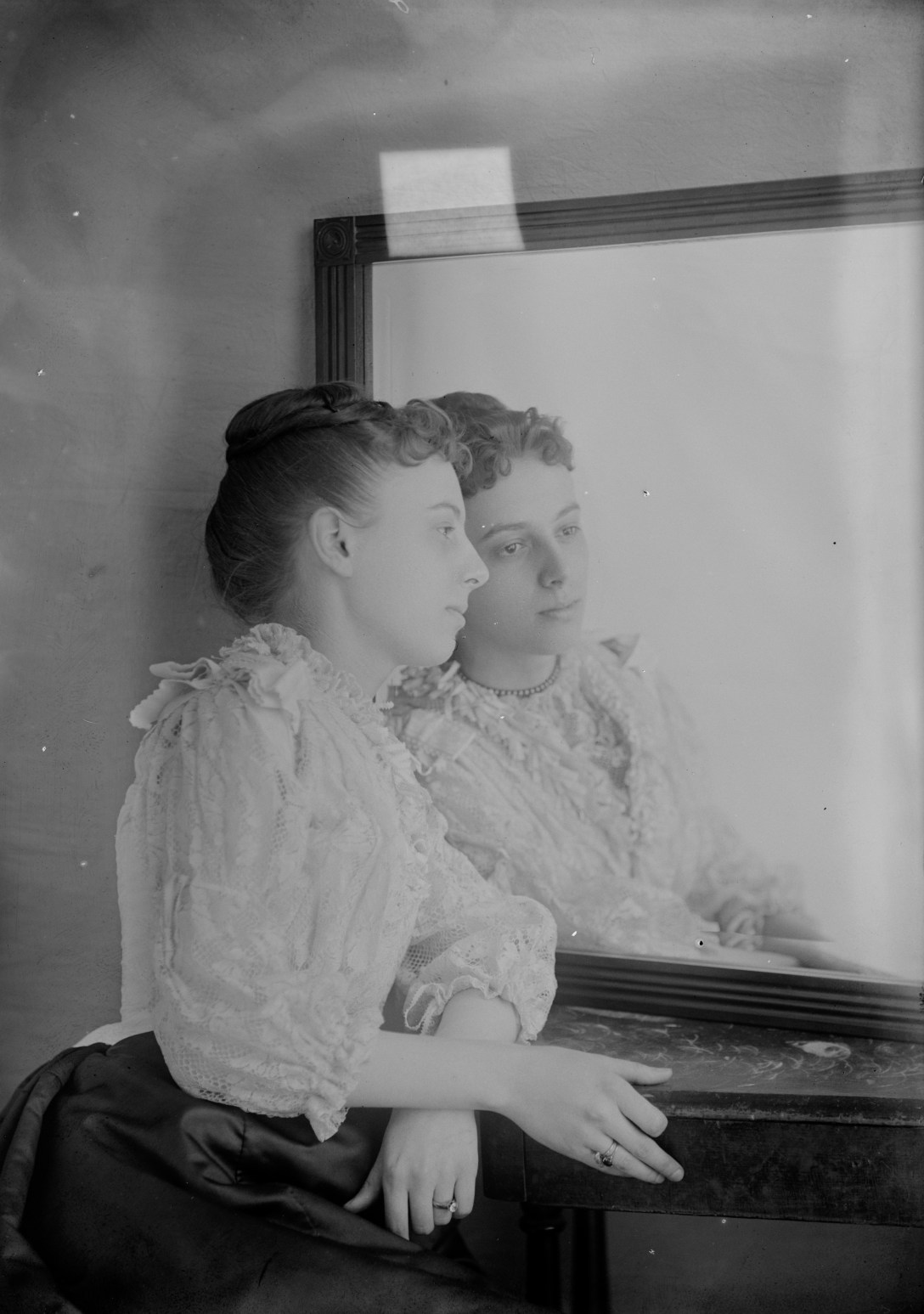
Image: Boston Public Library, “Nettie, mirror. Date: 1890–1929.”
ID: Young woman in white looking in a mirror.
 Psaltery & Lyre