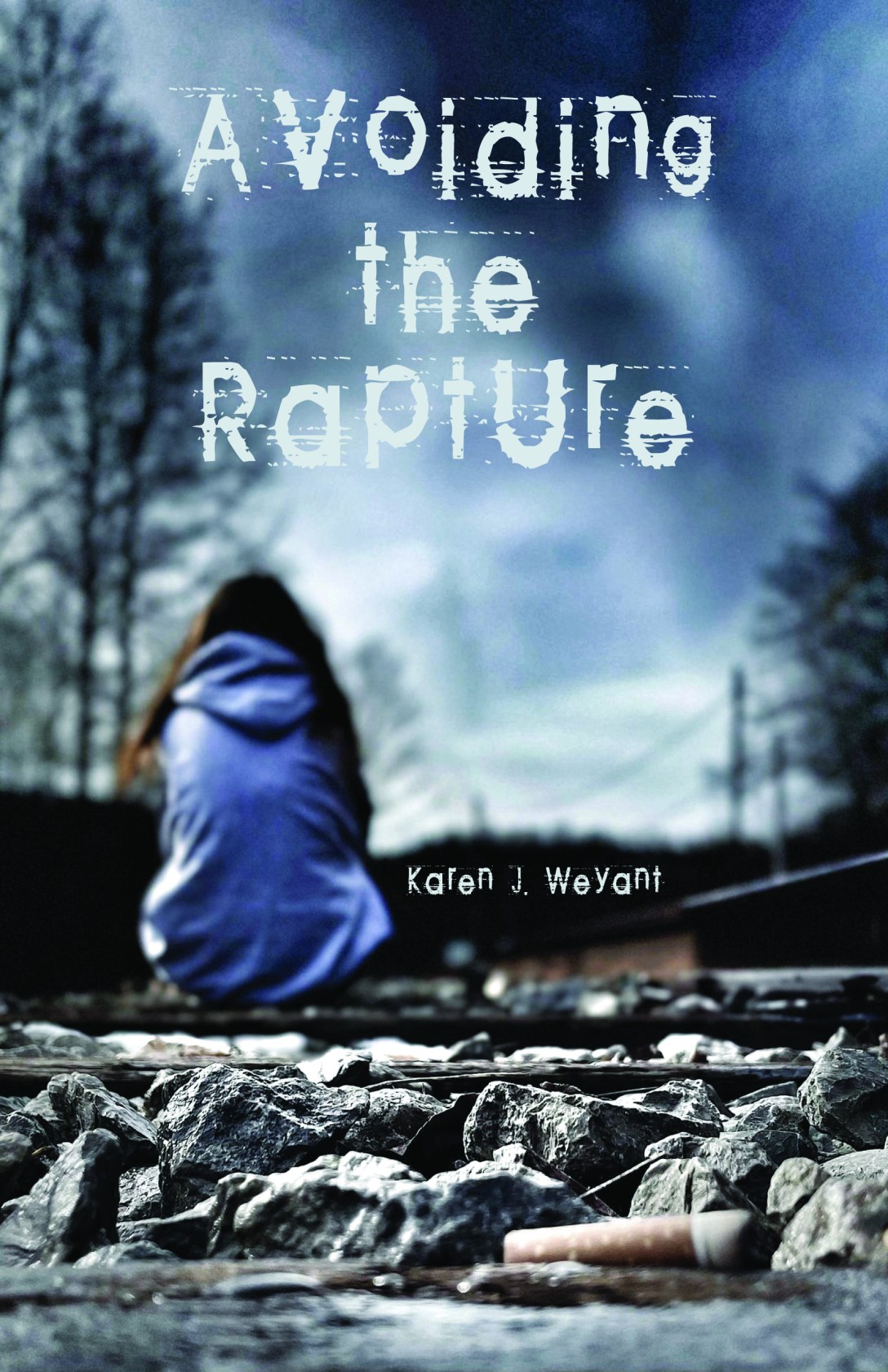
Avoiding the Rapture, by Karen J. Weyant
Riot in Your Throat Press, 2023
Review by Robert Fillman
::
The world looks different depending on where you see it from. This is a foundational principle of place-based writing. However, the poetics of place go beyond mere description. It’s about capturing a place’s essence and emotional significance, turning those intangible phenomena into something palpable and real, which is what Karen J. Weyant does so well. The characteristics of Weyant’s debut full-length collection Avoiding the Rapture, and her poems more generally, call to mind such words as “gritty” and “toughened” and “beleaguered”–words that imply the kind of hardscrabble existence often associated with Northern Appalachia, the western region of Pennsylvania about which the poet writes. But Weyant’s poetry also evokes a kind of calculated recklessness and resigned optimism, essential qualities for a girl living in a remote, middle-of-nowhere town, a setting in which coming of age means growing up too soon.
In Avoiding the Rapture, Weyant depicts an economic apocalypse that is ongoing. In its wake, we confront a post-industrial landscape suspended between past and future catastrophes. If the Rapture has come, it has taken with it glory and comfort and peace, leaving behind only survivors engaged in a relentless effort to manage their fractured identities—to make sense of the cracked lips, discarded beer cans, old fishing hooks, and cigarette butts that comprise their world.
The protagonist navigates Rust Belt existence, finding ways of knowing, as she savors the extraordinary meaning in everyday things. A flavored chapstick, for example, is more than a mere protectant for the body. It holds deep emotional value, signifying a belief in youth that “there are salves / for all the raw wounds the women / around them are forced to wear.” Similarly, in “Secondhand Harmonica,” testing a rusty instrument at a yard sale triggers not only echoes of rock music but an initiation into the tastes of teenage rebellion, the poet’s future intertwined with the previous owner’s “spit.” Again and again, for Weyant the corporeal becomes transcendent.
One gets the impression that the girls and women in Avoiding the Rapture feel compelled to flee with a hoard of memories bundled in their arms. But despite an urge to escape, they remain rooted. Raised by dutiful parents who taught them the importance of not squandering anything, they treasure what they have and find value even in the smallest experiences. As a result, they stick around, lingering on trestles and train tracks, alongside roadsides and strip malls, within church pews and truck beds. Even when an older sister returns home after a divorce, she offers no grand wisdom from the other side. Instead, she critiques the poet’s mismatched outfit. Again, we see the gravitational pull of familiar surroundings:
You know, she said,
smashing her cigarette stub into
an ashtray made in a junior high shop class,
There is no way those pants go with that shirt.
Here, in a poem aptly called “The Spring of Hand Me Downs,” we witness learned behaviors resurfacing amidst the remnants of a shared past, which is both relatable and touchingly sad.
One need not wonder why Weyant chose to give this collection its biblical title. Mysterious figures reminiscent of Melville’s Elijah emerge, and they usually hint at an unsettling truth: there’s no savior coming, despite the insistence of a “senile” Sunday School teacher, who claims to have seen “Jesus in the dryer steam” at the local laundromat (“First Lessons in Laundry”). Throughout, we confront similar battles of faith where prayers provide little solace. In “The Faith Healer on Hickory Street,” for example, a neighbor struggles to revive a “stunned” robin, which we understand to be dead. Old Testament plagues abound. Mayflies, beetles, and yellowjackets swarm like locusts, and chicken pox scabs turn to furrowed scars, serving as lasting reminders that life in rural Pennsylvania is more often about resilience rather than hope for salvation.
Amidst these reflections, the poet finds correspondence in nature. It might be a gnat that “stopped struggling / in the spiderweb above me” (“Touching the Two-Headed Calf”). Or it is a flower that blooms along a stretch of freeway: “With every blistered scab, you became the red bloom / of Queen Anne’s lace” (“To the Girl Who Wanted to be a Roadside Weed”). Sometimes, it’s an encounter with roadkill: “Even the opossum we found nestled near / a speed limit sign taught us lessons / we weren’t sure we wanted to learn” (“Roadside Dead”). All these perceptions serve as a poignant reminder: there is beauty in survival, and that beauty is amplified by the adversity that shapes it. In “Why the Rain Gutters Rattled,” the portrayal of a chipmunk’s frenzied descent down a plastic drainpipe captures the poet’s yearning for freedom. The rodent “skittering, clattering all the way to the bottom,” and “turning and twisting itself into a tight somersault, / neck curved forward, head pushed into its chest” reflects the poet’s desire:
I wanted something
to break free, the same way I longed to pull my hair
from its braid, or strip away my t-shirt and jeans,
hemlines and seams that cinched my body tight.
At the heart of Weyant’s poems are people boldly inhabiting a harrowed world. For armor, girls and women are clad in cut off jean shorts and lip gloss. Resourceful, they use beer to wash their hair. They are never afraid to mix it up with the boys, as in “How We Learned to Wear Heels.” Here, we see the extent these “Rust Belt Cassandras” will go to feel attractive—or prepared for whatever may be around the corner.
We teetered through
our teens, wore heels on first dates, waded through the mud
of Friday night derbies, sawdust kicked up from carnival grounds.
At our high school proms, we dyed our satin shoes to match
our dresses: teal, tangerine, fuchsia—shades perfect until we stepped
in puddles and watched splotches stain our feet, and the bright
colors swirl away in gutters, water gulping without making a sound.
Time and again, Weyant immerses us in the minds of characters who, driven by their pursuit of affection as much as their determination to survive, leverage the tools available to them.
If I were to introduce someone to the state of Pennsylvania, Weyant’s Avoiding the Rapture would top my reading list, not solely because I have admired her work for some time, but because of the jagged truthfulness in her storytelling. It is no secret that the Keystone State, whose economic engine was once propelled by thriving coal and steel industries, could be described as a patchwork of brownfields and ghost towns. Weyant captures this shift toward stagnation in her writing, exploring the impact of industry decline and resultant urban decay that has touched the lives of virtually all Pennsylvanians, directly or indirectly. Still, PA inhabitants persist, and they do so proudly. In Avoiding the Rapture, Weyant channels the working class and paints an honest portrait of the blighted heart of the Rust Belt, gracefully weaving together its patinaed elements that both inspire and haunt. I will be returning to this collection over and over again, not merely speaking as a Pennsylvanian or fellow writer, but as a seeker of clarity, kinship, and hope.
::
Karen J. Weyant is an Associate Professor of English at Jamestown Community College in Jamestown, New York. Her poems have appeared in a number of journals including Chautauqua, Copper Nickel, Crab Orchard Review, Harpur Palate, Lake Effect, Rattle, River Styx, Spillway, Slipstream, and Whiskey Island. She is the author of two poetry chapbooks, Stealing Dust and Wearing Heels in the Rust Belt; Avoiding the Rapture is her first full-length collection. She lives in Warren, Pennsylvania, with her partner, Anthony Patalano, and four unruly felines.
Robert Fillman is the author of House Bird (Terrapin, 2022) and the chapbook November Weather Spell (Main Street Rag, 2019). His collection The Melting Point will be published in 2025 by Broadstone Books. Individual poems have appeared in Salamander, Spoon River Poetry Review, Tar River Poetry, Verse Daily, and elsewhere. He teaches at Kutztown University in eastern Pennsylvania.
ID: Cover of Avoiding the Rapture by Karen J. Weyant.
 Psaltery & Lyre