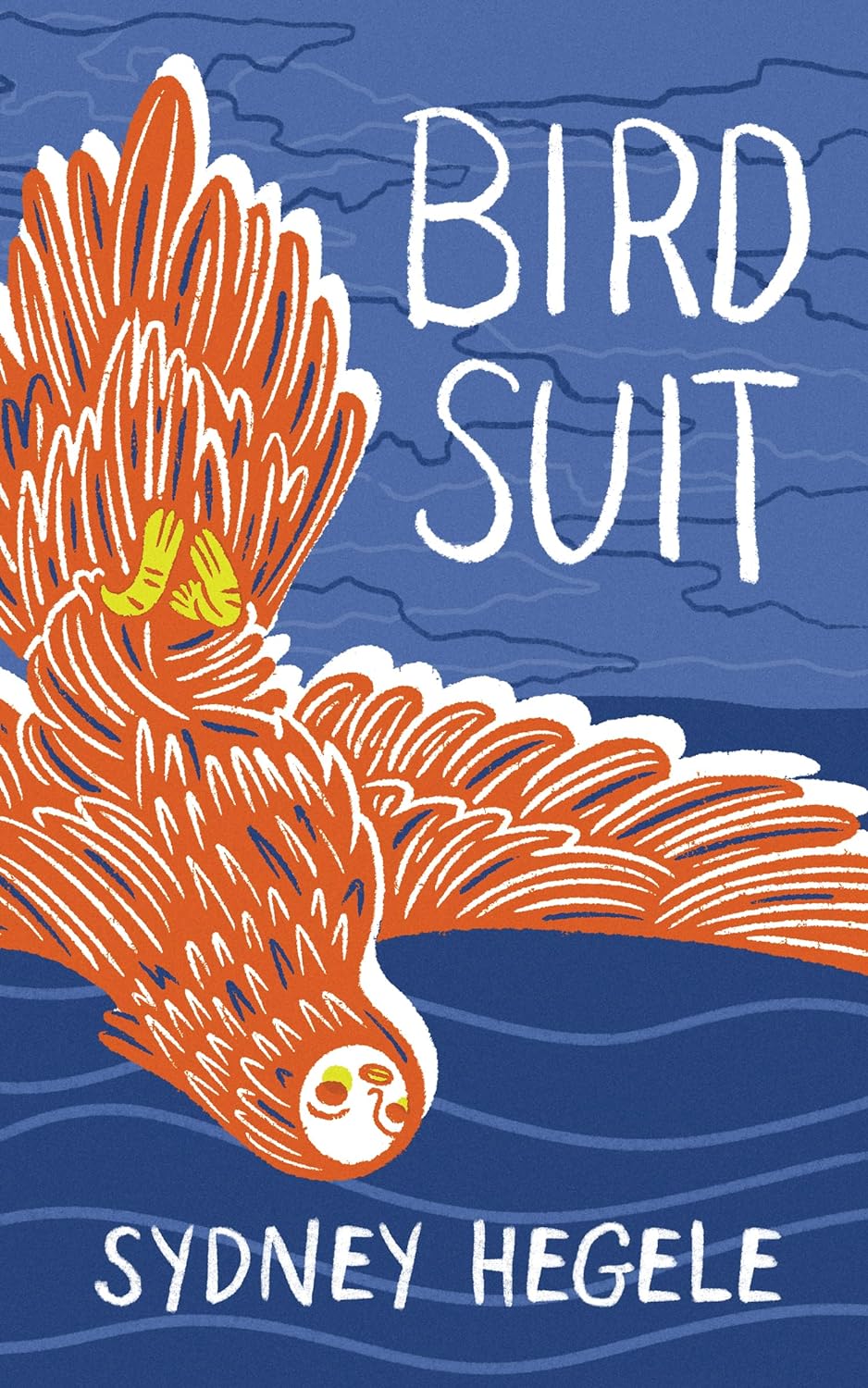
Bird Suit by Sydney Hegele
Reviewed by Izzy Astuto
Invisible Publishing, 2024
::
Sydney Hegele’s novel, Bird Suit, is a sumptuous folktale about dark desires and generational bonds. The tale haunts you long after you finish, lingering on the complex relationships between these characters and the broader mythology of their small town. Hegele’s careful pen is skilled in these topics, painting a gothic environment perfect for our actors to reckon with their most twisted wants. Their character building is particularly impressive, allowing readers to explore the layers within all of us.
Our main character is one Georgia Jackson, a born-broken 21-year-old with a fire inside her that only “a particular kind of boy-man” can tend. She’s stuck in the tourist town of Port Peter, home to famed Port Peter Peaches and the mysterious bird women, who eat unwanted babies left on the outer cliffs. Georgia’s world is small and lonely until her mother’s ex and local Anglican priest, Arlo Bloom, appears back in town with a doting wife, Felicity, and sullen son, Isaiah, in tow. Georgia finds herself falling under the spell of Arlo’s rough hands and Felicity’s curious gaze, entering into their sexy yet deeply toxic dynamic.
In the first handful of pages, readers can understand the mystical atmosphere Hegele has crafted—something akin to Ray Bradbury’s Something Wicked This Way Comes. The prose is dreamy but practical in the logic of this world. The bird women, for example, eat the babies any local girls don’t want, a well-known fact. “They go to the cliffside lookout off County Road Five, where there is a white plastic laundry basket with a pink fitted sheet inside. This is where the Port Peter girls leave their babies for the Birds.” Each of the characters gets their own monologued introduction, setting up just why they clash against each other so harshly. Through this lore, the town comes alive, orbiting around the drama the Blooms bring.
The most interesting Bloom for me was Isaiah, oblivious to his parents’ new conquest. He latches onto Georgia quickly, having little contact with others his age, and their codependency pushes the family to its breaking point. The two of them form the most intentionally genuine relationship shown, connecting about their past traumas. Early in their friendship, the two bond over their love for the theatre, which Georgia has had to shove down in order to stay in Port Peter for her mom. The moment is tender, and the two dream hazily of futures together that by the end, we know neither of them will get to see. However, the relationship is tainted, too, by Georgia’s shame over her sexual relationship with his parents. Further, Isaiah is terrified of his father and the birds he’s put in his head.
Bird Suit is chock-full of bird imagery, and one of the places we see birds the most is in Isaiah’s head. “Every time Isaiah’s father lays a hand on him, Isaiah gets another bird. Now there are many, many birds.” These birds aren’t exclusively from Arlo though, as Felicity’s ancestry seems to have something to do with their existence. Felicity, we learn, is descended from the bird women, hiding their supernatural influence just beneath her skin. The couple both carry dark impulses in their own way, an urge in their bones to lash out at those around them. These seem to be calmed, at least minutely, by the introduction of Georgia. While Arlo is the Bloom who manages the closest physical relationship with Georgia, particularly at the beginning, Felicity and Isaiah’s bodies begin to desire her before they even consciously recognize it.
The birds seem to represent many things for the Blooms. The bird women are outcasts from the rest of town, mistrusted and stigmatized. At the same time, though, there’s an understanding between the bird women and the human women of Port Peter. They may be scared of the Birds’ unpredictability, but they trust that when they need to get rid of a child, the Birds will be there. For one, the Birds seem to represent a sort of female solidarity against the abuse of the men in their lives. They serve as protectors—protecting the women of Port Peter from their mistakes, protecting Isaiah when they appear in his head and hide the memories of his father’s abuse. Isaiah’s connection to the Birds also inherently makes him more sympathetic to the women of the town, demonstrated in his fast bond with Georgia.
By the end of the book, Georgia is the only one with some semblance of a life of her own. She’s a successful playwright, even despite the suffocating guilt over the havoc she wrought on the Bloom family. It seems like she finally might get not just the forgiveness she so craves but also a true, loving relationship with Felicity, who she hasn’t been able to stop thinking of all these years. But instead, Felicity becomes “a woman who is no longer a woman at all, but a Bird.” The ending is abrupt but realistic regarding these women’s place in life. The story treats queer women with both love and honesty. It’s not a simple portrayal by any means, but one that allows for these characters and town to breathe truthfully.
This is probably my favorite moment of the whole book. From the beginning, Hegele hammers home that none of these characters feel like they truly belong in Port Peter, or maybe anywhere. Even once Georgia has settled, she only ever feels like it’s just that—settling. She can’t figure out why she feels this way, but Hegele seems to have an idea. While our central characters remain within the realms of the port, they’re all running away from facing their problems. They shove them down, deeper and deeper, until something has to give. The happiest ending for Felicity, then, is embracing the Birds and her identity. The happiest ending for Georgia, on the other hand, is beyond this story. Georgia still has to work through her deep-rooted traumas to reach her true happiness. This depiction is beautifully tragic, even more so because it reminds readers that no ending comes perfectly packaged, wrapped in a bow.
::
Sydney Hegele is the author of The Pump (Invisible Publishing 2021), winner of the 2022 ReLit Literary Award for Short Fiction and a finalist for the 2022 Trillium Book Award. Their essays have appeared in Catapult, Electric Literature, EVENT, and others. Their novel Bird Suit is forthcoming with Invisible Publishing in Spring 2024, and their essay collection Bad Kids is forthcoming with Invisible in Fall 2025.They live with their husband and French Bulldog on Treaty 13 Land (Toronto, Canada).
Izzy Astuto (he/they) is a writer currently majoring in Creative Writing at Emerson College. His work has previously been published by Hearth and Coffin and Renesme Literary, amongst others. Their Instagram is izzyastuto2.0 and Twitter is adivine_tragedy. More information about him can be found here.
ID: Cover of Bird Suit by Sydney Hegele.
 Psaltery & Lyre