by Jennifer Martelli
be afraid Mary
– Mary Szybist’s “Annunciation under Erasure”
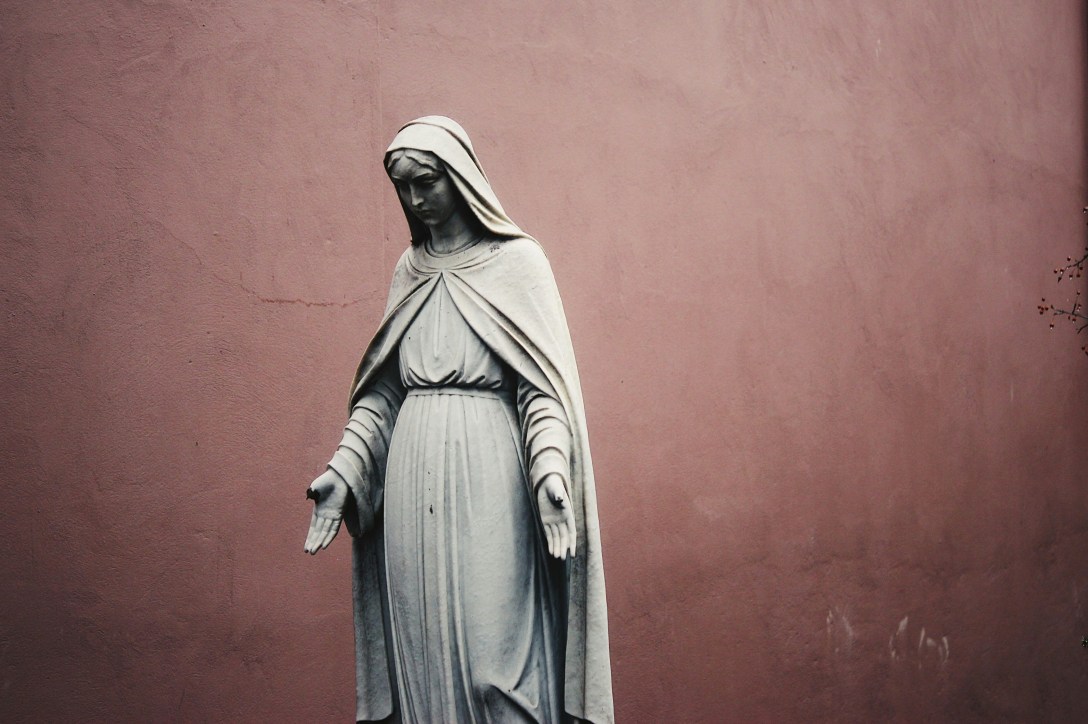
What do I really remember about the statue of the Virgin Mary who spoke? The people lined up at the fence around an old woman’s house? My whole first grade class at the school’s casement windows to see if She moved? Our teacher, speaking loudly, for us to sit down now? Years later, I walked Revere Beach with my mother and infant daughter. We ran into “Corky” from the neighborhood (who once pulled his penis out, waved it at me). He asked—for no reason—if I remembered the statue and how She spoke to us all.
::
Memory distorts time. At some point, I’ll have to add narrative to this story, but it seems so circular and endless. What was the time between when I first heard of the Virgin Mary statue that spoke and when I saw the people lined up at the fence of the house where She was planted? Between that, and Her face gouged off? Between that and Her suffocation under a trash bag? Her removal? People loved Her until she spoke too much. They left Her offerings: photos, roses, a hank of hair, a scapular.
::
Mr. Festa built my neighborhood on an old pig farm. He bought up acres of land, built ranches, called it “Colonial Acres.” My parents bought their first home in January, 1962, the month before I was born. My mother loved the pink kitchen with the dishwasher and disposal. A new elementary school was practically in our backyard: one-level, sleek, made with bricks the same orange color as our front steps. In just over a year, President Kennedy would be assassinated. When my mother planted tulips and jonquils out back by the kidney-shaped patio Grandpa poured, she’d dig up pig bones.
::
Kathy was the girl who knew things. Her mother had coffee percolating all day; my mother would cross our street to go visit, drink black coffee, smoke cigarettes. Years before the Virgin Mary statue spoke, I was sitting on the rough ocher brick front porch steps, waiting for my mother. Kathy crossed over and said that President Kennedy had been shot. I went inside to tell my mother, who said not to believe anything she says. I still don’t know if this really happened. Five years later, Kathy told me the Virgin Mary statue predicted the world’s end.
::
In 1968, the same year the statue of the Virgin Mary spoke to my neighborhood, Apollo 8 was the first human spaceflight to reach the moon. The crew photographed an Earthrise and orbited the moon ten times, the decade of a Rosary. Reaching the moon by the end of the decade was a goal President Kennedy never saw happen. Everybody I knew loved this young Catholic President, who, they say, was fascinated by innovation, the moon, youth. It is said that many of the women with whom he had affairs died, just as he did: questionably and awfully young.
::
In the first grade, I couldn’t wear slacks to school. No girl could. Shame, I had maroon and cerulean blue Danskin pants with stirrups. I had Blackwatch Tartan slacks and Royal Stewart to match my father’s (who sometimes didn’t want to look Italian). I had two kilt skirts as well, with fringe and real brass pins to hold them shut. I wore thick tights that sagged between my legs. When it snowed, we were allowed to wear pants under our dresses and skirts. We pulled them off in the cloak room, rolled them into bags until we went home.
::
The first appearance of the woman in the house with the Virgin Mary statue was the baseball story my sister and her friends told. Some boys were playing Run the Bases in front of her house, which was surrounded by a low chain-link fence. Someone didn’t catch the ball, or hit it wild: it shattered the front picture window. The woman (older? widowed?) rushed out (in her housecoat?). The boys apologized, (but didn’t say who broke the glass), promised to pay. After she went back inside (to get cardboard?), the Virgin Mary—whose arms were outstretched—pointed straight at the boys.
::
Back then, we girls in Colonial Acres thought with a single mind because we had to. The Monday after we had all received our First Holy Communion, and a year after the Virgin Mary had been covered with a big green trash bag and uprooted from Her lawn, we knew to wear our white dresses to school. We lined up outside the first and second grade wing of the A.C. Whelan Elementary. All of us (and no one knew anybody who wasn’t us): white-winged with puff sleeves, crowns of fake pearl and glass refracting light, the netting from our veils rising in the spring breeze.
::
Someone got scared of Her words and how unnatural it was for a statue to speak. Or maybe angry at how She was worshiped, then watched. “Someone took a hammer and broke her face off,” Johnny told me, walking home from school. He said they used the claw end. But maybe the pronoun was “he,” as in “he used the claw end.” And maybe I’m thinking of Michelangelo’s Pietà, struck 15 times by a man screaming, “I am Jesus Christ risen from the dead!” And maybe the hammer I picture is one of Grandpa’s hanging by nails in his workshop.
::
This story ends at the Beach. This story ends with men. One day, the statue was gone. All that was left was a circle of dead grass. One boy told me the Army came, strapped Her into a harness with a claw attached to a hovering helicopter. It lifted Her out of the ground, flew Her to the Beach (I still imagine this during daytime: Her floating in the blue sky), where She dangled low over the packed sand. On the ground, soldiers sprayed Her with machine gun fire until She was pulverized into talc, which blew over the ocean.
::
Jennifer Martelli is the author of The Queen of Queens, winner of the 2023 Italian American Studies Association Book Award and selected as a “Must Read” by the Massachusetts Center for the Book, and My Tarantella, also selected as a “Must Read” and named as a finalist for the Housatonic Book Award. She is the author of the chapbooks All Things are Born to Change Their Shapes, In the Year of Ferraro, and After Bird. Her work has appeared in The Academy of American Poets Poem-a-Day, Poetry, The Tahoma Literary Review, Scoundrel Time, Verse Daily, Iron Horse Review, and elsewhere. Jennifer Martelli has twice received grants from the Massachusetts Cultural Council for her poetry. She is co-poetry editor for MER.
Image: Jon Tyson
ID: Virgin Mary Statue with open hands before a pink wall.
 Psaltery & Lyre