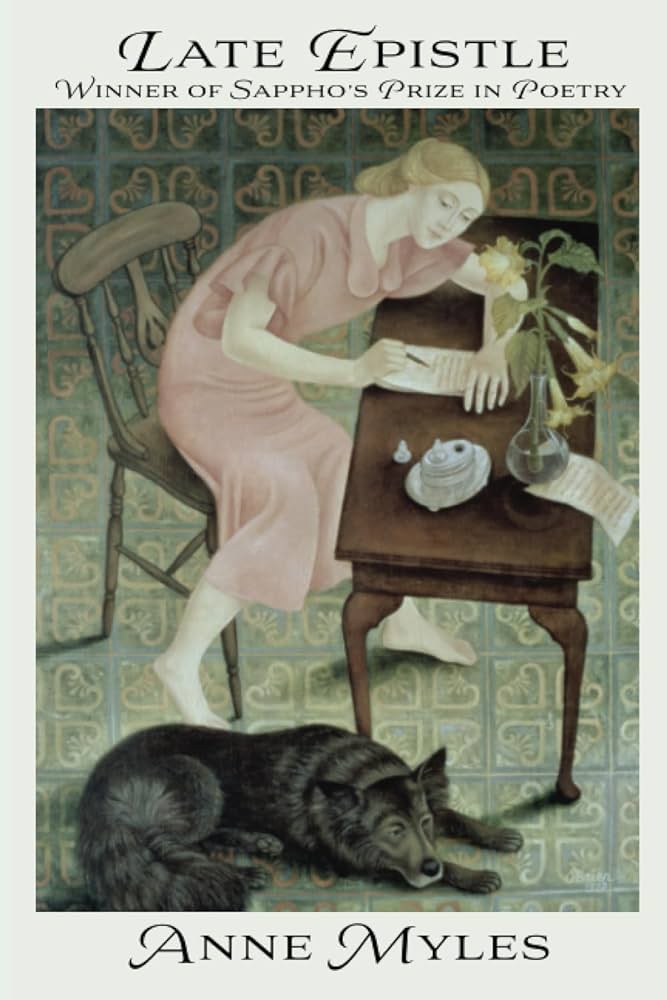
Late Epistle by Anne Myles
Headmistress Press, 2023
Review by Jennifer A Sutherland
::
Almost exactly in the middle of Anne Myles’ debut full collection of poetry, Late Epistle, is a poem titled “Luxe, Calme et Volupté.” It opens with a consideration of the Fauvist painting of the same title:
In Matisse’s painting, naked women relax along the shore.
Some sit and some recline; two fiddle with their hair;
one, clothed, guards a cloth spread with drinks and food.
A picnic by the water: is that the quintessential scene
we choose to represent embodied happiness on earth?
Beneath this first allusion lies another, as Matisse took his title from Baudelaire’s “L’invitation au Voyage,” a poem in which the speaker invites a lover to travel to an ideal world where all is harmony and beauty, “luxury, calm and pleasure.” Building on this chain of recontextualisation, Myles’ speaker layers upon the painting a scene from memory, late nineteen-eighties, Lake Michigan, a cookout with a group of friends from grad school. The endings of relationships loom, one real and unsatisfactory, another desired but impossible.
Of course we break up soon. Whatever – better to be stripped
when entering the underworld. Something was unfolding
it would take years to understand. But I’d keep on watching it,
life’s ordinary Arcadia: glimmering, near enough to touch,
to taste its sensual ease. . . .
In both the painting and Baudelaire’s poem, Arcadia is a place: a picnic by the water, a utopia far from prudish Paris. Myles’s poem situates Arcadia within an “ordinary” life considered from multiple vantage points, as an act, a stance, or a choice. Her speaker is active within the remembered scene, detached and watching as time passes, and looking back, surveying. Arcadia becomes a lens for understanding and making sense of what has happened, is happening and will happen. It is necessarily here, not there, and Myles’ speaker carries it through her youth, her time as a young adult figuring out how to love and be loved, and the days that must be lived afterwards. There are many lenses at work here, and they have been masterfully focused.
Other ekphrastic Arcadias appear in the collection. “Four Interiors,” a prose poem in numbered parts, converses with Rothko’s “Four Darks in Red.” Like the painting, it distills experiences, saturated with color, into ways of understanding or investigating. In one section, red-tinted light is filtered through the wall of the speaker’s mother’s belly. In another, the teenaged speaker imagines the shape of “the red lake that traveled” with her. “Painting the Flower” confronts O’Keeffe (and her subjects the speaker was relieved to learn were not what Stieglitz claimed they were), as she paints an amaryllis in a high school art class.
For years the amaryllis followed me,
hanging over the mantel or my tossed bed –
beginnerish, but the boldest thing I knew.
I can picture it above me as I lay there
dying back to the bulb for my long slumber,
wondering what kind of woman I was
and what my flourishing was meant to be.
The speaker’s relationship to O’Keefe’s flowers is not changed by or dependent on the static information or data presented by the paintings’ subjects. Instead, the relationship is both subjective and the speaker’s creation, an act of reaching toward and not merely perceiving, a collaboration or a claiming. Flowers, of course, are familiar things, and viewers of a painted flower layer their own personal understandings of the subject upon the painter’s chosen representation. This act of “stacking” subjective view upon subjective view is even more powerful when the artwork itself is abstract, as in the minimalist work of Agnes Martin.
The two women knew one another. O’Keefe, who was twenty-five years older, had been working for some time in New Mexico when Martin made her way there in the mid nineteen-forties. O’Keefe was a significant influence on Martin’s work, she was one of the few women working in the notoriously male art world, and though their personalities were very different they forged a friendship. (O’Keefe was talkative and energetic. The more reserved Martin sometimes found her exhausting. Years later Martin complained, affably, that O’Keefe forgot about her. The details are missing but the outline is there.) Both women produced work that, like Matisse’s, could be mistaken for simple in form, composition, and color. Their canvases demand collaborative eyes, and are offered as much as scaffolding for the work of memory as for passive appreciation. Myles turns to Martin in “My Abstract Sublime”:
Still there are the ruled lines the eye sees
even if they can be broken. What she got rid of
was everything. This is how I learned about loss,
about formlessness. Like the lake, like the sky,
like the nothing I saw with my back to the world.
But Martin did not get rid of everything. She allowed flaws in the canvas to remain visible. Her penciled lines show false starts. Color seeps from one gridlined-in box to another. These “mistakes” persisted partly because Martin was painting in Taos, and paint dried fast in the desert air. Environment always influences form. The visible flaws were also necessary to Martin’s work of ordering from disorder. Similarly, Myles’ speaker is working from real canvases and the flaws must be accommodated, absorbed, and used. In “Four Interiors,” she describes the time an adult casually referred to her, a child, with a slur reserved for Jewish people. In “An Old Photo of Bialystok,” the speaker contemplates a photo of a woman hurrying along an alleyway. The Nazis confined 50,000 Jewish people to the Bialystok ghetto in 1941 and eventually transported thousands of them, many of them children, to Treblinka. In Myles’ poem, the woman in the alley isn’t an ancestor but is a field upon which an idea of ancestry can be projected. This is not to say that the woman is reduced to transparency or irrelevance; it’s more that memory claims what is necessary to write its stories, to make them true from wherever it is the rememberer stands.
The poems in Late Epistle often begin or end in travel. In “Bark Eaters,” for example, the speaker races up the New York Thruway, “heart pounding, to tell a woman I loved women too.” In “Red Door,” she sits outside someone else’s home, idling in her car, imagining the domestic scene inside. She drives around the block thinking about the door handle but she doesn’t return to open it. The life in that house remains mysterious, unaccessed. In “Ferryville,” the speaker cruises along the Mississippi:
The river tropes itself, incision winding down
into the heartland. Held by locks and dams
it pools and widens. Metaphor, another ferry
I can’t stop boarding – as if it fixed things, as if
it could tell me where I am. [. . . .]
Horses make their way through several pieces that are muscled and alive. In “Sensing,” for example:
Her gait I knew. Her power as she moved.
I was together with something under the sun.
What lay ahead kept retreating in its distance,
in breath and birdsong. I did not comprehend
desire or its absence but I sensed I was chosen
for some difficult embrace. The light was hot
and searching. I wanted to keep going
and I wanted to wait. I could see this field
and the one after it. I didn’t know any other.
Horses are gorgeous creatures, but artists have many metaphors from which to choose. The choice a poet makes, especially when the choice is made again and again as with O’Keefe’s flowers and Martin’s fields, is its own kind of ekphrasis: a response to artistic possibility. The horse in art is often moving and always moving forward. Horses cannot see behind them. A rider can but perhaps prefers not to while the horse is moving fast. What is seen while moving forward must be reserved for later.
The titular poem is dedicated to a therapist from years before, whose “white hands [. . .] caressed / their prizes: husband, child.” The poem might be a letter to that woman, the speaker’s “altar,” “grail,” and “shrine,” or it might be addressed to the speaker herself, perceived again, more tenderly now perhaps, in retrospect, in the light of what has been lost and now better understood. The admonition to “Write it!” hovers just beneath these poems, particularly in “Arts and Crafts,” another standout piece in which the speaker recognizes: “Letting go attachment — / isn’t that the greatest art / we’re here to learn?” To write a letter to someone distant, someone with whom one has long been silent, is something like a spell or an act of memory intended to reclaim. A letter is correspondence and narrative at once, a way of shaping experience and delivering experience to the reader. A letter preserves, contextualizes, and memorializes, not only its subject, but its author. Given time between writing and reading, a letter is an ekphrasis, prompting a response to words one previously recorded. Every reading is collaborative. The memory rewrites itself and becomes new while containing what has gone before. When the letter is a poem or a collection of poems, it need never be “delivered.” It can remain suspended, always en route. For so long as the letter seeks its destination, the destination lives.
::
Anne Myles is the author of Late Epistle, winner of Sappho’s Prize in Poetry (Headmistress Press, 2023) and What Woman That Was: Poems for Mary Dyer (Final Thursday Press, 2022). She is Professor Emeritus of English at the University of Northern Iowa and lives in Greensboro, NC.
Jennifer A Sutherland is the author of Bullet Points: A Lyric (River River Books), a finalist for the Eric Hoffer Medal Provocateur and Foreword Indies Poetry Book of the Year. She lives in Baltimore.
ID: Cover of Late Epistle by Anne Myles.
 Psaltery & Lyre