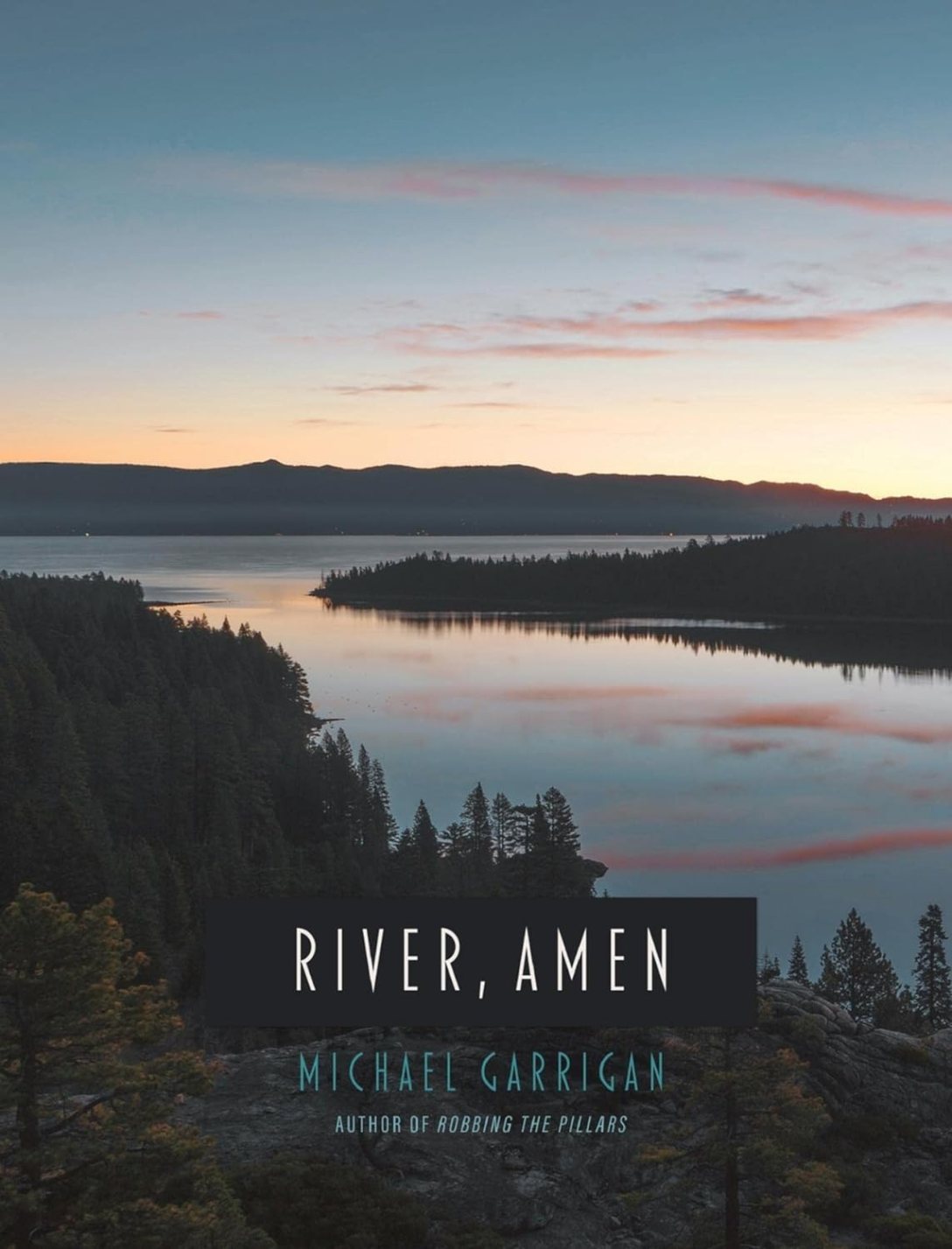
River, Amen by Michael Garrigan
Homebound Publications, 2023
Review by Matthew J. Andrews
::
A few months ago, I spent a late night catching up with a friend I hadn’t seen in a few years, trading stories by a crackling fire. He talked about his struggles with church in general, the disillusion and the sense of claustrophobia, and how he had taken instead to driving up into the Sierra Nevadas, to a secluded spot he had carved out for himself along the Tuolumne River and finding God in the soft sounds of forest and the whispering words of water.
I kept thinking of my friend as I read River, Amen, Michael Garrigan’s second full-length collection. These poems similarly turn away from the pageantry of church and instead look to the natural world as the true embodiment of the holy. This is not necessarily a rejection of organized religion so much as the idea that finding the divine requires any level of formality. In “Two Catholics Meet Over a Campfire” (what is it about campfires that so easily burn away our veneers and cause us to get right to the heart of the matter?), the two titular speakers discuss the doctrine of transubstantiation, the idea that bread literally becomes the body of Christ during communion, and one says, “You know, that’s a beautiful thing, isn’t it? / something that shouldn’t need a line or a robe.” In this collection, God is not cloaked in a vestment but freely available to anyone willing to take a walk outside. One can’t help but remember Jesus pointing out flowers, reminding his disciples that “not even Solomon in his splendor was dressed like one of these.”
References to traditional rituals abound in this collection, but they take the shapes of ordinary natural occurrences. A rushing river becomes a prayer, the motions of casting a fishing line bring to mind the signs of the cross and descending into the waters amounts to a baptism. In “Communion,” Garrigan recasts the bread as “wafers of jewelweed / and ragweed” and imagines the full transformation of all who partake: “…your eyebrows are crows, your eyes eagles, / your feet stay feet, but now leave / paw prints of five in the mud, river otters.”
God is found everywhere in these poems, but it is the river that takes center stage. One senses in this book that the river is of particular significance not simply because of its beauty or its function as a metaphor of pilgrimage but because of the ecosystem it sustains. The river gives life abundantly to all around it, making it Garrigan’s ideal metaphor for the divine. In “Oyster River Love Songs,” voice is given to a variety of plants and animals—from sycamores to knotweed, from the heron to the eel—but they all join together in the same chorus: “The river feeds us / This river names us / This river chants our mantras.”
Fishing occupies a prominent place in this collection, and Garrigan certainly mines the sport for spiritual metaphors. In “Fishing Penns Creek During a Pandemic,” for example, the speaker casts and then sits idle, “asking for a response, / waiting for the next metamorphosis.” But for all the patience and praying for a bite, fishing serves a grander function in these poems: it joins humanity into the same chorus sung by every other creature, into their shared dependence on the waters. Like the fish, the bugs, and the weeds along the shore, the fisherman is named and fed by the river. One thinks again of communion, ingesting a holy gift freely given.
While much of this book lingers in the sacred significance of wilderness, the poems certainly do not suffer from a sense of naivety. Like our churches, the rivers of the world can be polluted, corrupted, and coopted for other purposes, and as many of these poems are set in the same Pennsylvania that Garrigan calls home, the shadow of the coal industry looms large over this collection. The natural world, therefore, is not a Walden-esque escape, but its own spiritual path with obstacles to be overcome and faith to be challenged.
About these challenges, Garrigan does not mince words. In “Coal Country Paradise,” we are asked to imagine our current world through the eyes of some futuristic archeologist, who speculates that we lived “in the dark eating Styrofoam, breathing coal smoke and drinking / water from traffic cones, our bones bent to our faces as we fell / in love with the acidic elixir of silica benzene and mercury.” Elsewhere, Garrigan writes of industrial sins poisoning the very rituals of the river itself, as in “Rust Belt Ossuray”: “This fractured land holds me with its coal dust / clinging to everything—casting gray shades, / oily coffee sheen.”
While these poems cast a steely-eyed gaze at the temptation to despair, they are not overcome by it. In “Coal Country Paradise,” it’s easy to miss in the future man’s disdain for our primitive stupidity that there is indeed a future man at all, that despite the self-destructive tendencies of our modern society, humanity will indeed carry on and, presumably, improve. River, Amen is, like much of the catalog of faith-based writing, about a form of resurrection, the hope that we can rise above a fallen earth.
For me, the climax of this collection comes in “Post-Industrial Wilderness, Rejoice!,” a triumphant piece that invites the reader into this future moment of victory:
Let us praise this river that was killed and is burnt
orange but thriving with wild trout and midges fluttering
above oily sheen and its life, its resilience its wildness
returning and spreading and all its tarnished beauty!
Let us bulldoze dams and let water run wild again.
Let it grow, all of it, even the invasives.
Let knotweed arc over thistle and beer can.
For what is native in a place that has been
scraped and curled by furnace blasts?
The tone and images recall the end of Revelation, where Jesus returns to a battered and bruised earth to build a new city for people of all nations. It’s a beautiful picture of reunification between a broken planet and its inhabitants.
In “Creation Story,” the collection’s opening poem, Garrigan installs a sense of urgency to the reader’s spiritual quest, insisting that “Each river becomes a prayer” and advising that we “Listen before / all these water songs evaporate.” But by the closing poem, “Benediction,” after we have journeyed downstream through beauty, despair, and, ultimately, triumph, Garrigan comes back to the same image, albeit with a slightly different twist: “All our water songs evaporate.” The urgency remains but because of our lifespan and not the river’s. The river will flow long after we have gone, and while we’re alive, we must seek its waters.
::
Michael Garrigan writes and teaches along the Susquehanna River in Pennsylvania and believes that every watershed should have a Poet Laureate. He is the author of two poetry collections — River, Amen and Robbing the Pillars. He was the 2021 Artist in Residence for The Bob Marshall Wilderness Area. His writing has appeared in Orion Magazine, River Teeth Journal, and North American Review.
Matthew J. Andrews is a private investigator and writer. He is the author of the chapbook I Close My Eyes and I Almost Remember and the forthcoming full-length collection The Hours (Solum Press). He can be contacted at matthewjandrews.com.
ID: Cover of River, Amen by Michael Garrigan.
 Psaltery & Lyre