by Kristine Langley Mahler
I have collected many talismans as a Catholic. It has fallen out of practice for my demographic—early forties, college-educated liberal white American woman—to even declare oneself religious anymore, much less Catholic, but I don’t mind. My moon is in Aquarius, which means I am stubbornly independent and love nothing more than defying norms. I have an Aquarian moon, a Cancer sun, and I lector at Mass once a month, standing at the ambo with my nose ring on full display, reading aloud with a memoirist’s delight lines like “Give to your servant, therefore, an understanding heart to judge your people and to distinguish right from wrong.”
I have written before about how it is easy for me to recite the Apostles’ Creed and then come home, change into my workout clothes, and drive to my local park, walking in the mown prairie past a firing range while listening to my upcoming week’s astrological forecast. I wrote, “Didn’t God arrange the stars in the sky? Didn’t God give us the curiosity and knowledge to find the meanings He imbued in this world?”
I can be Catholic and mystic both. God bless free will.
A candle burns beside my computer screen, made from the leftovers of purple Advent candles from last year melted and mixed with the ends of intention candles I purchased from Next Millennium, one of my local metaphysical stores: Courage, Confidence, Abundance, Gratitude. All intentions I pray to Catholic saints to bestow upon me as well.
Beside the candle: a small hex jar of Sandhills sand, collected by a friend’s mother and gifted to me on the Cancer new moon. A palm-sized chunk of amethyst picked up at the Tucson Gem Show in the last month before COVID arrived. A carved stone crab; vases of blue jay and robin and turkey and hawk feathers I have found on my walks; a smooth chunk of green stone, big as my hand, pulled from the shallows of Lake Superior.
Behind the candle: a devotional candle for St. Kateri Tekakwitha that I bought at the gift shop near her tomb in St. Francis-Xavier Mission, Kahnawá:ke, Québec in 2017 and finally lit last fall when my father was awaiting cancer results. It worked. The candle is only half-burnt, so I still have some intentions left to be granted when I need them.
An item that the Church bestows with meaning and heft is as valid as the bird feathers I choose to believe are messages that I am on the right path. What is a spiritual object but an object we pour our spirit into, by either divine direction or our own?
A recent example:
Ironweed has a firm stem; it is hard to bend and it is hard to tug ironweed out of the ground. It grows nearly nine feet tall, towering overhead—to dominate ironweed is to dominate a giant. Its leaves are courtesies, sharp points jabbing out of the stem, and ironweed throws a smattering of small purple blossoms like asters around, but they are overhead and out of reach. A person is not drawn to ironweed for the flowers; a person is not drawn to ironweed for anything. Ironweed is above, hard to eradicate, appearing on soil that has been disturbed and repels any grazers from chomping it in their teeth.
I drew Ironweed from my Prairie Divination Deck recently, and the code words were “depletion” and “overdoing it.” I chafed at the idea of anyone—or any thing—telling me my own mind, insisting that I had done too much, was doing too much, was wearing my self out.
But I suppose I pulled ironweed because I was, in fact, wearing myself out, running low on iron. When my doctor told me I needed to get a colonoscopy to understand why my levels were so low, I simply ate another two iron gummies and told her I’d be back to check them again. I was low on iron, but St. Kateri Tekakwitha heard my petitions again and passed them along to the Lady, who passed them along to the Father, and He cleaned up my blood in time for the bloodwork last month that passed inspection. St. Kateri knew what it was like to be low on nutrients, depleting herself and overdoing it.
The image on the divination card does not show ironweed’s height. The ironweed is hacked off mid-frame because people love to focus on the flower, the show, the attractor. Behind the ironweed, however, muted and smeared like old pastel, the earth crackles and a hedgerow rises and pinkish-purple petals are tracked onto the earth in strips. The maker of the image knows that even ironweed will lose its prettiness and perform one final act of show.
St. Kateri did not live during the old gospels; St. Kateri lived during the years of Hélène Desportes’ grandchildren, my eleventh-generational ancestors, the ones living in Montréal—just across the Rivière Outaouais—when Kateri breathed her last holy breath in Kahnawá:ke. I went to St. Kateri’s shrine and knelt before her marble tomb in 2017, and I returned again this past summer and I knelt before her marble tomb once again, thanking St. Kateri for her intervention. I recited the old prayers and I did them partly in my Duolingo-Level-4 French because St. Kateri learned the language as a person in exile and I could do no less.
The remedy is the prayer. The remedy is in the stems I collected on the trudge up the Calvary at Oka in Québec, a plant that looked like ironweed growing along the ridge when I finally burst through the forest and could look down at the country from atop one of the Deux Montagnes—the tall green stems I stood on a wooden bench and still had to lift my phone above my head just to mount, to take a photo of the Outaouais with Kahnawá:ke in the distance, humidity hovering in the atmosphere and the sky thick as a vow.
I keep my Catholic talismans in contact with my mystic talismans. I have an altar mounted on the wall above my laptop screen, built out of tigerwood by my father—a Catholic who attends Mass so faithfully we still had to go to church if we were traveling on a vacation Sunday. My father also built me a matching tigerwood box to hold my tarot cards; he used a drill to punch out constellations in the handle.
I attended the Holy Day of Obligation for the Annunciation of the Blessed Virgin this year, as I have for the last four years. I go because I love the first reading from the Book of Revelations, the woman clothed with the sun with the moon under her feet and on her head a crown of twelve stars.
I returned to my desk with the altar above, holding The Sun tarot card, a shell I found on the beach in North Carolina, carnelian and red jasper and citrine and yellow calcite and fools gold, mica I flaked off a cave wall in New Mexico.
Taped on the wall above the altar, a photograph I had a woman take of me four years ago with an aura photography machine (the AuraCam 6000, not that digital app crap). There is a light blue arc of an aura above my head and a closer protective magenta curve over my face and arms. My throat chakra was strong and my inner knowledge came through. My arms are open and balanced atop the sensors, which cannot be seen in the photograph. The resulting image is a woman open to receive, though I suppose that is not always accurate. I am only open to receive what I want to receive.
The photo reminds me there is more to me than what I can see. The woman who took my aura photo pointed out six small white concentrations and she called them my angels.
When my husband’s grandmother died five years ago, he was the only family member still Catholic in her Polish family line, so we received the statue of St. Anne, which she had kept in her bedroom for years in gratitude for granting her the safe pregnancy and delivery of her daughter, my husband’s mother. The statue is roughly thirteen inches tall—a double statue, really, because there are two figures attached to each other’s side: St. Anne, standing tall and draped with layers of both marine blue and light blue robes so only her face and hands are exposed; and her daughter Mary—THE Mary—holding open a book with the letters “A” and “Q” delineated in gold gilt. Mary wears a soft pink gown and her head is bare. St. Anne is instructing Mary, her immaculately conceived child (Catholic dogma moment: the Immaculate Conception actually refers to St. Anne conceiving Mary, the only fully-human child born without original sin). St. Anne appears to be teaching Mary how to read.
St. Anne is the patron saint of women who want to be pregnant, but also the patron saint of grandmothers—St. Anne, after all, is the grandmother of Jesus.
We keep my grandmother-in-law’s statue in a prominent place in our house, not because we want visitors to think we are Catholic zealots (we assuredly are NOT; my hippie-Catholic instruction in the acoustic-guitar hands of Marty Haugen taught me a Pope Francis-can approach years before he arrived), but because it keeps my grandmother-in-law alive to us.
Growing up, my family had a crucifix in our house—small, unobtrusive, not gory. My parents were not collectors of Catholic paraphernalia, but I have become one.
I began gathering religious iconography when I began visiting New Mexico regularly. I have been visiting the Santuario de Chimayó in northern New Mexico for over twenty years, ducking under the low doorframe to cross the adobe threshold in the room beside the sanctuary to scoop out a plastic container’s worth of holy dirt. I bring the dirt home and place it on my window sill, or my dresser top, and I have rubbed it on my throat to try to ease the pain of acid reflux. If you visit Chimayó, as you wait your turn to scoop dirt, you will sit on a wooden bench in the prayer room. Shiny silver milagros are nailed everywhere, symbols of the parts of the body where healing is requested or was granted. Racks of discarded crutches hang on the wall alongside photos of children and adults who were healed by the dirt, photos sealed inside plastic baggies with their names written in Crayola marker in both English and Spanish. I have not photographed the room because it does not feel right; it would feel like photographing a ghost.
I am obsessed with the retablos, the folk art saint paintings prevalent in New Mexican churches as well as the tourist shops. The art shops too. If I could afford them, I would dedicate a whole wall of my house in Nebraska to retablos. My fantasy: flipping through stacks of saints in the Land of Enchantment, selecting the ones I want to bless my house, naming my needs.
Catholic materialism and new age talismans are both old as dirt, but do you know what thrived long before metaphysical stores? CATHOLIC STORES. You can pick up Bibles and Catholic missals there, sure, but you can also get holy prayer cards, scapulars, medallions—all the saint ephemera. I have a rosary my childhood best friend purchased from a Catholic store in the Vatican; the rosary is made of rose petals compressed into beads and my friend told me the store owner told her it had been blessed by Pope John Paul II (yes, this happened back when he was Pope). I do not mind if JP 2 did his rounds through the Vatican gift shop and simply held up a hand, pronouncing a hurried In nomine patri et filii et spiritu sancti before walking on; that is blessed enough for me.
I bought my statue of St. Kateri Tekakwitha at a Catholic store and I also bought a bracelet with a St. Kateri medallion I used as a keychain; when I visited the tomb of St. Kateri in Kahnawá:ke this summer, I replaced my broken keychain with a keychain holding a tiny, 1/8” x 1/8” red square of fabric encased in a glass circle surrounded by metal that the ladies at the gift shop told me came from a burial cloth that covered St. Kateri’s tomb for forty-eight hours, creating a third-class relic by touching the cloth to the first-class relic of St. Kateri’s body. Honestly, I am glad I do not have the responsibility of carrying an actual piece of St. Kateri on my keychain like a loyalty card.
I have a good amount of paraphernalia for St. Kateri: a small statue, still in its box; a prayer card on the fridge door; another prayer card above the small altar in my office. I keep St. Kateri’s intention candle on my desk and I have lit it twice, a request for my father and a request for myself. What can I say other than that she protected us? That my requests were heard and passed along and they were granted?
I have never asked intentions of my gemstones or my tarot cards; they are not alive, the cards and stones hold intentions within them and when I need to remember what I already know, I use them as a scrying tool. The gemstones represent behaviors I know or want to inhabit. The tarot cards are representations of emblems I hope to embody. But the Catholic saints? The saints speak with God. I keep their talismans around because they are portals to a place I cannot go. My gemstones and cards take me into myself; the Catholic saint totems take my prayers and transmute them to God.
They are all worthy of being held and believed, the stones and the prayer cards and the tarot cards and the statues. My French-Canadian ancestors in Deux Montagnes climbed the same mountain to the top of the Oka Calvary centuries before I did; their daughters, all named for saints and prefixed “Marie-” to honor the saintliest Lady of them all, must have picked ancestors of the same plant I did; pressed the stems in their books just as I did; put the dried maybe-ironweed on their windowsills just as I did. I ask St. Kateri to hold my prayer to always see God-in-the-world, God-in-the-talismans, a belief too strong to eradicate.
::
Kristine Langley Mahler is the author of two nonfiction books, A CALENDAR IS A SNAKESKIN (Autofocus, 2023) and CURING SEASON: ARTIFACTS (WVU Press, 2022). She is the director of Split/Lip Press. Her work has been supported by the Nebraska Arts Council and Art at Cedar Point, twice named Notable in Best American Essays, and has appeared in print and online at DIAGRAM, Fourth Genre, Ninth Letter, Brevity, and Hunger Mountain, among others. A memoirist experimenting with the truth on the suburban prairie, Kristine makes her home outside Omaha, Nebraska. Her work may be found at kristinelangleymahler.com or @suburbanprairie.
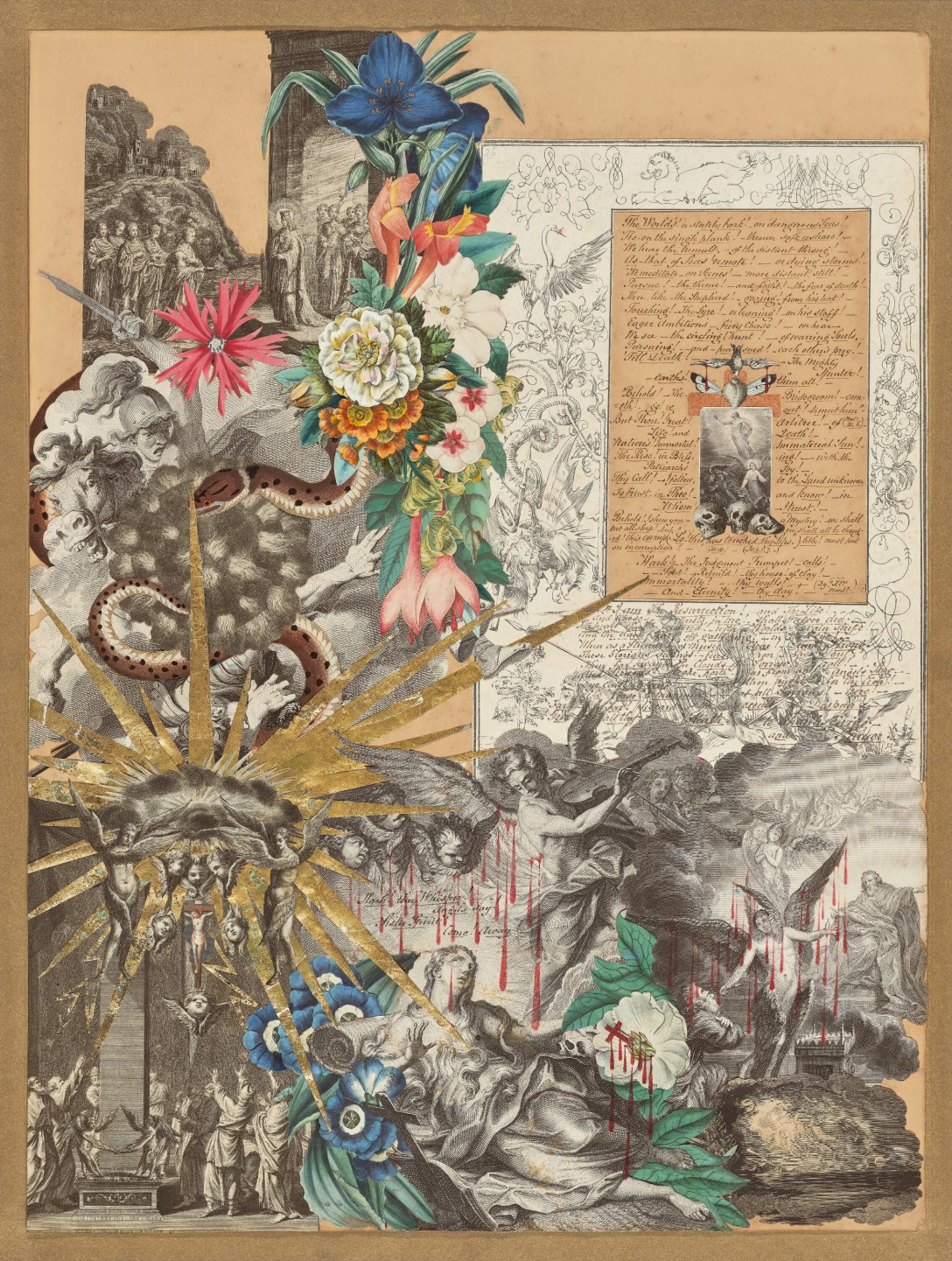
Image: “Collage” by John Bingley Garland. 1850-60s. In the public domain.
ID: A collage featuring gold foil beams, a snake, blossoms, the crucifixion with angel heads, a yellow page of writing, and Mary Magdalene lies on blossoms while an angel plays the violin and blood drip down.
 Psaltery & Lyre