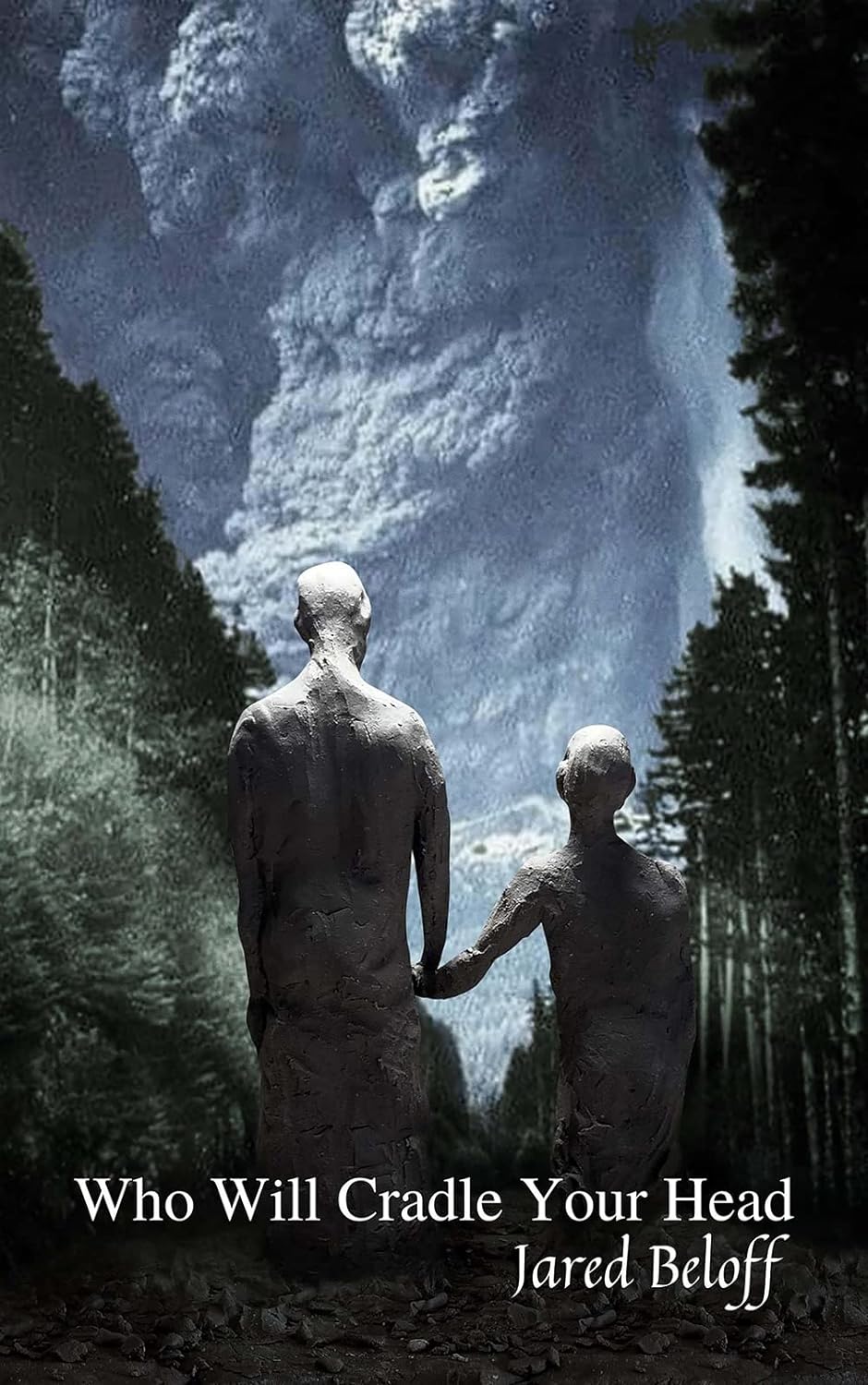
Who Will Cradle Your Head by Jared Beloff
ELJ Editions, 2023
Review by Dan Carey
::
Jared Beloff’s debut collection of poetry, Who Will Cradle Your Head, envisions what the future looks like on Earth as the climate continues to rapidly shift. The introductory poem, “Are All Your Predictions for the Future Real?” answers its question in the first two lines: “If by real you mean as real as a house floating / into the sea, the waves claiming the kitchen.” Many poems exhibit moments of sudden and intense dread and hopelessness, like “Animal Crackers,” where the focus shifts, from the speaker’s game with his daughter, to atmospheric worry. He ponders when to “tell her this is enough” and that everything “is an attempt to live in an unrecognizable world.”
Many poems in this collection focus on an inevitable oncoming cataclysm. Beloff conveys this as an ancient pattern in “The feral pigs of Chernobyl are glowing” when he says, “the scent of decay holds / a greater half-life than any memory / we’ve made.” The poems describe how people, places, and things are grown, built, and destroyed in an endless loop—only the materials change. In discussing the present predicament, he suggests that those in power have sat around debating the issue instead of working toward solutions, as the damage becomes irreparable. An attitude of apathy hangs in the poem “Politicians discussing climate change”:
Supplication sounds like drowning,
anger dips
under the ebb,
a ninth wave. We’ve run out
of names
for windswept
clouds and coasts battered
our arms
tired, tied.
Beloff’s book introduces his dark sense of humor, which helps ease the blow of impending disaster and catastrophic change. The speaker in Beloff’s poems doesn’t sugarcoat his worries, but searches for ways to spell them out so that people understand (“what can we say / that would sustain?”) and employs humor to make for a softer landing. For example, in “The divers off the coast of New Florida,” Miami transforms into a modern Atlantis as people “watch the Golden Girls as an archaeological reality.” In “Living Happily at the End of the World”, Beloff jokes, “I pass you a drink. We smile, the world on fire around us.” The first stanza of “Rewind” displays his talent for dark humor by reversing a car’s motion and imagining it sucking up its own exhaust with the same intensity as narcotics use:
Cars inch in reverse along the freeway
careful not to tap the fenders behind them
free base their exhaust with a muffler’s open straw
pull backwards into lots, driveways and dealerships.
The result prompts us to laugh at first, then leaves us with the notion that if people didn’t travel to work in single-passenger cars, there wouldn’t be so much traffic. The book proposes that, if that solution seems relatively straightforward, could more problems be solved by some simple cooperation—carpooling as a start?
Ten poems in this book comprise what I call the “Sasquatch” sequence. Nine of the ten are prose poems featuring the mythical creature wandering Earth as places formerly inhabited by people reassimilating with the wild. In one poem, he cradles the carcass of a pygmy rabbit; in another, he waits for Leviathan at the coast; he visits an abandoned bunker and traverses through a burnt-down forest. At times, he seems to accept the end of life as an inevitable truth. In “Sasquatch ponders the seasons of decay,” he asks, “When the last tree falls, will I be there to hear it?” In “Sasquatch survives another fire season,” though, he’s more hopeful: “listen closely… immolation’s relief: here are the painted trillium blooms, here the rise of the underbrush, a blaze of blueberries flickering to life.” One can’t help but feel awe when he says, “I am arrested as the water spreads, unhinges its jaw to swallow the land” in “Sasquatch sees the ocean for the first time.” The last of this sequence, “Sasquatch covers each footprint,” reminds us of our mortality. Despite our wishful thinking: “Always is what we tell ourselves in love and landscape, the promise of a clearing’s light. I seek you there, held for a moment in the sun, aware that in our paralysis there is an ending.”
Beloff integrates language powerfully with the natural world. Sometimes, he uses verbs comprised of words that can also be used as nouns to represent the wild: “moss rivers itself”; “snow serpents like water or a woman / waking to the sun’s glare”; “a stand of sunflowers / stem their way through soil.” Beloff’s language often played with my expectations. Reading his poems surprised me and led me to anticipate more unique encounters with language throughout the collection. Beloff also utilizes personification beautifully: “fish lipping / the water’s skin”; “the ivy’s searching hands / and bittersweet vines / swim the humid air.” The poem “Restoration” is rich with examples of inanimate objects communicating, from “broken glass / and tattered curtains” to “pellets and peels next to a Bible,” all the way down to “the roots / that buckle the boards” and the “fuzz of moss sugaring / pulp and dust.” Beloff’s decisions to apply such rich diction and personification in these poems produce a voice that often seems to come straight from the natural world itself, like instinct or intuition protruding through a wall of clouded logic.
The shape of poems also accentuates the mingling of language and nature. “A Maladaptation of Cells,” “Avoiding Maladaptation,” “Chirality,” “Adaptation,” “Murmuration,” and “A World Seed Bank” are all concrete poems, where visual images are created by the words. An erasure poem, “The Earth is a Burning Haibun We Sing to Ourselves” fits with topics like transformation, destruction, rebirth, etc. based on the process of creating erasure. An original body of text must be broken down and transfigured. The shape of these poems deepened my experience with their language. I found myself turning the book around in my hands to read certain poems; such active participation granted me a more intimate involvement with the subject matter.
In “Rewind,” my favorite poem, Beloff casts a spotlight on people, vegetables, and industrial objects like tools and vehicles moving in a reverse time-lapse. Certain objects seem to be acting on their own, except for one: the “clouds” whose “drifting pods / seem natural.” The rewind makes it look as though “cars inch in reverse,” “factory stacks inhale smoke,” “a miasma of sparks spider back / to disassemble the front door,” and “jets vacuum white vapor.” The poem may look like an exercise, where the prompt was to reverse a bunch of images and see what happens, but the outcome is profound, and I genuinely want to know at the end “where all of this is leading.” The way this poem plays with time and how routine events are perceived fascinates me.
What I appreciate most about this fierce and unflinching collection is that rather than stoke fear, Beloff faces this unrecognizable world through the eyes of speakers like Sasquatch or a father, with eyes wide open. Pressing on into uncertainty inspires hope in humanity to fight towards a livable, safer, more certain future. In “Playing with Climate Models,” the speaker states, “Nothing dies, only energy is given… Energy is given, transferred”; he plucks another encouraging chord in “Sasquatch explores fresh kills”:
I trace these green recesses
like a scar’s braided
renewal shading our grief,
which is also hope,
a weave, which is memory
but also love.
The love that exists in the ability to remember inspires us to press on, with our scars as reminders of where we come from.
I am anxious and alarmed at the prospects our planet faces, but the belief that “energy is given” comforts as a consolation that we are all comprised of matter continually recycled into new forms of life. Small moments speak volumes about the planet’s persistence, like at the end of the poem “The World Seed Bank”:
They wait—for the
first crack to open
to let the light
burn.
A burning light, when thinking of this collection, represents our world in flames, but also the spark of creation expanding from a center, like the Big Bang, from which everything moves, destroys, grows, and transforms endlessly.
In Who Will Cradle Your Head, Jared Beloff channels the universe into his poems with primordial awareness of where we come from and where we are headed. He also remembers to appreciate the world as it exists now, where respite can come from anywhere, including such occasions as helping his daughter match the names of animals to the shapes of her crackers.
::
Dan Carey’s poetry has appeared in Anti-Heroin Chic, Crosswinds Poetry Journal, DropOut Literary Journal, The Red Letters, and Suspended Magazine. He received his MFA from Lesley University and currently works as a teacher and manuscript consultant. He also holds the position of Social Media Manager for Grid Books/Off the Grid Press. Dan grew up in Ipswich and currently lives in Cambridge, MA.
ID: Cover of Who Will Cradle Your Head by Jared Beloff.
 Psaltery & Lyre