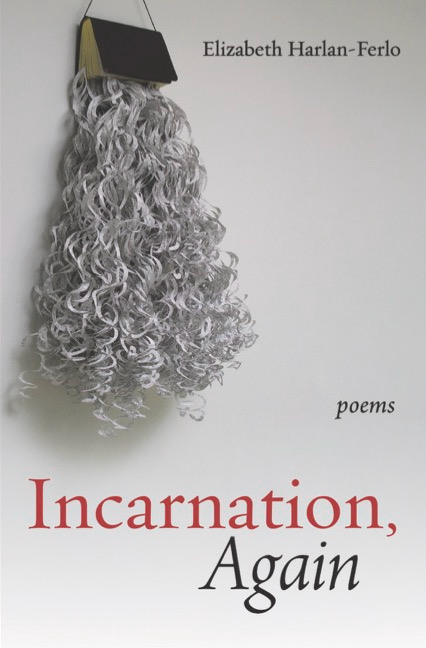
Incarnation, Again: Poems by Elizabeth Harlan-Ferlo
Review by Whitney Rio-Ross
Resource Publications, 2022
::
“Get close.” So begins Elizabeth Harlan-Ferlo’s poetry collection Incarnation, Again. I have never read a poetry book in which the first poem’s title so clearly communicates what the book is about to offer readers. “Get close”—an invitation, a dare, an imperative. Harlan-Ferlo covers all these linguistic implications, as well as the spiritual and physical ideas the words conjure.
The opening poem also introduces how, for Harlan-Ferlo, the personal and the spiritual are inextricably intertwined. Because the poet is a former Episcopal chaplain, this intertwining could feel exclusive for those who are not part of the Christian church. Harlan-Ferlo, however, quickly reassures readers; “Get Close” reveals a life and faith informed by a respect for multiple religions. Even I, a fellow Christian in the Episcopal tradition, felt more welcome because of her widened perspective. On the (rare) occasion that someone asks me for spiritual advice, I suggest they develop friendships with people of other faiths—and not so they can proselytize. An appreciation for other religions not only increases our empathy for those who do not believe our doctrine; it also illuminates and expands our own faith, rendering the familiar strange and the strange familiar. I felt that truth all through Incarnation, Again.
Several poems refer to the poet’s religious upbringing as a pastor’s daughter. They vary in tone and communicate the mix of cynicism, nostalgia, empathy, and lingering questions one might expect from a woman who ended up in a religious vocation herself. “Rise to the Occasion” manages to crystalize the childhood and adolescence of a pastor’s daughter in one poem. The girl moves from hearing “Here, some crayons” to “That skirt is awful short for church.” Throughout it all runs the refrain: “No, your father has a meeting.” We also get to hear Harlan-Ferlo’s piercing insights as an adult working in a Christian environment. The hilarious, self-aware poem “Church” lists tropes of various church traditions. Yet my laughter turned to wincing when I came across the one that best summarized one of my beloved churches: “Church of St. Just Take a Cab, Church of St. Are We Rich, Church of St. Private Garden, Church of St. Pride Parade.”
Most of the book, though, doesn’t look only at the Christian tradition but plunges right into the holy text, offering a poetic exegesis. Some like “A Reading: Can You See” and “A Reading: Many Times They Had Seized Him” are Midrashic, reimagining Gospel stories to draw out theological truths beyond their usual sermons. I have re-read “A Reading: Prepare” (Matthew 3:1-6) more times than I can remember. Though I have long loved the story of John the Baptist, reframing it from the perspective of the one being baptized made the story pulse with new possibilities. I hold my own breath when the speaker enters the water and thinks,
I’ll creep in,
even though
you remember before, how
you found
yourself under,
the sky of your lungs torn open.
Other “A Reading” poems (or the poems that use scripture passages as epigraphs) go far beyond the biblical contexts and connect the stories to more contemporary experiences. “Judas Communion” recounts the story of an adolescent church friend’s relationship with an older man. The title alone of “Internet Comments Theology” offers a painfully relatable framework for the parable of the log in the eye. A few of these exegetical poems are specifically put into the context of a woman’s body. “Fig Season” addresses female infertility after citing the story of Jesus and the fruitless tree, giving a theological heaviness to the speaker’s reaction at seeing a baby:
I can barely hide
my naked desire,
what I would take
if it grew.
Whether in reference to scripture, other literature, or contemporary dating culture, the body is at the heart of Incarnation, Again. What else should we expect from such a title? But it’s not just any body; it’s the female body. As in “Fig Season,” Harlan-Ferlo explores the female reproductive system and the typical themes of fertility and giving birth. The title poem highlights the wonder behind this familiar female experience when the childless speaker sees a young pregnant woman and confesses, “I’d settle for this / regular miracle.”
But Harlon-Ferlo goes beyond procreation. So much theology about female sexuality revolves around their reproductive systems and whether they are functioning properly. When (especially male) theologians talk about women’s bodies in the Bible, they are usually talking about motherhood or barrenness. Female biblical characters who are having sex without childbearing at the front of their minds are prostitutes, adulteresses, or temptresses. Incarnation, Again dares to delve into a womanhood beyond terms of the womb. Harlon-Ferlo writes about the female body as if it—apart from its ability to give birth—might be singularly holy. In “Mr. Right Theology,” the female speaker desires knowledge and notes that
Augustine surely disapproves
of my woman-mind,
my body grasping
homoousion, one
essence, Trinity.
“Booty Call Theology” uses language of sexual longing and shame to reflect on the speaker’s reluctance to claim her Christian identity. “Rape Theology” is an embodied meditation on the myth of Leda, in which Zeus takes the form of a swan to rape a woman he desires. The fear is palpable as the speaker concludes, “There’s no way to know who’s god.” Though the poem is dark and terrifying, it again connects the holy and the sensual. The rape is not vile because of a woman’s ability to reproduce; it is vile because it violently dishonors a body that is holy whether it can bear children or not. When reading the poems about women’s bodies, the conclusion of the creation story echoed in my mind: “God saw everything that he had made, and indeed, it was very good” (Genesis 1:31, NRSV).
Incarnation, Again is a book bursting with imagination. From the expanded rhetoric of multiple religions to daring readings of the Bible to a theology that allows for a holy female incarnation, Elizabeth Harlan-Ferlo’s poems reveal the mystery behind what we might think we already understand. Her imagery, language, and questions point to the idea that there is always something beyond what we have already perceived. “Get close,” these poems say. “There is so much more to behold.”
::
Whitney Rio-Ross is the author of the chapbook Birthmarks (Resource Publications) and the winner of the 2021 Sacred Poetry Contest. Her poetry has previously appeared in 3 Elements Review, Susurrus, Rock & Sling, Amethyst Review, and elsewhere. She serves as poetry editor for Fare Forward and lives with her family in Nashville, TN.
ID: Cover of Incarnation, Again by Elizabeth Harlan-Ferlo. Curling, sliced pages fall from an open, hanging book.
 Psaltery & Lyre