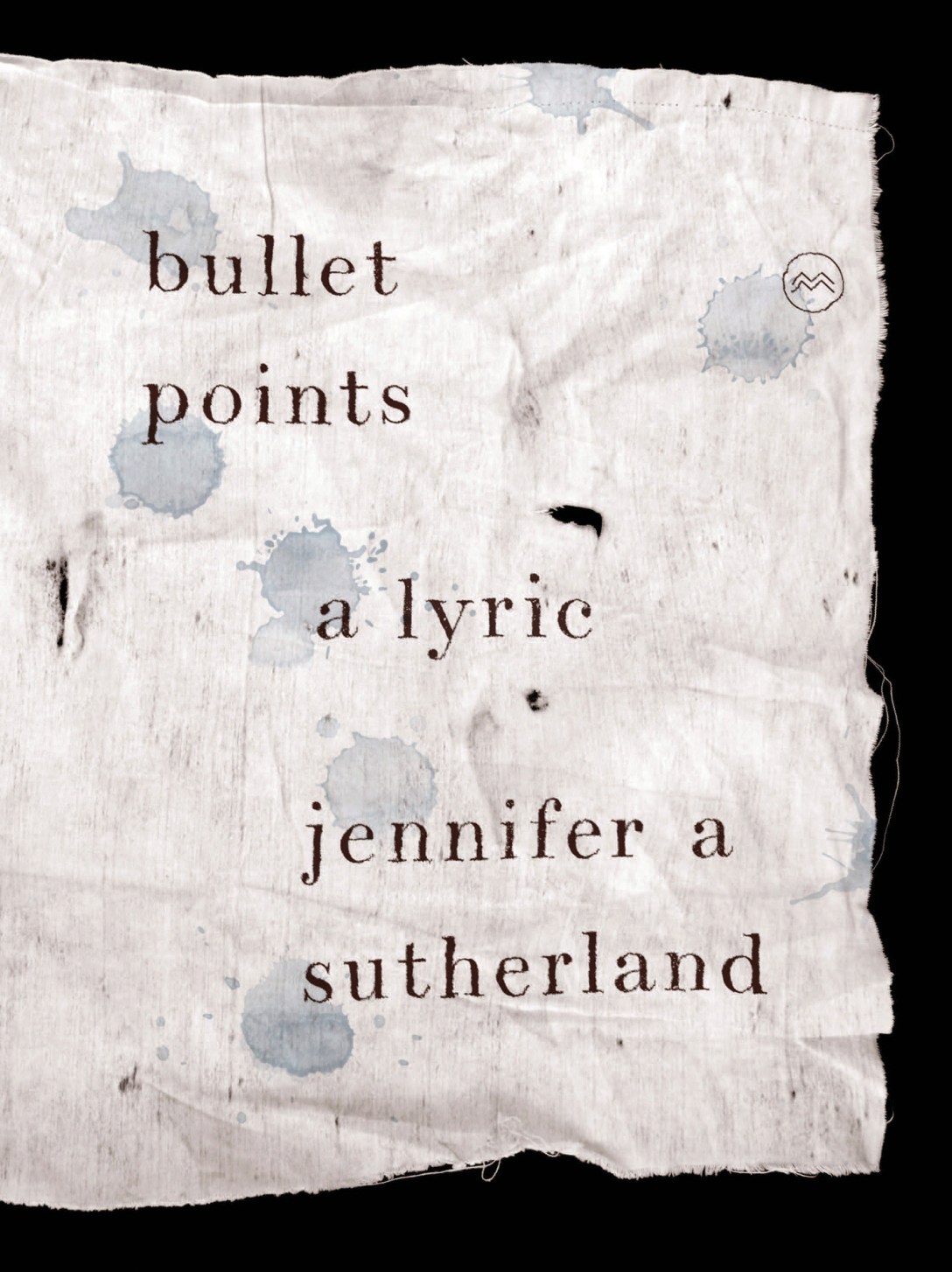
Bullet Points: A Lyric by Jennifer A. Sutherland
Review by Sara Stoudt
River River Books, 2023
::
In his advice for writing, mathematician Paul Halmos recommends writing “on the spiral plan”: first write chapters 1 and 2, then go back and rewrite chapters 1 and 2 before starting on 3, then rewrite chapters 1, 2, and 3 before moving on to chapter 4, etc. The same advice works for reading Jennifer A. Sutherland’s Bullet Points. Sutherland recounts, in slowly paced and non-linear fragments, a shooting in a courthouse where she was serving as a lawyer, and her personal aftermath. Reading Bullet Points, I continued to go back and forth, connecting phrases and finding links across pages, like I was forming a mental map, unpacking the event and processing the ensuing trauma along with Sutherland.
Sutherland uses connections between her experiences, both at home and with the shooting witnessed at work, and history. The details of the shooting, where a woman is killed by her former father-in-law ahead of a hearing involving her ex-husband, link to Sutherland’s experience with her ex-husband, J, and domestic violence. “Exhibit Two: J. accidentally backed the minivan into a concrete pylon in a parking lot and dented the back fender. That was on a Mother’s Day. He was so angry at us for what he had done.” Sutherland’s experiences move between historical events, and the early vignettes of historical figures are used to anchor her– from Joan of Portugal, who “popularized the verdugado when she wore one to hide her pregnant belly. Scandalous, as she did not bear her husband’s child,” to Swedish Queen Christina. These historical stories, seemingly out of place at first, give Bullet Points a cadence with which to recount her own history. She eases in and grounds herself in other’s histories; the shooting and domestic violence incidents hovering as allusion but not explicitly named until page 7 and 29 respectively. Like a scrapbook, personal and news artifacts are spread amongst Sunderland’s own words, from tweets (“I am okay. Shaking. You expect to be brave and it turns out you aren’t.”), to text messages, to snippets of related indictments. As she researches from the outside of the event inward, she re-searches her own memories, trying to reconcile them.
As part of her story, Sutherland describes the process of writing and what it was like to be given feedback when she tried to write about the shooting. “A famous poet told me why I could no longer speak as I had spoken before the shooting. ‘You’re still there,’ she said to me, ‘in the stairwell. You can stay there, or you can leave.’” What can seem in a first pass as a disorganized stream of consciousness becomes an intricately woven tapestry, slowly unraveled, not unlike one of the “scenes” that is unpacked slowly across pages, returning just when you have forgotten about its start. Sutherland writes, “Scene in which a woman in a darkened room spins her hair into wooly yarn.” And pages later, Sutherland returns to this idea, “Scene in which the yarn is spun into a heavy cloth.” Sutherland is self-conscious about this meandering path towards meaning, admitting: “But I digress. I tend to do this. To delay.” While she writes, somewhat self-deprecatingly, “I know that I’m repeating myself. I do this for reassurance, to make certain this is still me speaking”, these repetitions are not redundant. They serve as a mimicry of the process of processing: retreading grief, trauma, one’s own life, until sense is made if not found. Each link across experience and the pages are interwoven carefully; words and phrases continue to appear throughout the narrative like recurring characters reasserting their symbolism.
One theme, symbolized as a net, is the tension between unraveling her experience and feeling trapped by it. “Seeing clearly sometimes is a grief, sometimes a net, one swum into because one is weary in the water and then tangled up in woven panic.” Later, the symbol reappears: “I sense nets lurking beneath the surface, things I’ve woven and things I haven’t, and the eels that are caught inside them.” Other recurring themes are informed by her experience as a lawyer. The ideas of incorporation and proxy play off of one another, both can be a stand-in, when necessary, like the other lawyer working with her on a case as a “body that stands in for mine” or the multiple references to these ideas in the context of a “shield” or a “fiction.” “Another kind of incorporation in the way that all such fictions are intended to evade the risk of being…”
As I read, I was glad for the whitespace in the formatting of Bullet Points, just waiting for a reader’s annotations that will help track each connection. My copy is full of scrawls, and each time I re-read, I catch something new. No matter how close a reading we perform though, we as readers cannot fully understand what it was like to live this experience, nor what it was like to write about and through it. Sutherland anticipates this even in the end: “The reader will lose access to the context of my composition process. The text alone will offer clues to many things about me and the circumstances of the writing but some things will necessarily remain obscure.”
::
Sara Stoudt is a statistician, teacher, and writer from Pennsylvania. She is the co-author of Communicating with Data: The Art of Writing for Data Science and a member of the editorial team for the Future of Data Science and Our Environment creative data anthologies. Her other non-academic writing can be found in The Pudding and on the Cover Me blog among others.
ID: Cover of Bullet Points : A Lyric by Jennifer A. Sutherland.
 Psaltery & Lyre