by Mitchell Nobis
for the Todaros
At first we just made jokes. Sent texts that said “Bring the marshmallows!” and retweeted photos of the smoke cloud on the horizon. Then we said “holy shit” a lot. When the county said evacuate, we didn’t grab much anything, really. A bunch of water bottles—I filled the huge camping jugs. My wife grabbed backpacks and stuffed them with clothes. I grabbed the book I’d started last weekend. A novel about some family would do me zero good in the end times, but maybe I could barter it after I was done. Who knew what we would need? As our five-year-old said last year when the pandemic hit, “I don’t know—this is my first apocalypse.” The shit she hears us say, then twists back to us. I mean, when she said it, it sounded like, “my first pah-pop-a-licks” but we knew what she meant. We thought it was funny then, before our horizon caught fire.
The kids grabbed school work, Sangy her cell phone, Weezie her notebook and colored pencils, then screamed when they realized the dog was still out back. “I got him,” I said. My wife took the kids in the Subaru. I snatched the keys to the Winnebago we’d talked about selling but hadn’t. It might be our home by tomorrow. “We’ll see,” I said. Better safe than sorry.
I watched her and the kids leave as I filled the Winnebago’s water tank. I couldn’t breathe. Absence and smoke. Hope and worry. The hurricane-force winds blew my hat away. I watched it tumble, then catch an updraft and float up like a drunken balloon. The Winnebago creaked and tilted, and I said my first prayer of the day.
I couldn’t keep up with texts, so I posted “safe so far” on social media, unhooked the hose, and ran downstairs to turn off the gas and water mains. Homeownership makes us say a lot of weird prayers, but I said another then for the house. Finally, I called Indiana into the house, grabbed his bowls and bag of food, and hopped into Bagos. We always thought we were clever with names. Everyone else calls their Winnebago Winnie, so of course we named ours Bagos, like some undiscovered Greek island or something. I put as much thought into naming our first. Sanguine sounded pretty and meant something nice. Later on I found out it means “blood,” too, but it still fits—Sangy is an inherently grouchy incisor. She thought it’d be funny to name the dog Indiana. (Yes, she’s seen it. That’s why she thinks it’s funny.) We pass on all sorts of heritage, eh.
Ten years spread for our kids seemed insane when Weezie came along. Louisa got past all sorts of goalies to breathe life into our dry high plain. Too much energy for Louisa, so Weezie it was. But now these dry plains are on fire. I always dreamed of living a few ranges into the mountains, back where my grandpa had that shack. It was actually a trailer, but I always called it a shack. It fell apart years ago, after him and my dad and all that, or maybe we could head there now.
They were probably gone only five minutes, but I texted and asked if they were at my mom’s yet. “No, dummy,” she said. “You gone yet?” and “Traffic bad obviously.” My wife, so calm as our world literally burns. Me, running through the house one more time like some comic relief Pixar chicken, unsure what else to grab. I took fleeces and hats. The unseasonable (what does that even mean now) heat was supposed to end tomorrow. Single digits cold coming and, god, maybe snow. A good chance according to the forecast. Please.
I was sure she already grabbed coats, but I remembered in Red Dawn the Russians had those furry hats, and I could’ve sworn Jennifer Gray was wearing a toque in a few scenes, so I figured an apocalypse meant warm hats. Then my phone went nuts. Jeff and Emily were away. The neighbor kid has been feeding their dog. Indy and I jumped into Bagos and hit the road. I stopped at Jeff’s, grabbed Cecil and his bowls and food. The county’s warnings were frequent and dire, so we hit the road.
It was hard to see. Smoke so thick. The gales blew Bagos around like a paper sack, but I kept it between the lines. A bit like a drunken kid from the university, but good enough. The dogs ran after each other in the back until the welcome wore off. Then they stared out windows. They knew the air wasn’t supposed to be solid or gray. Their ears pinned back, worried. I rubbed Indy’s brown-and-white head, but he still started that high-pitch thing he does when shit ain’t right. “Can’t blame you,” I said, scritching his ears. Cecil’s a huge golden retriever. He walked in a circle, looked out a window, walked a circle, repeat. “Cecil,” I said, “you’re gonna make us combust if the fire catches all that hair you’re shedding.” Cecil just kept turning. He had dropped so much hair I could see it in the rearview, a blanket of golden. So I told him about work lately to help calm him down. He didn’t seem to care about Zoom meetings, but I regaled him about the time Bob ripped a huge one with his mic on and then narrated it, like, “Whoa, nelly!” under his breath but we all heard it and called him Keith Jackson in the chat.
How would this work, when everything burned? Would we need to barter? Live in camps? I mean, the whole world wasn’t burning, yet. Just us. Still, it pissed me off that the survivalist nutbags might end up right. I should’ve learned how to tie knots or filter pee to drink. I guess we’d all relocate for now, somewhere that hadn’t burned yet, somewhere that had gotten rain this year. Seattle? Seattle got a year’s worth of rain last month. I have college friends up there. I wished Grandpa’s shack was still out there in the mountains. I grew up outdoors, climbing trees or hiking or playing ball or chasing dogs chasing squirrels chasing birds away from nut stashes. Kicking balls against Grandpa’s shack. Once a month or so we’d get above treeline for an afternoon, to where it’s like another planet and the tallest plants reach your ankles. Just scrub. I never learned the plants’ names like I should’ve. “I bet the doomsday dorks know plant names, dammit,” I told Indy. You think things will always be here. You think you’ll have time before they burn.
I’ve tried to get the kids up there too, but we don’t make it as often. Work. School. More work. “Why do we do that shit?” I asked the dogs. For a minute I rooted for the fire, but then I remembered all the people. And trees and, sure, the squirrels. Shit. Everything was smoke. Maybe we could start over. Could we start over? Live in Seattle? Make a living selling the girls’ art on Etsy or something? They’re both incredible artists. I mean, Weezie is five, but you wouldn’t know it to look at her drawings. She really has an eye. Maybe we could find some commune, get off the grid. Live life like it’s always winter break.
The news just looped the same warnings. I turned it off. Enough for now. We were on the road. “Nothing else we can do,” I told the dogs over and over like a mantra. I started singing it like a jingle. “Nooothing else we can dooooo.” Then I wasn’t sure what to listen to as the world turned to ash, so I put on a classic. Muddy Waters. I sang along with the dogs. At least I assumed the dogs were singing too. My girls were northbound, and we were 20 minutes behind them. A carful of ladies, an RV of boys. Seemed right to holler “Mannish Boy” while getting the arms workout of the decade keeping Bagos on the road. I will never understand how water people pilot sailboats. I thought the wind might launch Bagos to the moon, or at least to Kansas, which is like the opposite of sailboats I guess, but you get my point. It certainly wasn’t helping Bagos go the right direction. “Whoever figures out how to harness the wind will be a billionaire,” I told the dogs but then realized we have harnessed the wind but barely do it because people think it’s for sissies or something. “Just…goddammit, we’re dumb,” I told them. “Nooothing else we can dooooo,” I crooned, “until we catch up with the giiirrrls.” The dogs didn’t sing along.
My girls. God what I’d give to know they’re safe. I’d die now if I knew they could live long and happy. I’d let the wind toss Bagos into the wall of a Costco if I could guarantee that. I call them my girls because I’m the only guy in the family except Indy, but I should stop. One time a couple years ago after four beers, my dad said “Sanguine’s just a nutless boy, pal.” I don’t much care one way or the other what Sangy is. Brilliant and grouchy and who gives a shit what else. I should just ask her. “I just hope to hell they’re all safe,” I said to the dogs. They didn’t answer, and Indy started doing that quivering thing he does when it thunders. I felt bad, so I said, “I hope you’re okay too, buddy.”
The news had said the fire was engulfing Superior, a couple towns south of here. Head north or east, they’d said, so we all did. But then the wind pushed the fire farther and farther east, so everyone turned north. Traffic crawled. My folks’ place, a few more towns and a lifetime north. On a normal day, the drive takes maybe 45 minutes or an hour, tops. But now, a whole county’s worth of people on the roads east of the mountains. Hell, all of CU—a city’s worth of college kids—all bugging out and on these roads somewhere. We hoped they’d head to I-25, so we took US-287. Inching. Just follow the brake lights. Follow the winking red eyes staring at you. Evil or salvation? I really thought when my world caught fire it’d be more orange than gray.
It’s weird being inside a cloud. The mountains have surveyed my whole life, and I know they’re out there now, but for the moment my whole world’s red lights in gray. The mountains watched us all, like usual, I assumed. Impassive. We couldn’t see them for the smoke. The mountains had the time to judge us. Still, we found our ways to stab them. No snow up there yet in December. You remember a world where the Rockies don’t have snow in winter? Me neither. Poor Weezie—first a snowless Christmas, and now New Year’s spent on the run from climate crisis. A guy on the radio last week said “Climate change will come for all of us at some point,” the prick. I oughta bill him for damages. I mean, he’s right, but you don’t poke Fate like that. That’s like when Weezie was a baby and never napped but when she did, we had a pact to never say, “Hey, Weezie’s sleeping!” because that was a sure bet to wake her up. Now my girls are up ahead somewhere. Lost in this smoke. I texted. “You good?” She replied, “Smoke stops soon then traffic goes faster get off the phone and drive.”
She’s always right, of course, and a wind gust pushed us. Sounded like a band of banshees and Macbeth’s witches screaming over a freight train. We tilted hard, and I tossed my phone and turned into the lean. Our sailboat was going down. We swerved onto the shoulder and skidded on gravel. I saw a stone fly toward the highway. The way everything freeze-frames in a crisis. I saw that stone, suspended in a frame, as we skidded to a stop about twenty feet off the road. I hoped the stone didn’t hit a car. I never saw where it went. It slipped into a wrinkle and disappeared.
We rocked and creaked in the wind but didn’t fall over. I said my third prayer. This one a thanks. Christ, thanks. It might’ve been my fourth prayer. Depends on if we count when I said I’d die if it kept my girls safe. Regardless, we were upright. The cloud of dust we had kicked up swirled off into the smoke, a patch of tan in the blackened air. We hadn’t hit anything. I said the thank you again, and then one more time. I said it to a few different deities because better safe than sorry and what the hell do I know.
Crisis can bring out the good, and folks stopped to check on us. I gave a thumbs up and waved them on their way, nodded a thanks. I think I did all that at once, the way we overcommunicate in panic. Everything in me was moving double-time. You think a phrase like “my heart jackhammered” is cliché bullshit until something like this happens to you and it feels like your ribcage will snap like sidewalk concrete being broken for a sewer project. I counted some deep breaths and got the shakes to stop. “Jesus,” I said to Indy, “look at us quivering like….” I lost my train of thought. We needed to keep going.
Calmed, I backed us up and straightened us out, then put it in park and took another deep breath. I pulled my phone’s power cord and fished it up off the floor and back into the drink holder.
It was full of notifications. Texts from everyone. My jackass buddy in Seattle saying “They weren’t literal in the song when they said burn motherfucker burn, y‘know.” He’d feel bad later when he found out we were on the run, but whatever. Funny is funny. And not funny, which is funny. Behind us, the wind had pushed the fire through Superior, had burned the town down like an Old Testament warning. The problem with the Old Testament is that it’s not much of a warning if it kills people. Then it’s just an attack, a firestorm from the wind gods coming down the mountains. “Haters gonna hate,” I told the dogs, knowing that didn’t even begin to capture it. Or did it.
My left arm, sore from taming Bagos in the wind. My shoulders were tight. I breathed again. We were here, not on fire yet. You think dying in a massive fire would be all orange and red, but this was a thousand shades of gray, like swimming through a dream with no doorways. I asked the dogs if they liked Muddy, but Indy just whined his high-pitched signal to aliens. I said, “Keep it up—aliens could only help,” and I switched to Merle Haggard. Cecil wagged his tail. I should’ve known Jeff would raise a hipster dog. My Grandpa listened to Merle and Hank and all the old guys, some of whom were young then, I guess. We got back on the road, and when “Pancho and Lefty” came on, I told the dogs to take Merle’s part while I sang Willie’s, but they just watched the smoke swirl. Indy was still quivering. Whining and quivering, a dog’s version of a country song. “So you’re a songwriter,” I said, “but not a singer.” Indy whined and vibrated. “Good to know.” We’d have sore throats for days from smoke. “Or COVID,” I said to the dogs, who didn’t laugh.
Who knew what we would need? Obviously, I hoped our house wouldn’t burn. I prayed that our life would still exist. My wife’s aunt farther south, probably okay according to the news, but still. Would we be back? You grow up watching things like Red Dawn, you wait your life for the other shoe to drop. Was this it? Thank god we’d had Bagos in for service in the fall. Would we stand on top of it, fighting off zombies? Or would we just get COVID in a tent city? “How bad will the future be, exactly,” I said to the dogs, but Cecil kept walking circles in the back and Indy wasn’t feeling existential. Or maybe he was feeling too existential. I puzzled through the million ways we could fall apart.
I thought about those trees I used to climb. I hoped they’d live forever. I’d spent every Zoom meeting in those trees, really, in some way. My mind, nine whorls high but nodding about “new protocols for our virtual office.” My mind feeling Colorado wind rock my tree, and me leaning back and forth in a chair from Office Depot, feeling us spin around the sun. It all ends in fire, doesn’t it.
But just like that, somewhere along US-287, I could see green. The smoke thinned, and pine trees were like an explosion of green.
I hadn’t realized how much my head ached from squinting to see in the smoke. My eyes opened wide. Trees. So many trees. They weren’t even wild, just the pines planted behind Targets and mattress warehouses along the highway, but still. Green. Dusty, or ashy, but some green, anyway. Any green. A sliver of green was more than the gray.
Outside the smoke at last, in drought’s blade of a sun, everything looked bleached, except the green. The green washed across my windshield. The trees—they whipped back and forth in the wind like a cartoon, like cartoon trees, all eyes and mouths singing songs to welcome us travelers speeding down the path to Paradise. I could practically see cartoon music notes blowing off into the sky as our cars bounced on balloonish tires. We probably weren’t headed for some Toon Town, though. Maybe Loveland. Maybe Seattle. Maybe the future. A future, at least. We would go where we would go, I guessed. Whichever or whatever came first. Whichever led to my wife and the girls, to whatever was home now. What would be home now? I didn’t know what to call any of it. It didn’t have a name.
::
Mitchell Nobis is a writer and K-12 teacher in Metro Detroit. His fiction has appeared in Porcupine Literary, Flyover Country, and Rejection Letters. His poetry has been in HAD, Whale Road Review, The Night Heron Barks, and others. He also hosts the Wednesday Night Sessions reading series. Find him at @MitchNobis & mitchnobis.com or falling apart on a basketball court.
Image: DESIGNECOLOGIST
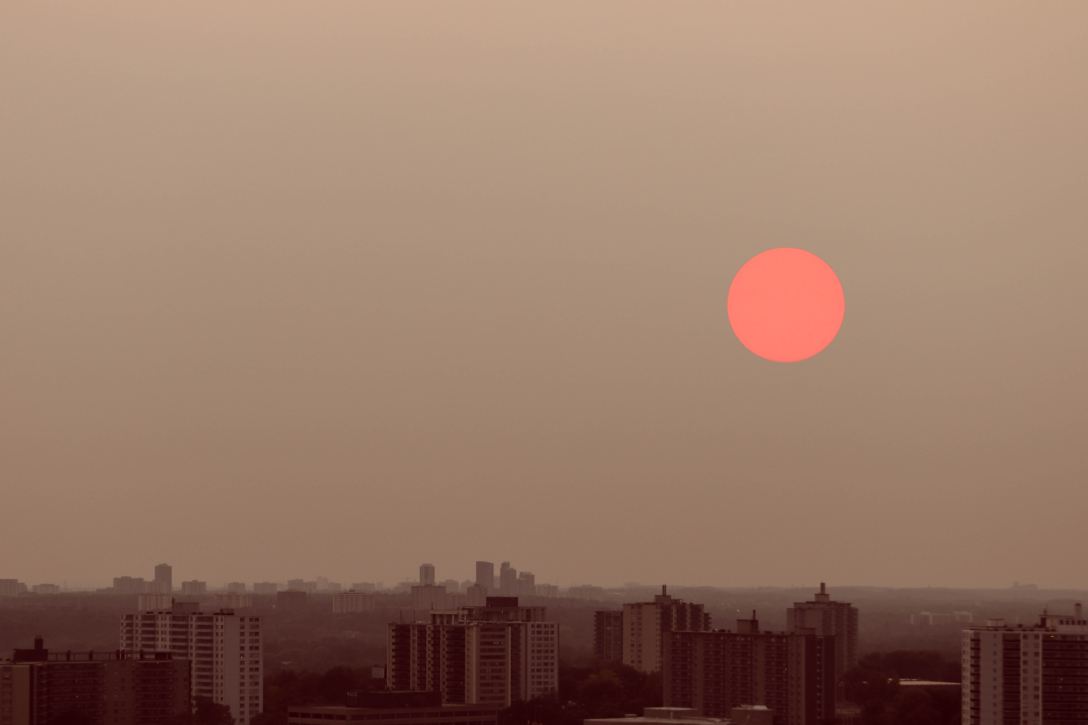
ID: smog and a red sun above Toronto.
 Psaltery & Lyre