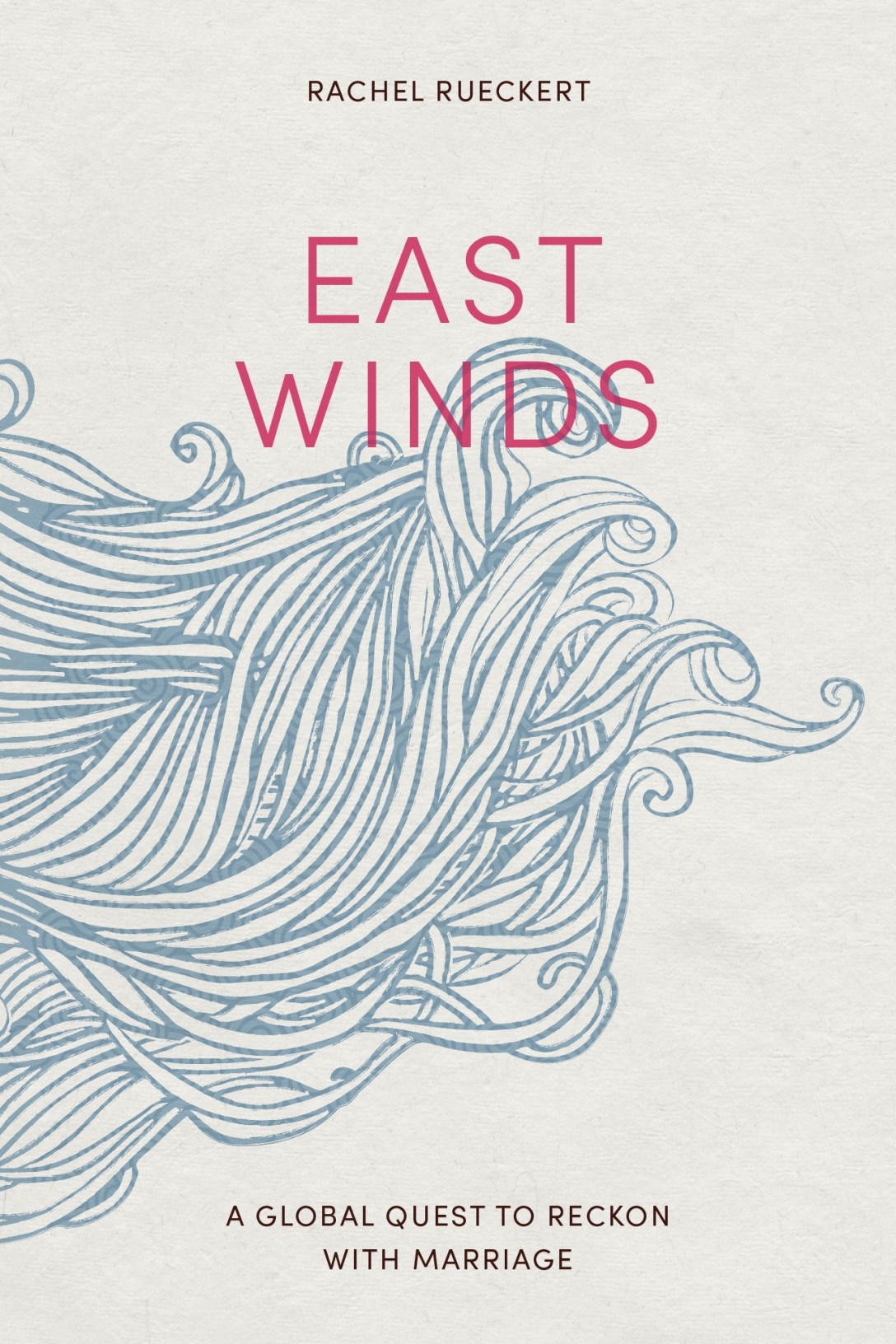
East Winds: A Global Quest to Reckon with Marriage by Rachel Rueckert
Reviewed by Elaine Thomas
BCC Press, 2022
::
In 2015, newly married Rachel Rueckert and her husband embarked on a journey around the world. A self-described “wanderer” and “adventurer,” Rueckert had planned, and scrimped and saved, for a (solitary) year-long global pilgrimage, and would only accept Austin’s proposal of marriage after he agreed to accompany her, to make the global backpacking trip their honeymoon. As the couple explored South America, Asia, and Europe, Rueckert also explored her memories and questioned her own values and expectations, particularly those surrounding marriage. As they traveled she grappled with how to share her life with another without losing her sense of self. She sought to balance a fierce need for independence with customs and beliefs absorbed from her family, community, and religion.
After they returned home to the United States, Rueckert spent the next eight years writing about those travels and explorations, about all that she learned from the experience, about the lands visited, about marriage, and about herself. She earned an MFA from Columbia and published this vivid, layered, and splendid first book, East Winds: A Global Quest to Reckon with Marriage.
There are many reasons to read and enjoy East Winds. It is a thoughtful travel memoir and spiritual quest, but it is indeed a love story, too. Rueckert dedicated the book to Austin. (Who wouldn’t be inspired by a handsome, generous-hearted soul whose opening pickup line—seemingly said without irony—was, “You and I should have a long, philosophical conversation”?) In addition to Austin, she also dedicated East Winds to the many other Mormon women who shared with her their own “singular truths” about marriage and relationships. (One young woman remembered being encouraged to wear makeup because “the frosted cookies are always the first to go.”)
The philosophical conversation with Austin, no doubt still going strong, extends throughout East Winds. So does Rueckert’s internal dialogue with herself, and with her family history and religious heritage. Her questions are complicated by the Mormon belief in celestial marriage. As she was taught in children’s Sunday school: “A temple sealing is different from getting married outside of the temple, where people have to say ‘till death do us part.’ The sealing makes it so families can be together forever.” Commitment for eternity is a pretty heavy expectation for any earthly relationship. Add to that Rueckert’s own family situation as the child of divorced parents and some anxiety about marriage is understandable.
As she and Austin travel in East Winds, with each country and destination, within cultures and among local peoples, she carefully examines marriage, as an institution and a lived practice, including its numerous forms, rituals, artifacts, and the day-to-day sharing of lives. With undergraduate training in anthropology, Rueckert is a keen and open-minded observer. She recognizes that many of her questions and struggles, while specific to her background, are also universal—are really about the business of being human. Like the rest of us, she discovers that the vulnerabilities involved in allowing oneself to be loved are part of the ongoing process of learning to accept and love oneself.
In the final segment of their trip, and of the book, she and Austin walk the Camino de Santiago, a pilgrimage to the shrine of Saint James. Lucky is the reader traveling along both on their external journey into Spain and on Rueckert’s internal journey into greater self-understanding. Her analytical and lyrical skills as a writer are nowhere more evident and compelling than on her Camino. With each “ill-prepared” step she conveys the physical and emotional demands, walking hundreds of miles over thirty-two days wearing sandals, exhausted, through times of rain and snow, crossing mountains and plateau. Yet the quest, and the companions on the quest, their “Camino family” as she calls the other pilgrims with whom they walk, make it all worthwhile. She feels close not only to these other pilgrims walking alongside her and Austin, but also to her Mormon ancestors and the stories of their pilgrimages westward across the United States as they, too, searched for spiritual understanding and authenticity.
Her evolving awareness of the deep power of story adds yet another meaningful layer to Rueckert’s pilgrimage: “To tell a story, any history, is to assert a kind of power…. To interrogate or reframe a story—to realize we are enmeshed in stories—is to reclaim part of that power.” Pressed by one of the women friends she makes on her journey to say it out loud, Rueckert claims the title of writer, and in doing so claims something at the heart of herself: “I am a writer.” With that simple yet significant statement, and the agency it brings, she knows, “I could be the narrator, shaper, of my own life and not just a character.” She has learned to accept, even find comfort in, being who she is and tethered to things beyond herself. As East Winds closes, the reader feels convinced that many more wonderful adventures—and books—lie ahead.
::
Elaine Thomas lives in Wilmington, N.C. A former journalist and college communications director, she holds an M.Div. from Duke University and is a hospital chaplain. Her writing has been published in numerous journals and literary magazines.
Image description: Cover of East Winds by Rachel Rueckert.
 Psaltery & Lyre
I very much enjoyed writing this review and appreciate your sharing it. Please know that I would always be happy to review for you again, if and when that might be helpful. All best, Elaine
>