
All of This Was Once Under Water by Natalie Padilla Young, with art by Maximiliane Spieß
Reviewed by Dana Delibovi
Quarter Press, 2023
::
The places we inhabit also inhabit us. We drink them in, and sense what Alexander Pope called “the genius of the place.” The poetry of place arises organically, and is as old as lyric verse itself. Poems with named places, their environments, even the dead beneath their soil were written during China’s Han Dynasty (202 BCE–220 AD) and Greece in the seventh through fifth centuries: “Horse cart skirrs through / the Upper East Gate to the north / beyond the city walls / gaze / at the graves.” (Han poem, translated by Jeffery Yang.)
Utah, especially the region of the Great Salt Lake, is the place of Natalie Padilla Young’s fine poetry collection, All of This Was Once Under Water. Young’s book is poetry of place—when the place is as strange as it gets. In the poet’s Utah, extraterrestrials and lake monsters live side by side with polygamists, pierced women, and worshippers. It’s a state defined in the book as “alien in its own right,” on top of any otherworldly aliens who visit.
A powerful place
All of This Was Once Under Water is such strong poetry of place, it drove me to Google “Utah + space aliens” and “Utah + monster.” UFO sightings and meddling extraterrestrials are part of Utah’s common lore; the Skinwalker Ranch—about 30 miles from the Salt Lake City in the Uinta Basin—is a UFO hotspot. Meanwhile, a North Shore Monster lurks in the Great Salt Lake, but Bear Lake, Panguitch Lake, and other lakes in the state have their monsters, too. All this, in tandem with the unique legacies of indigenous peoples—Navajo, Ute, Goshute, Paiute, and Shoshone—Conquistadors, Mormons, and new immigrants.
It’s certainly not necessary to read up on Utah before engaging with Young’s book. Rather, it’s a testament to the book’s excellence that it peaked my interest in its location. First and foremost, All of This Was Once Under Water is a brilliantly curated book, in which the sum is greater than its parts. Young arranges the poems and divides them into sections with great precision, and the book flows, crescendos, and shifts to drive the reader on. Poems composed of chronological historic events punctuate the book at key points, building a timeline that adds resonance to all the other poems. The abundant illustrations by Maximiliane Spieß are perfectly suited to the book: weird yet warm; toned in rock-red and agave-green; physical yet supernatural. Young and Spieß have not created a collection. They have created a world.
A defined landscape
Right from the start, Young’s book makes it clear that the place of this poetry is anything but ordinary. “Prologue: The Cast,” the opening poem, includes Utah, the Great Salt Lake, and aliens among the dramatis personae. This defining first poem leads in to a remarkable second one, which sets the work even more firmly in its place: “Sick with Rocky Mountain Spotted Fever, Brigham Young Looks Out Over the Salt Lake Valley for the First Time.” Young the poet is a descendant of Young the spiritual pioneer, and what might have been a distant and political poem in other hands is intimate and personal in Young’s:
… a journey
ending for a start
in a land without
persecution, a vast slate
ready to perfect
Young also lavishes love, affection, and her wry sense of humor on the monsters and aliens that populate All of This Was Once Under Water. For example, in “An Ambush of Major and Minor—the Monster Sings,” the monster of the lake is not a malign presence, but a wise witness to the groans, thuds, and songs of the Mormon pilgrims:
An underwater witness,
he felt the wagons and handcarts,
the Mormons rumbling
the valley, and knew everything
about their new ground, knew
the square inches riddled with salt …
This poem is followed by Spieß’s very unsettling settlers.
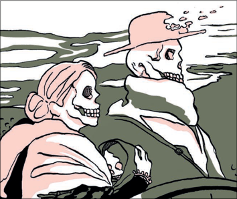
[Detail of art by Maximiliane Spieß.]
A lesson in craft
Young’s poems, and indeed and the book as a whole, are compelling in their visual presence. This author clearly recognizes that modern poetry is a visual as well as aural art. Young is very skilled at structuring a poem for the page. She does not have a go-to form for her poetry; rather she selects a form where her meaning will find a home. That’s why, for instance, “For Classification Purposes” which riffs on natural history, is a prose poem (with spaces like gaps in the narrative). It’s why “Of Course the Monster had a Mother,” scatters its lines and uses no punctation, to reflect a mother and child floating and dipping in the lake.
Young also has the ability, within what begins as matter-of-fact or cynical poem, to twist up emotions so tender, they twinged up my spine. The feelings arising from friendships, familial love, and the anguish over our beleaguered planet churn through Young’s writing. A technique she uses to amplify emotion is the visual equivalent of a kireji in haiku. She breaks the line or stanza, or makes an in-line gap, right before a radical change in tone from clinical to emotional, as she does in “Great White Sharks Must Move Forward to Breathe”:
No longer able to reach 15 mph
without space and something to chase, the creature passes
again and again away. Sometimes reaching 20 feet
of despair and relief. She is landlocked and can do
nothing for the shark. Nothing for the flattened animals
on the roads around her house—too many
to be a mistake, mistaken,
an accident.
Early in my reading, I found it jarring to read the word “aliens,” which appears very frequently in the book. It was apparent that Young meant “extraterrestrials,” but “aliens” is so fraught in the United States as a slur for immigrants, it bothered me to see it again and again. After a while, my feelings changed. The word “aliens” in Young’s poems denotes extraterrestrials, but it also connotes immigrants and the prejudice they endure. By the time I finished the book, I understood how cruel it really is to call another human being an alien.
All of This Was Once Under Water is beautifully wrought book that taught me a lot—about writing, about Utah, and about replacing distrust with compassion. Natalie Padilla Young’s poetry of place is well worth a trip.
::
Dana Delibovi is a poet, essayist, and translator. Her work has appeared in After the Art, Apple Valley Review, Bluestem, Confluence, Ezra Translations, Moria, Noon, Presence, Psaltery & Lyre, Salamander, and many other journals. Delibovi is a Pushcart Prize nominee and a Best American Essays notable essayist. She is Consulting Poetry Editor at the e-zine Cable Street. Find her on Twitter at @DanaDelibovi and at https://danadelibovi.wordpress.com/.
Image description: All of This Was Once Under Water by Natalie Padilla Young featuring art by Maximiliane Spieß. In the cover image, a tattooed woman stands in a poll of water with dark mountains in the distance. The colors shift from orange to pink and black.
 Psaltery & Lyre