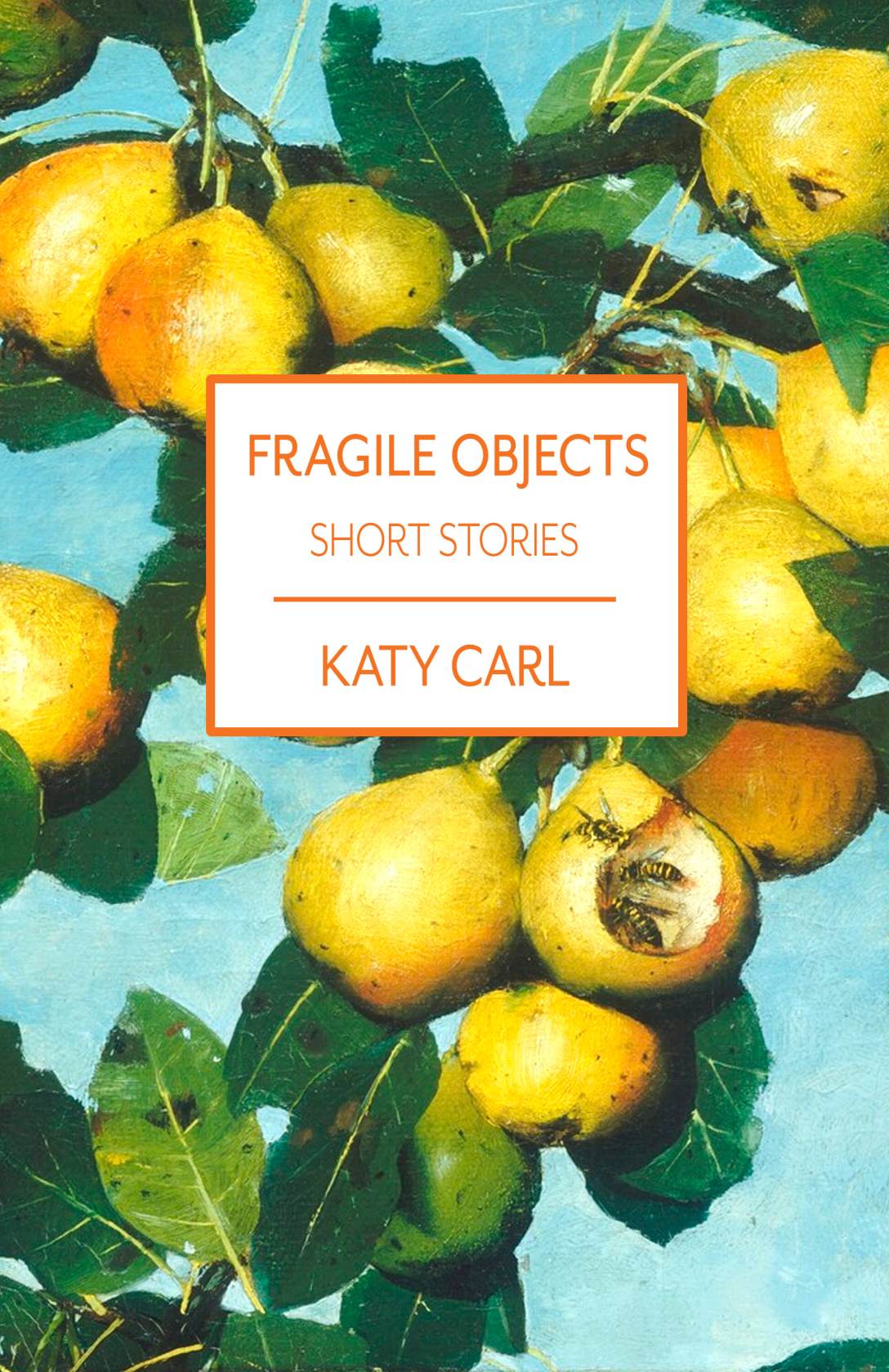
Fragile Objects: Short Stories by Katy Carl
Reviewed by Joan Bauer
Wiseblood Books, 2023
::
In a follow-up to her lyrical debut novel, As Earth Without Water, Katy Carl trains her unflinching gaze on the body, both in its frailty and its mysterious power. The stories collected in Fragile Objects are understated yet harrowing, with a touch of the gothic. It can be dangerous here to venture out of the city, away from the familiar.
In the title piece, a young boy accompanies his father to the next county to visit a grandmother who is failing in some unseen way. “[The] house held an atmosphere of sleep and long hours where waking did not mean much.… The coffee tables, glass-topped wood, and the cabinets along the walls held frangible curiosities Bub knew he must never touch[.]” But the grandmother will not be crossed—as Bub’s father points out, “’[your] backwoods comes out when you’re angry’”—and in a sudden outbreak of violence, the two adults “[seem] not to see the child in danger at all[.]”
This early dynamic is reversed to great effect in “Hail Thee, Festival,” where children are too much the object of parental indulgence. Bonnie, a young mother, works her volunteer shift to the tune of a veteran’s nonstop narration:
We have cornhole, table tennis, sack races, soda pong (liability), photo booths, face painters, hair
braiders, henna tattooers, clowns making balloon animals or the floaty kind with strings, your
choice, and always one or two people taking little sips off the helium supply to make their voices
go all squeaky. Which you shouldn’t. Not that you—but someone always does, and it’s a bad idea
so don’t say I didn’t warn you.
The more cultured Bonnie soon takes over the story, creating a real split in tone that might be dislocating in the hands of a less capable writer. Bonnie and her husband have moved with their daughter from D.C. to a “smaller, safer city” in the hope of achieving a more authentic life. At the festival, where cheap prizes mount up with abandon, Bonnie observes a small, skeletal woman whom everyone tends to avoid–partly because when she prays the rosary, “she sways with outspread arms, she chants aloud.” All of a sudden, this woman overturns the wading pool of the duck pond as though it were the money-changers’ booth in the temple, denouncing this worship of Mammon until she is led away. Bonnie’s young daughter barely registers the commotion, but Bonnie reflects that “as I dwindle into the crone years, as mind fades and yields to body, as body yields to place, I will remember.” Perhaps, she thinks, it is “[better] to watch these children carry, so lightly as they do, the groaning burden of this inescapable excess. The only question left is: how can we propitiate these children, so that one day they may be able to forgive us for all we’ve given them?”
A truly exciting pair of linked stories, “Allie” and “Jack” (Best of the Web for Fiction, 2021), turns on a couple’s alternate versions of a key moment at the end of their failed relationship. Carl’s unsparing portrayal in “Jack” of a feckless, self-absorbed young man recalls Marilynne Robinson’s Gilead novels. Meanwhile, “Allie” follows a story arc all its own—from the couple’s last days together, through Allie’s disillusionment with the environmental non-profit where she works, to her almost idyllic new living arrangement with Violet, a compassionate older woman who has served as an escort at the abortion clinic. Just listen as Carl evokes Allie’s unplanned pregnancy:
Allie’s body became an exoplanet, an unfamiliar world. She developed capacities she wasn’t
sure how to classify: subhuman, superhuman, inhuman? She could smell microbiomes; she
could taste insincerity. She could hear, like a radio transmission, what to eat when; could feel
the proteins sliding into her bloodstream, building the mysterious presence. She had thought a
host organism should seem defeated, overthrown, consumed. Now she felt surprise at her
unthought-of power.
What a beautiful way to imagine the obscurity and depth of reproductive embodiment—taking Allie by surprise, it soon seizes hold and becomes her heart’s deepest desire.
Contrast this with the outraged young narrator of “Battleground State,” in which college friends Areta and Diane pledge to avoid “evil men” –though each woman suggests she is breaking this rule when she forms a romantic relationship. Areta, who was raised by a single mother and grandmother, develops “a terrible pity for the soft crocheted sweaters they wore at home, the smooth fabric headwraps, the terrycloth slippers…. How had she not seen it before? Mama and Memaw were upholstered: domestic objects, more permanently planted in that apartment than their own thrift-store furniture.”
And yet, the two women are tragically taken from her; and when Diane produces an ultrasound image just as the two friends set out on the Women’s March, Areta cannot respond lovingly to her friend’s news: “’you don’t even own your own self, he owns you.’” Areta abandons Diane in a puddle of slush, “[flinging] her hands toward the cloud-streaked firmament, waiting for the walls of the world’s strongholds to fall.”
But it is not just the women who struggle with what it means to live in the body. In “The Convert,” originally published in 2008, a young man wildly overshoots in his efforts to cultivate chastity. When his father gives him pornography in an attempt to test his resolve, he is ready to castrate himself to subdue lustful thoughts. Despite the shock value here, I had to wonder at the concupiscence of such a father—and I wished for a compassionate sponsor who might have guided this young man. The question of sexual ethics receives more nuanced treatment in the excellent “Company Men,” in which a bishop’s assistant must investigate complaints about a young pastoral associate. Sometimes, it can seem impossibly hard to live with integrity–and even harder to wield authority with compassion.
What begins as a foray into parochial living in “Hail Thee, Festival” turns quietly brutal in “Sequatchie Valley,” where Ward Tarrant asks his wife Lucia to cosign a loan for a farm. The couple had talked on occasion about “how cool it would be to grow their own food, how much purer and healthier,” but Lucia had never thought Ward was serious. And yet she agrees to move out of the city with him and their two small children to live a “pure” life—which means endless work for Lucia, scratch-baking the bread, washing the clothes by hand, and homeschooling the children while she packs food for the produce collective. Lucia looks forward to slaughtering the pig with her husband, but things go terribly wrong–and the children “[continue] to watch, two shocked jack-o’-lanterns, preternaturally still.” Eventually, Ward’s quest for organic certification falls short, and Lucia resorts to foraging for food until, at last, “a gruesome thought [drifts] across her vision like a floater.” What follows is deeply harrowing, even insane; this story recalls the work of O. Henry Award winner Lorrie Moore, who, in her 2009 novel A Gate at the Stairs, has her grieving young narrator Tassie climb into her brother’s coffin with him, where she is nearly buried alive.
Katy Carl was the inaugural Writer in Residence at Wiseblood Books, and she gratefully acknowledges the mentorship of publisher Joshua Hren, who also co-founded the MFA program at the University of St. Thomas in Houston. As I read Fragile Objects alongside Hren’s novel Infinite Regress, I noticed a pleasing agreement between their two voices. Carl’s is more understated—you might say she is like Edith Wharton to Hren’s Henry James—but both are unstinting observers of human nature. With these stories of childhood and pregnancy, parenting and loss, Fragile Objects quietly punctures the ideals—or, rather, the idols—that can leave young people foundering in loneliness and division.
Finally, in a sign of her range, Carl pairs her soft-spoken gothic with magical realism in “Omnes Habitantes in Hoc Habitaculo,” a thoughtful retelling of the story of Mary Magdalene. A young woman, Mignon, is possessed by the chattering voices of her dead relatives, and by the time she’s in college, she can no longer eat or go out. When Mignon is hospitalized and strapped to her bed, we witness firsthand how mind yields to body and body to place. But a mysterious black-clad stranger arrives with a book and some holy water. And in a beautiful image of a talented writer finding her voice, “the place’s rightful inhabitants begin to speak.”
::
Joan Bauer holds a master’s degree in English and has worked as a trust officer in a bank. Her short fiction has appeared or is forthcoming in Dappled Things, Amethyst Review, San Antonio Review, The Windhover, and Boudin, the online home of The McNeese Review. “Consignment,” a novelette, is also forthcoming from ELJ Editions.
Image description: Cover of Fragile Objects by Katy Carl. The cover art shows yellow pears. One pear is open and wasps are eating inside.
 Psaltery & Lyre