by Jory Mickelson
It’s June, I lay on my stomach
amid the graves. The early rain
has washed the sky to a clarity
of blue. I am remembering how we
used to race, when were young yelling,
“Let’s see how fast we can run between here
and Chicago,” a word we used to mean
almost anything we didn’t know the meaning of,
like when we’d pretend we were miners crawling
beneath the earth, flat on our stomachs with the weight
of mountains suspended above our backs.
Our headlamps dimming, giving the last
of our strength to escape the mine’s collapse.
“We’re almost there,” you’d say, “keep
crawling. We’re almost to Chicago.”
But in 1922, there was no safety
when the strikebreakers were taken
into the woods outside of Herrin
by the union miners. We are always looking
for the hero in our stories, a way
to make beautiful all our violence.
When I turn over in the grass to read
the names carved into the granite marker,
sometimes I wonder if they can
hear me as I lay parallel on the earth, we
thinking our thoughts and unthoughts
together in the early light. Somedays
I hope they never hear me, when in
shame, I wonder how did my life become
my life? How little resistance was in me
when I gave myself over to brutality?
What is the difference between me
and the crowd of spectators gathered, cheering
in Herrin Cemetery, who watched as men
were roped together? What is the difference
between me and those who beat and shot
the men roped together begging for their lives? I am not
sure I have an answer. Those alive at the end had
their throats cut by a union man with a pocket knife,
the blood washing the cemetery’s grass. Those who
witnessed the massacre slowly went home. Those
left alive did not speak of it again.
In the Columbus Museum of Art,
Paul Cadmus’ painting hangs in silence
through the morning and afternoon light. The pigment
doesn’t have a word to say. The dying men,
like Christ, are pictured in almost coital release.
But here, there will be no rising. Here, before this
picture I have no answer.
Those buried around me have been still for
more than a century, their desires and troubles
fled. I wouldn’t call it rest. All our stories
are only repetitions, like light, gathering
and dispersing, each day indifferent. Each day
a variation of the same. Never reaching what we call
Chicago. Never knowing what this really means.
::
Jory Mickelson’s first book, WILDERNESS//KINGDOM, is the inaugural winner of the Evergreen Award Tour from Floating Bridge Press and winner of the 2020 High Plains Book Award in Poetry. Their publications include Court Green, Poetry Northwest, DIAGRAM, Jubilat, Terrain.org, and The Rumpus. To learn more about them and their work, visit www.jorymickelson.com.
Image: Erol Ahmed
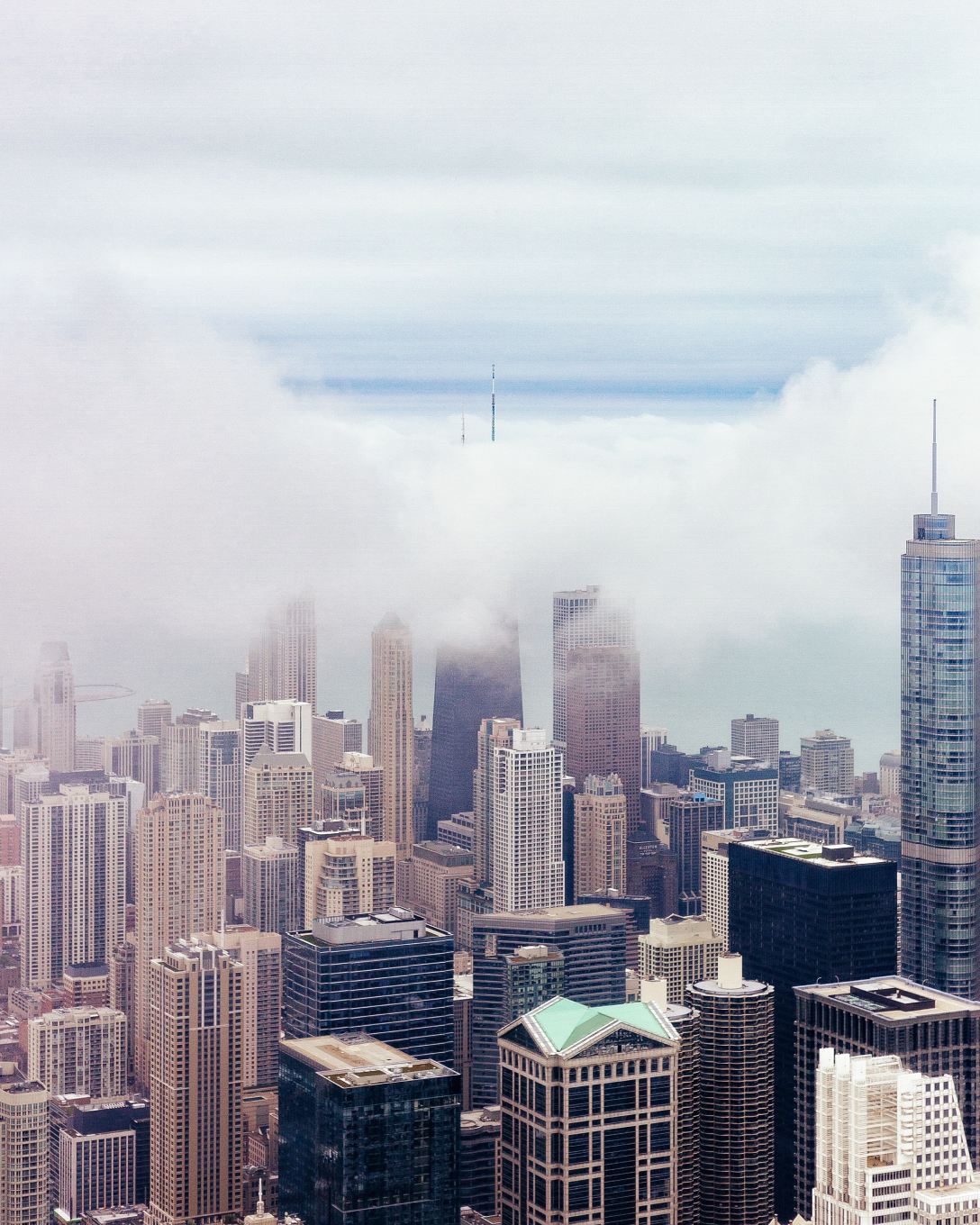
Image description: fog over sky scrapers in Chicago.
 Psaltery & Lyre