by Gail Tyson
for Steve
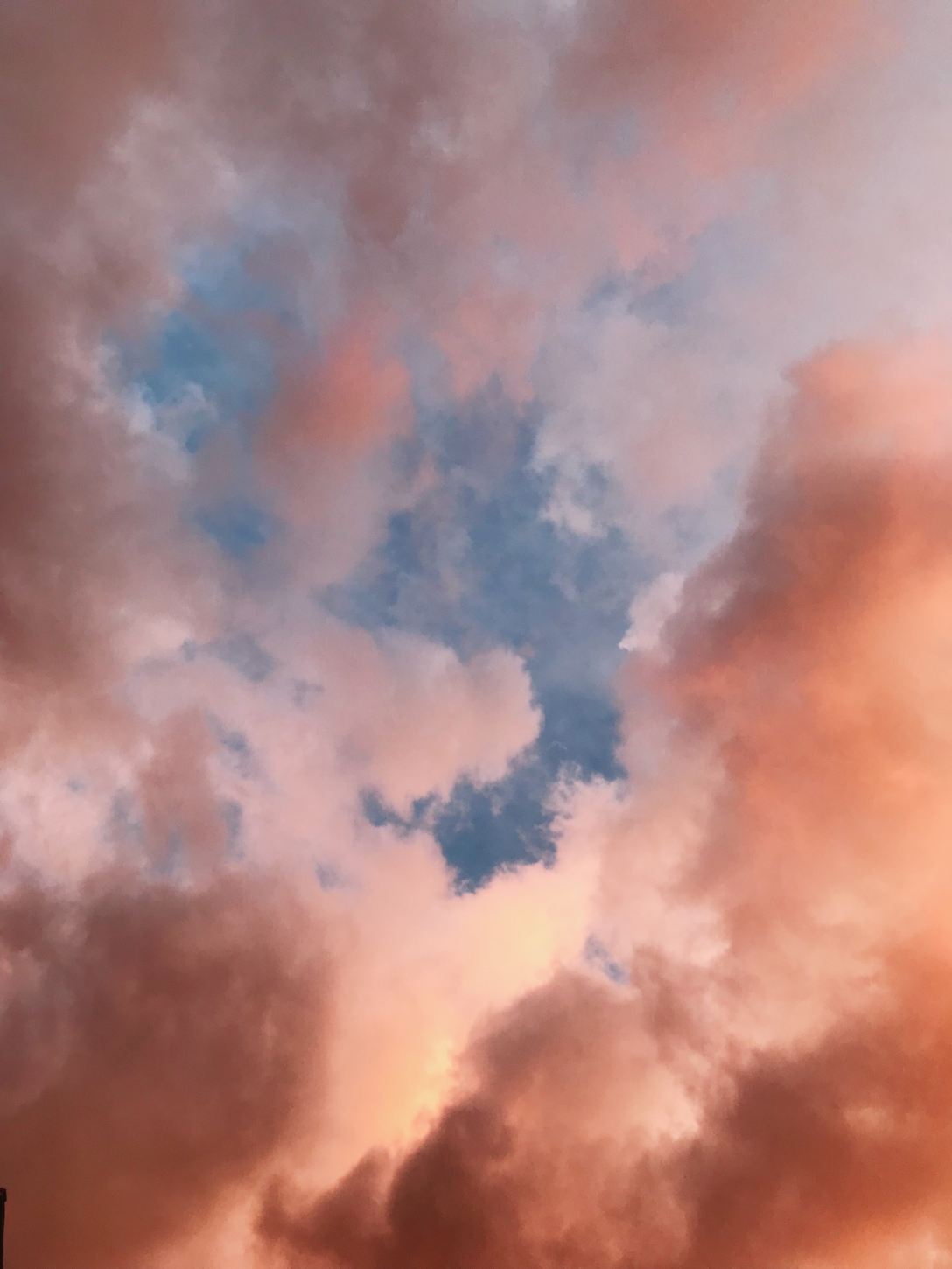
Ripples of vermilion, intense and saturated, hover for no more than a minute. Awe holds me at the window, draws me out of time, beyond the close of day and the coming night’s routines: crisp Riesling on my tongue, book cradled by my hand, voices drifting up four stories to my loft.
The torch-beamed clouds fade, shift, disperse. The only record of that fleeting, fiery vision survives in my digital photo album. Later I compare the image to pictures in Gavin Pretor-Pinney’s The Cloud Collector’s Handbook: Altocumulus, Stratocumulus undulatus, Lacunosus. The supple, sonorous names transport me back to Third-Year Latin class, where it seemed to me only the burly nun and I heard what lives in a dead language—farmers scything hay, thick and sweet, while armed men wandered foreign seas, oars chanting amō, amās, amat.
As much as I loved translating Virgil then, now I delight in deciphering cloud forms. My sixteen-year-old self could not decode the world’s uncertainties word for word, and these days they still confound me. Am I drawn to cotton-candy tufts that can change within minutes because life feels as tenuous as it did to an adolescent? As we all adapt to living with variants of Coronovirus, nothing works quite like it did pre-pandemic. We certainly can’t have the same expectations that our planes will depart on time, our packages will arrive as scheduled, our trust in people who govern us will return. Clouds mirror that mutability but also turn it into something transcendent.
The fragility of life isn’t where my fascination with clouds began. My friend, Steve, often photographs them. (He is one of a long line of cloudscape artists including Edward Stieglitz, who made 350 contact prints of clouds.) The first time Steve texted me an image (thunder-and-lightning Cumulonimbus), he inspired me to do the same. Soon we were trading pictures of light-reflecting water droplets that resembled jellyfish, a ragged ledge, castle turrets, or sheer lace against a sapphire sky.
About that time I read about Pretor-Pinney’s Cloud Appreciation Society, and Steve bought copies of its handbook for each of us. Over the past six months my practice of pondering clouds has reframed impermanence as a flow state. During flow, we engage deeply and meditatively, an immersion that seems to slow time. Concentrating on distant masses of water vapor, suspended in the sky, quiets my fretting mind. Neurologists tell us that panoramic vision is more restful than focusing on near objects. The ritual of lifting my eyes to the heavens, far above the doubts that impinge on earthly life, soothes me. Spotting clouds, my spirit floats away from the disappointments I can’t resolve. For a few minutes, though, I can rise above those setbacks and see them for how limiting they are.
And more: Cloud forms spark imagination. Photographers worldwide have captured clouds that look like a horseshoe, a swan, a hummingbird, a feather, or Aladdin’s lamp. Images of rare phenomena that entrance me include diamond’s dust—a kind of fog made of ice crystals in polar regions—and the tube-shaped roll clouds caused by storms, and cloud caps, soft and snug as an alpaca beanie on a mountain peak.
Naturally not one of these shapes remains intact. While I initially mourned the loss of each luminous vista, I’ve come to value the protean world above me. It’s a paradox how impermanence can link to wonder, but then again wonder is itself a fleeting state. Could our loss of so much during the pandemic—in-person time with beloveds, communal rituals, shared meals and performances—made us more aware of impermanence? Deepened our craving for wonder? Since emerging from lockdown in mid-2021, I thirst for the “marvelous things, miracles, objects of astonishment” described by Old English speakers as wundor. When sundown pours through cloud holes or illuminates Cirrus streaks of ice crystals, my blood fizzes like champagne.
There was no champagne living alone through lockdown. Eleven months after my husband died, the day Steve flew back to California after visiting, the pandemic isolated me. Secluded, I tracked how much I was changing, week by week. Dick and I had been good partners, but he put me on a pedestal—without much room to move. Now I followed my nephew’s advice to live boldly, discovering courage I didn’t know I possessed. In two years I renovated my house, sold two properties, and moved to another city, where I lucked into a lease on a loft apartment. Its three nine-foot windows offer a vast view of clouds, dense to diaphanous. Watching them turn from pearlescent to the color of ballet slippers, apricots, and periwinkles, I felt hopeful as I left one life behind and turned to the next one.
Clouds change color, I learned, because they reflect light from the sun and filter through haze and dust in the atmosphere. In a way, I mused, they embody light. My fancy reminded me of a Japanese study measuring human bioluminescence. “The human body actually glimmers,” those researchers wrote, but we cannot see this light with the naked eye, its intensity being 1,000 times lower than the sensitivity of our organ of sight. This memory fired a desire to concentrate my energy on what felt essential. Could the harmony, beauty, and joy I cultivated inwardly reflect in my outer life? Might it even ignite my next incarnation? Quicksilver changes over three years had thwarted me from knowing who I was, what I wanted, and what I didn’t want. Until December 2021 when, like a fluffy, cotton-ball cloud that hovers for hours, the changes resolved. It was a shift as mysterious as being able to think in another language, when one day all the practice flows off your tongue. Three years after my husband began to waste away, I defined myself as single rather than widowed. I felt curious about sharing my life with a man again. And if he came along, this time I wanted not worship, but challenge.
Almost a year later, that desire has eluded me—due partly to my season in life, a couple of online dating flops, and my reluctance to try again. Fearing that intimacy was over—after not being touched for eighteen months of lockdown, even a hug from a friend—I felt dispirited and sad. Even more so when a friend said, “Anything can happen!”
Then one evening I read the words “It’s saddest to have never lost anything at all.” The observation—written about a woman who may have been hopeful about her arranged marriage, but who grew estranged from her husband—spoke to me. Unlike that woman, I did not leave but was left, not by choice but by fate. Truth is, I’ve grown through the loss of love because of the depths that loss has taken me to, the changes it has wrought, and the chance—with sustaining friendships like mine and Steve’s—to live more than one life.
For days the “saddest” sentence intrigued me. What kind of life might I have, I wondered, if I relinquish the chance to share it with one person? Beholden to no one, couldn’t I relish the freedom to wander at will? Friends scoffed at my letting go of a love life and told me it will happen when I least expect it. The sentiment annoyed me until I reviewed my life and admitted that is exactly when my handful of lovers, one by one, took a place at my side.
Since then, contemplating the sky’s evanescent shapeshifters feels a little like giving up on love. Watching the clouds move, I have learned to release the yearning to keep a particular formation fixed. Rather, I revel in their cosmic dance, remembering how my lovers came into view like clouds: one emerging from a yearlong correspondence and taking shape in a new way, another turning up on a hiking trail like an apparition, and the last moving toward me, with me in shared grief. Man by man they dazzled me, lured me into “we,” and changed my life until they left—partings I was not ready for, but expected.
In the space of letting go the question rises, unbidden: What if I expected nothing, let wonder set the skies and me afire, for a few moments turning life radiant?
::
Shanti Arts has published Gail Tyson’s chapbook, The Vermeer Tales. Recent work has appeared in Psaltery & Lyre, Still: the Journal, and Thimble Literary Review. She wrote this piece in Knoxville, Tennessee but has recently moved to Santa Cruz, CA.
Image: Jeremy Bishop
Image description: White clouds turned pink and orange during golden hour. A blue sky is visible behind the clouds.
Note: “It’s saddest to have never lost anything at all” is quoted from Matthieu Aikins’ The Naked Don’t Fear the Water: An Underground Journey with Afghan Refugees (2022) p. 43.
 Psaltery & Lyre